Showing posts with label idolatry. Show all posts

Thursday, February 25, 2016

Moshe Earns His Stripes


Parshat Ki Tisa

by Rabbi Avi Billet

Through much of the story of the Golden Calf, the focus is often Aharon. What was he thinking? What was his plan? How could he do what he did? Was he ever blamed for his role? Was he justified or vindicated in the end? 

While that is certainly an important discussion, those questions have been addressed in this column in the past. (Linked above and below) However, the same questions can also be applied to Moshe.

Think about it. He was on the mountain, oblivious of any tumult down below. He is informed by God, at a peak in his “chavrusa” (personal study session) with God, “Go down, for the people whom you brought out of Egypt have become corrupt.”

Moshe chooses to listen to everything God has to say before deciding if he’s actually going to go down to watch his people face the music. However, he also makes the choice to stay and talk to God about His plan to destroy the nation, creating a new nation of the Children of Moses. He talks to God, seems to convince God to change His mind, but also even His Middot (character traits, how He operates), to the point that God no longer intends to destroy the people.
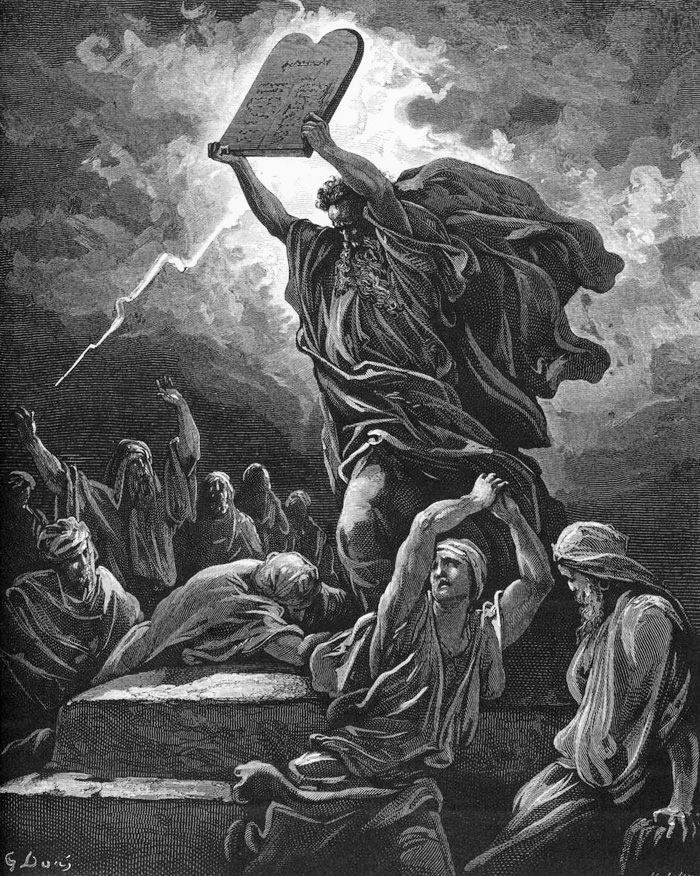


And then Moshe emerges, and in his own anger, he destroys the Luchot (tablets) and orders the killing of the worst offenders, which end up being around 3000 people. Leaving everything else aside, there is a certain irony in that the same man who petitioned that God spare and not destroy the nation is the one who presided over the deaths of half of a percent of the male population.

What led Moshe to think that he could stay and converse with God, after God told him to “Go down” in 32:7?

A very simple reading shows us that God spoke to Moshe in 32:7 using the verb “Vay’daber” (and He spoke) and continued speaking to him in 32:9 using the word “Va’yomer” (and He said). Since there was no interruption from Moshe in between these two introductory verbs, it stands to reason God had a change in attitude between 32:8, the conclusion of the “Vay’daber” portion, and 32:9, when we are told “va’yomer.”

This subtlety is similarly apparent in Shmot 6:2 when we see "Vay’daber" and "Va’yomer" both making an appearance, and the teaching that the former verb indicates God speaking harshly while the latter verb impresses us with God’s mercy is raised by several commentators. In other words, when God said, “Go down, for the people whom you brought out of Egypt have become corrupt. They have turned away from the way I have commanded them by making a golden mask,” God was really angry. But, when He saw that Moshe did not leave right away, and that Moshe was considering how to play his own hand, God saw a leader trying to figure out the best way to save his people. And so He switched gears, speaking to Moshe with “Vayomer,” indicating a compassionate attitude.

God says, “I have observed the people, and they are an unbending group. Now do not try to stop Me when I unleash my wrath against them to destroy them. I will then make you into a great nation.” (32:9-10)

I think what is going on here is quite clear. When God says, using language of compassion, “Do not try to stop Me,” what He is really saying is, “Now is your opportunity to stop Me. Give it your best shot.” And of course, Moshe comes up with a 3-part argument that removes the immediate danger to the nation: a. they are actually Your people whom You took out of Egypt, b. why should Egypt be given fuel to desecrate Your name with a claim that this was Your plan all along, to annihilate Israel in the wilderness?, and c. what ever happened to Your promise to the forefathers?

Let us be clear – the people were guilty of desecrating God’s name in the most egregious of ways. A punishment was in order. But in this particular case, the punishment through the hands of man was going to be far less encompassing and devastating than that which God might have otherwise wrought. (Compare the irony to David's decision in Samuel II 24:14)

Neither Moshe's breaking the tablets or ordering the deaths of thousands seem to weigh against him in the future. In fact the Rabbis taught that God was pleased with the choice Moshe made in smashing the Luchot. He gets overwhelmingly passing grades in this story, despite some of the eyebrow-raising details in his not listening to God, on the one hand, and in his wrath which unfolds against the people, on the other hand.

In terms of Aharon's role, he too is vindicated in his legacy. He certainly does not lose his high priest status, and to this day he continues to be revered as a lover of and pursuer of peace. However in Devarim 9:20 – Moshe tells the people that God got angry at Aharon, and Abravanel maintains the view that Aharon lost any rights to enter the land on account of his role in this story.

Perhaps the difference between the two brothers is that each one had a very different leadership role in relating to the people here. Vis-à-vis God, Aharon never lost his focus. As God sees to the heart, Aharon retained his status as high priest forever. But as a leader to the people, he seems to have given in to their whims a little too much.

Moshe, on the other hand, earned his best stripes here. He showed God how good of a shepherd he could be to his people, and he showed the people that sometimes a father has a right to get angry at his children. It is surely a difficult balance, to be a loving and caring shepherd while also being the disciplinarian father who must take a stand and defend everything that is holy.

But every indication in the story, especially at the end when Moshe's face is shining, demonstrates that Moshe did everything right here. His choices, his decisions, and his actions are all vindicated as he is elevated to the highest status a mortal could achieve.

May we be so lucky that our choices and decisions and actions always turn out to be the right ones.

Thursday, August 20, 2015

The Tree In Me

or The Connection Between Appointing Honest Judges and Not Planting Trees for Idolatry

Parshat Shoftim

by Rabbi Avi Billet

At the beginning of Parshat Behar, when the Torah describes the laws studied at Mt. Sinai, Rashi asks a question that is well-known by those who study Rashi’s commentary: What does the topic of Shmittah (resting the land on the seventh year) have to do with Sinai? This question is utilized in almost equivalent usage as “what does this have to do with the price of tea in China?”, meaning what do two unrelated topics mentioned near each other have to do with one another?

 We can ask the same question at the beginning of our Parsha. We are first told that judges and officers need to be placed at the gates of cities, and that they should be upright and honest men who do not take bribes. Immediately after this, we are told, “Do not plan an asheirah or any tree near the altar of God.” (16:21) An asheirah is usually defined as a tree that is worshipped in some kind of idolatrous practice, but Rashbam says in this context it refers to any kind of tree, and Rashi adds that a building is also forbidden to be erected near the altar.

 What does the asheirah tree have to do with appointing honest judges?

 In Sanhedrin 7b, Resh Lakish describes anyone who appoints an unfit judge as being just as guilty as if he planted an asheirah tree. The Midrash Aggadah repeats this teaching without attribution. Some of the commentaries on this verse echo Resh Lakish, noting, for example, that the numerical value (gematria) of “asheirah” (506) is the same as “dayan she’eno hagun” (an unfit judge), which indicates that appointing an unfit judge is like planting an asheirah tree, because the judges sat near the mizbeach (Baal Haturim). Targum Yonatan removes the hints and says rather straightforwardly, “Just as you are not permitted to plant an asheirah next to the Mizbeach of God, so too you are not allowed to match a foolish man to dictate the law along with wise judges.”

 The Alshikh makes the parallel a little more poetic, as he gives us an image which we can understand. Just as a planted tree grows and becomes more beautiful and impressive over time, even though the asheirah is either for idolatry or is simply planted in the wrong place, a bad and unfit judge starts off with small iniquities, and becomes increasingly corrupt as well as entrenched in his position over time. Similarly, Maimonides (laws of Sanhedrin 3:8) describes how easy it is to justify hiring a bad judge based on his social skills, his strength, nepotism, his knowledge of languages, etc. and not based on the proper criteria, such as his knowing the law. We similarly might admire a tree, not knowing whether it is a tree used for idolatry.

 It is notable that the warning in the Torah for how a judge should not behave, as well as the warning in the Torah against planting an asheirah, sound the same. The word in question is spelled differently, but to the ear, it can be confused due to the similarity of sound: “Lo tateh” means do not bend judgment, “Lo titah” means do not plant.

 The Kli Yakar notes (quoting a Midrash) that all of the warnings at the beginning of our parsha, were engraved in the steps leading up to King Solomon’s throne. Don’t bend, don’t show favor, don’t take bribes, don’t plant, don’t erect (a monument), and don’t offer (a blemished animal). The connection to Solomon was that all of these rules applied to whomever was serving as a judge.

 Kli Yakar explains the many parallels between judges and the rules that follow it, about planting trees and erecting monuments. For example, a judge should not stand alone like a monument, but should be one of many “stones” in a Sanhedrin, just as there are many stones that make up a mizbeach. This makes it easier to be just, and to avoid bribes.

 In 20:19 we are reminded that a person is, in some ways, compared to a tree. In one of the last mishnayot in Avot 3, Rabbi Elazar ben Azarya teaches how a person whose deeds are greater than his wisdom is compared to a tree with very strong roots who can’t be toppled over by even the strongest of winds.

 We have a challenge to take the tree metaphor and apply it to our lives in the best of ways. To make sure our roots are strong, that our foundation isn’t flawed, and that we are planting ourselves in the right places to allow for the best spiritual growth we can achieve.

 The further we spread our branches and leaves, the harder it becomes to nourish the outer limits of our reach. But if we maintain the connection to our roots and to our source, we can continue to grow, stronger and taller, as the canopy we create becomes a source of nourishment, shade, comfort, and inspiration to ourselves, our families, and those we care about most.

Wednesday, May 1, 2013

God, Egypt, and Care for Our Fellow Man


Parshat Behar Bechukotai

by Rabbi Avi Billet

The Torah gives three examples of "Your brother becoming impoverished." (V'khi yamukh achikha). The first has to do with selling family property, and how it returns to the original owners at the Jubilee year.
            
The second and third examples deal with a case where he can not sustain himself and is relying on community assistance (25:35-38), or even needs to be sold into slavery to support himself (25:39-42), respectively.
            
At the end of each of the latter segments, a similar statement is made:
"I am God your Lord who brought you out of Egypt to give you the land of Canaan, [and] to be a God for you," (25:38) and "This is because I brought [the Israelites] out of Egypt, and they are My slaves. They shall not be sold [in the market] as slaves." (25:42)
            
The idea of being slaves to God instead of slaves to men, or of God's intent to "be a God for you" would likely make for a great psychoanalytical study, were we not speaking of God.
            
But the truth is, it doesn't end there. The next section begins with a reference to the "brother becoming impoverished" (though with a different language) (25:47), and it concludes with instructions for when the Jubilee comes, and all slaves are freed, as God says, "[All this] is because the Israelites are [actually] My slaves. They are My slaves because I brought them out of Egypt. I am God your Lord." (25:55)
            
This last summary sentence actually brings together the notions set forth by the earlier verses – Israelites are slaves to their God, Who is their God because He took them out of Egypt. The focus on Egypt is so significant, not only because it reminds us of the other times in the year when we mention Egypt (ever evening Kiddush, during the Shema, and otherwise on a regular basis), but also because it is how we remind ourselves of which precise moment turned a group of slaves who happened to share a common ancestor, into a nation sharing a destiny forever.
            
Most significantly, the Exodus from Egypt is mentioned in the first sentence of the Decalogue as well [Shmot 20:2 – "I am God your Lord, who brought you out of Egypt, from the house of slavery"] – an obvious connection on account of the next two verses in the Torah here, which happen to be the last two verses of Parshat Behar, whose parallel to the Decalogue is unavoidable: "[Therefore,] do not make yourselves false gods. Do not raise up a stone idol or a sacred pillar for yourselves. Do not place a kneeling stone in your land so that you can prostrate yourselves on it. I am God your Lord. Keep My Sabbaths and revere My sanctuary, I am God." (26:1-2)
            
We can argue that it is hard to come to grips with the seeming obsession over our being God's servants or slaves.
            
But when we look at the setup of all the different examples of the "brother becoming impoverished," and how not to lose focus of who we really are and how we should really respond, it gives us a brand new look at what the Aseret HaDibrot (Decalogue) is meant to represent for us.
            
Many are familiar with the notion that the first five of the statements in the Decalogue refer to one's relationship with one's Creator, while the last five statements refer to relationships between men and fellow Man.
            
But in the Aseret HaDibrot, all the commandments between fellow Man are written in the negative. Don't murder, don't commit adultery, don't steal, don't swear falsely, don't covet. There are no instructions for how to positively relate to fellow Man.

So perhaps here, in Parshat Behar, we have the underlying unified message: Caring for another person means picking the other person up when he is down. It also means respecting the humanity of the "other," never blurring the lines between slaves of God and slaves of men, and being sure to help a brother in his hour of need.

Remembering Egypt and of our being "slaves to God" both serve as grounding principles for how we live out our Jewish lives with the proper foci.

We must know who we are and what values we espouse. We must continue to model what it means to look out for one another, to help others who are needy, and to look for positive ways to be of assistance – not just negative things to avoid, in staying out of people's way, but proactive care for our fellow Man.

And above all, remember Egypt. Remember what binds us to one another. Remember what binds us to our God, to our Torah and to our Land. Remember that being a slave to God is very different from being slaves to men. Particularly nowadays, in a free society, when people choose whether to be slaves to God, we appreciate our commitment and dedication to a "mitzvah-focused" life which grounds us and keeps us connected to our God who took us out of Egypt.

Thursday, October 11, 2012

The Crouching Sin

Parshat Bereshit

by Rabbi Avi Billet

The stage is set. The first two sons of Man have brought their offerings to their God, and He has favored the younger's dedication. The older brother is disheartened, and it shows on his face.

Says God, "What are you so frustrated? Why has your face fallen? If you do good, you will lift up! But if not, then sin lies crouching at the door. It desires to get you, but you can rule over it." (4:6-7)
            
In the next verse Kayin kills his brother.

The story is incomplete. Why Kayin killed Hevel is unclear. Was he provoked? Was it self defense? Did he even understand that his act could be fatal? Was the murder premeditated? Or an error? There are a myriad of interpretations hinged on the question of what the "sin crouching at the door" might be. As God's statement was the last thing Kayin heard before he committed murder, one can argue it was the trigger that unleashed his rage. But what did God mean?

In a lecture on repentance delivered in 1987, Rabbi Aharon Lichtenstein explained the "sin that crouches at the door" as the most blatant obstacle to proper observance of the Law and commitment to God which plagues a particular hashkafic (philosophical) community.

"…[It] is not the same sin at every door. Each door, each domicile, each community has its particular sin, a specific spiritual danger indigenous to it, endemic to that group or that individual." Quoting the Chafetz Chaim, he notes that different generations have different pitfalls. Some "succumb to idolatry, others to desecration of Shabbat, some to sins between man and his Maker, and others to interpersonal sins."

At the same time that he declared the sin plaguing the Religious Zionist community (ie "Modern Orthodox" community in the United States) to be one of "shikhecha," forgetting God, or "lacking the immanent sense of God felt so deeply, keenly and pervasively in other parts of the halakhically committed Jewish world" (which is indeed a problem), he defined "avodah zara" – beyond idolatry – as "superstition and misguided conceptions of God."

Rabbi Lichtenstein does not need my stamp of approval. His assessment of our community is spot on. But I think his definition of avodah zara is also quite noteworthy.

Looking to rabbis (people) as role models is wonderful. Idolizing them and turning them into flawless human beings is idolatry. Many rabbis exhibit excellent judgment all the time. Some make mistakes. The real Gedolim acknowledge their mistakes.

Kosher laws are quite special. Making an obsession about invisible parasites – and thus declaring water, lettuce, broccoli and strawberries unkosher – is idolatry. (No one is interested in eating infested vegetables. Remind people that bugs are not kosher, but don't wage war on fruits and vegetables!)

Modesty is one of the most important Jewish traits. But making a religion solely about personal definitions of such – when the law is somewhat flexible, and in some cases changes based on the standards of the general society – is idolatry! Modesty is not just about length of clothing and size of head coverings.

A chupah is a public event that declares a man and woman united in marriage. This allows them to be seen together in public, and to sit together at a wedding or any simcha other than their own wedding. Who has separate seating at their family Shabbat table?

Why do advertisements for communities and retirement homes in magazines only feature males in the photographs? Is it such a crime to see a photograph of a little girl, a mother in modest dress, or an elderly woman in a wheelchair? This is our world. This is life.
           
Mandating to others how to live, and judging their "frumkeit" based on externals (not calling a Kohen or Levi to the Torah or not counting a bar mitzvah for a minyan on account of a T-shirt or their not being from "your crowd") is not only the most disgusting form of sinat chinam (baseless hatred), but is also a form of idolatry. 

I received the following email in response to a debate about metzitzah that I posted on my blog, in which a pro Metzitzah b'Peh person told me that he cares not about Jews or people (or babies) in general, but only about "God and Halacha": "The 'pious' Jew who only cares about 'God' and His rulebook is clearly off the derech… whatever he is worshipping it is not God. He [has] invented a God to worship and [has] created an imaginary rule book… to replace the much more challenging reality [of what it means to be an observant Jew]."

Kayin could not overcome his crouching sin, perhaps his passion, and it caused him to kill his brother.
           
For some Jewish people, worship of the "avodah zara" I have described is their crouching sin. On account of it Judaism is ultimately denigrated, the shouting matches which ensue, and the negative feelings exacerbated through criticizing others all come at the expense of the, perhaps unanticipated, desecration of God's name which appears in television, newspapers and blogs fueled by misinformation, yes, but also improperly presented information which depicts Orthodox Jews as being hopelessly stubborn or blinded by their own faith.
            
In Kayin's case, his sin lay in his inabilities: to discern the flaw in his gift to God, to learn from his mistakes, and to see that he could live in harmony with his brother, despite their differences, and that each had a unique way of relating to God. If they could only respect the other approach – live and let live and stop telling the other what to do in the most intolerant of ways – they could have lived in harmony.

The saga of brother versus brother need have never unfolded so tragically.

Friday, August 10, 2012

Avoiding Getting Lost: A Modest Proposal for Jewish Education Overhaul

In addition to containing a relevant message for all, this week's Dvar Torah is partially a response to this article, and my friend Rabbi Dr. Aaron Ross' two-part response [here is part II]

Parshat Eikev 

 by Rabbi Avi Billet

 The first chapter and a half that begin Parshat Eikev contains what we might describe as the opposite formula of the "Tokhachot/Rebukes" that appear in Bechukotai and Ki Tavo. In those cases, an ideal is put forth, which is subsequently dwarfed by the enormity of the Rebuke which follows it. In our parsha, the ideal eclipses the possible bad.

 The parsha begins (7:12) with the words "V'haya Eikev Tish'm'oon" – On account of your listening and observing the following laws… God will love you, will heal you of your illnesses, will give you bravery unmatched, will cause your enemies to flee from before you, etc. All you have to do is rid yourselves of their idols.

 The emphasis on avoiding the worshipped images of silver and gold is so strong that other terms are introduced (7:25-26) to bring the point home: To'evah – serving these items is an abomination; Cherem – enemies’ belongings are taboo and may not be used; Sheketz – having these items is offensive; Mokesh – taking the idols will ensnare or trap you into becoming more curious about them.

 “Mokesh” contains a rare root form (in the Torah) which appears one other time here (7:16 as “Mokesh” and in 7:25 as “Tivakesh”), in Shmot 10:7 (in a different context) as well as in Shmot 34:12 and Shmot 23:33 (similar contexts to here), the latter example ending a description of what the conquest of the land will look like. Much of what is mentioned there is echoed here, with a few slight differences.

 Back in our parsha, Moshe continues painting an idyllic scene when we expect to hear the bad that could come from turning away from God. "Guard yourself, lest you forget God and are not observant of His laws. Maybe you'll… build nice homes... have cattle, sheep, silver and gold aplenty. You will become haughty and forget God, Who took you out of Egypt… You will say, 'My strength and fortitude made all this happen.' Be sure to remember God, because He is the One Who has given you the ability to be successful." (8:11-18) 

The concern is that amidst all the good you have you'll forget God. Therefore, don't forget God. Fair enough.

 Moshe continues however, with the consequence for forgetting God. "If you forget God and start worshipping other gods, you will be lost or destroyed. Just like the nations who are being removed from before you, so will be your lot – 'Eikev,' (on account of) your not listening to God." The word Eikev closes the unit with a nice bookend paralleling the way the parsha began. In context, it highlights how abandoning God for the snare of idolatrous worship and how losing all due to misplaced appreciation becomes the theme of this chapter and a half. A President said, “You didn’t build that.” But the Torah argues that God (not Government) had a lot to do with your success.

 The Or HaChaim focuses on the double language of "Avod Tovedun," and says there are two stages of what can happen: becoming lost, then being destroyed. [The root alef-vet-dalet can mean either one.]

 As I believe “destruction” is ultimately God’s choice, I also believe it is truly in our power to do more to avoid becoming lost.

 Last week’s Siyum HaShas of Daf Yomi was a fantastic spectacle of what Kavod HaTorah should and could look like. It wasn't perfect – what is? – but if 90,000 Jews of many different spectrums of Orthodoxy specifically, and Judaism in general, can gather together in one place (not to mention other large gatherings elsewhere in the US and Israel) to celebrate Torah learning, there is hope for us to not get lost.

 But the concern over the success of Jewish education, which is a challenge addressed regularly in schools, online discussion boards, synagogue meetings, the blogosphere or the Jewish Press, is the biggest litmus test which will determine whether we, as the Or HaChaim puts it (in removing a punctuation mark), "will be lost just like the nations." This is not to suggest that the nations of the world are "lost." But the nations of the world do not have the Torah – certainly not in the way we have the Torah.

 If we are to succeed as Jews "Eikev" (on account of) our remembering God and heeding His bidding, a real overhaul is needed in Jewish education. Schools could always use improvement. But the overhaul that is needed is in the homes, where children must be taught over and over "What we have is a gift of God." And where parents literally learn Torah with their children.

 Consigning all our children's Torah learning to other people is a recipe for saying, "Of all the things we do as a family –learning Torah is not one of them." With that kind of attitude, we will be lost "like the nations" who don't value Torah in their own homes. Making TVs, computers, mobile devices and similar technology into the items we utilize the most in our homes – unless they are used regularly for maintaining the God-focus – is the modern-day challenge of avoiding the “Mokesh” (the snare and trap) that helps us get lost.

 It doesn’t have to be Daf Yomi, Gemara, or even something in the Hebrew language - though that is, of course, ideal. But a text should be picked and studied – not just read – and discussed on a regular basis. This will not only enhance parent/child relationships, but will also make absolutely clear what our values are, and will helpfully assure we don’t get lost along the way.