Showing posts with label ki sisa. Show all posts

Thursday, February 25, 2016

Moshe Earns His Stripes


Parshat Ki Tisa

by Rabbi Avi Billet

Through much of the story of the Golden Calf, the focus is often Aharon. What was he thinking? What was his plan? How could he do what he did? Was he ever blamed for his role? Was he justified or vindicated in the end? 

While that is certainly an important discussion, those questions have been addressed in this column in the past. (Linked above and below) However, the same questions can also be applied to Moshe.

Think about it. He was on the mountain, oblivious of any tumult down below. He is informed by God, at a peak in his “chavrusa” (personal study session) with God, “Go down, for the people whom you brought out of Egypt have become corrupt.”

Moshe chooses to listen to everything God has to say before deciding if he’s actually going to go down to watch his people face the music. However, he also makes the choice to stay and talk to God about His plan to destroy the nation, creating a new nation of the Children of Moses. He talks to God, seems to convince God to change His mind, but also even His Middot (character traits, how He operates), to the point that God no longer intends to destroy the people.
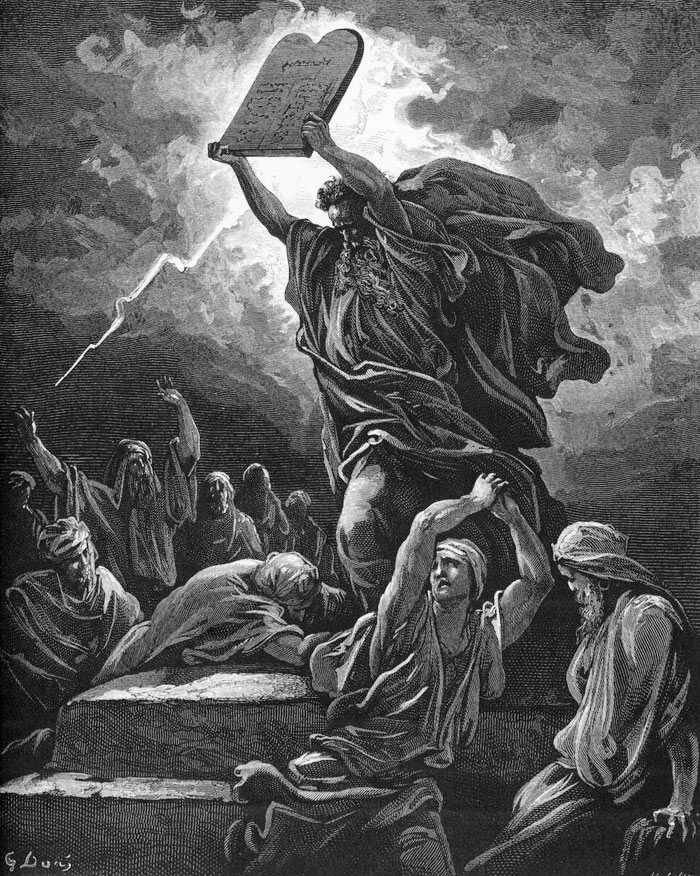


And then Moshe emerges, and in his own anger, he destroys the Luchot (tablets) and orders the killing of the worst offenders, which end up being around 3000 people. Leaving everything else aside, there is a certain irony in that the same man who petitioned that God spare and not destroy the nation is the one who presided over the deaths of half of a percent of the male population.

What led Moshe to think that he could stay and converse with God, after God told him to “Go down” in 32:7?

A very simple reading shows us that God spoke to Moshe in 32:7 using the verb “Vay’daber” (and He spoke) and continued speaking to him in 32:9 using the word “Va’yomer” (and He said). Since there was no interruption from Moshe in between these two introductory verbs, it stands to reason God had a change in attitude between 32:8, the conclusion of the “Vay’daber” portion, and 32:9, when we are told “va’yomer.”

This subtlety is similarly apparent in Shmot 6:2 when we see "Vay’daber" and "Va’yomer" both making an appearance, and the teaching that the former verb indicates God speaking harshly while the latter verb impresses us with God’s mercy is raised by several commentators. In other words, when God said, “Go down, for the people whom you brought out of Egypt have become corrupt. They have turned away from the way I have commanded them by making a golden mask,” God was really angry. But, when He saw that Moshe did not leave right away, and that Moshe was considering how to play his own hand, God saw a leader trying to figure out the best way to save his people. And so He switched gears, speaking to Moshe with “Vayomer,” indicating a compassionate attitude.

God says, “I have observed the people, and they are an unbending group. Now do not try to stop Me when I unleash my wrath against them to destroy them. I will then make you into a great nation.” (32:9-10)

I think what is going on here is quite clear. When God says, using language of compassion, “Do not try to stop Me,” what He is really saying is, “Now is your opportunity to stop Me. Give it your best shot.” And of course, Moshe comes up with a 3-part argument that removes the immediate danger to the nation: a. they are actually Your people whom You took out of Egypt, b. why should Egypt be given fuel to desecrate Your name with a claim that this was Your plan all along, to annihilate Israel in the wilderness?, and c. what ever happened to Your promise to the forefathers?

Let us be clear – the people were guilty of desecrating God’s name in the most egregious of ways. A punishment was in order. But in this particular case, the punishment through the hands of man was going to be far less encompassing and devastating than that which God might have otherwise wrought. (Compare the irony to David's decision in Samuel II 24:14)

Neither Moshe's breaking the tablets or ordering the deaths of thousands seem to weigh against him in the future. In fact the Rabbis taught that God was pleased with the choice Moshe made in smashing the Luchot. He gets overwhelmingly passing grades in this story, despite some of the eyebrow-raising details in his not listening to God, on the one hand, and in his wrath which unfolds against the people, on the other hand.

In terms of Aharon's role, he too is vindicated in his legacy. He certainly does not lose his high priest status, and to this day he continues to be revered as a lover of and pursuer of peace. However in Devarim 9:20 – Moshe tells the people that God got angry at Aharon, and Abravanel maintains the view that Aharon lost any rights to enter the land on account of his role in this story.

Perhaps the difference between the two brothers is that each one had a very different leadership role in relating to the people here. Vis-à-vis God, Aharon never lost his focus. As God sees to the heart, Aharon retained his status as high priest forever. But as a leader to the people, he seems to have given in to their whims a little too much.

Moshe, on the other hand, earned his best stripes here. He showed God how good of a shepherd he could be to his people, and he showed the people that sometimes a father has a right to get angry at his children. It is surely a difficult balance, to be a loving and caring shepherd while also being the disciplinarian father who must take a stand and defend everything that is holy.

But every indication in the story, especially at the end when Moshe's face is shining, demonstrates that Moshe did everything right here. His choices, his decisions, and his actions are all vindicated as he is elevated to the highest status a mortal could achieve.

May we be so lucky that our choices and decisions and actions always turn out to be the right ones.

Friday, February 18, 2011

His Finest Hour...? Not Really (and yet...)

See also this attempt at defending Aharon

Parshat Ki Tisa

by Rabbi Avi Billet

Looking objectively at the depiction of the creation of the Golden Calf, it is quite hard to understand the role Aharon plays. Is he guilty of something really really bad? Is he a manipulated victim? Was he coerced? Was he just in the wrong place at the wrong time?

What is clear is that on account of Moshe's delayed return, Aharon is approached and told to make "something" to replace Moshe as leader. Aharon instructs the people to get the earrings of their family members – children and wives – and with the earrings the men bring back (which seem to be their own earrings), he has a mold or model golden calf fashioned. Either he does it personally, or he has someone else do it. Upon seeing how some of the people related to the calf, Aharon builds a mizbe'ach and announces "There will be a festival to God tomorrow!" – God, of course, being the Tetragrammaton – God's four letter name of יקוק.

What is also clear is that Aharon never referred to this calf as a God, and he certainly never participated in any festivities or worshipping of the calf.

What, then, was his role? Why does Moshe become so upset with him?

Ralbag posits that Aharon was doing only one thing: stalling.

He asked for the jewels of family members, assuming they would not give their jewelry up easily. He began to mold a model of the calf to delay the actual building of what the people were asking for.

When Moshe still did not show, Aharon began building a mizbe'ach. This takes time. And when it was finished, instead of inaugurating it right away as is commonly done, Aharon had the brilliant idea to buy more time through delaying until "tomorrow." That the people took the initiative on their own the following morning, when they saw Aharon was not leading any festivities, is their problem. Aharon could no longer fight off the mob mentality that had overtaken the minds of those who were smitten by the perception of what the Golden Calf would do for them.

Abravanel observes that we really do not know when the people first approached Aharon. At the end of Mishpatim Moshe went up, with no provisions and no foreseeable means of nutrition, to be on the mountain for an undetermined amount of time. Up until then, every time he went up he came down the same day. (See his ups and downs in Shmot 19).

Did they approach Aharon after 3 days? A week? Two weeks? Just because the tale of the creation of the Golden Calf pans out in six verses does not mean it did not take two weeks of negotiating and staying the crowd! That the Torah told us Moshe went up for 40 days and nights (24:18) does not indicate the people, or even Moshe, were aware he'd be away that long, or for any specific amount of time. It is possible Moshe might have stayed longer, had he not been sent packing on account of the wayward actions of the people down below.

And if Hur had been killed (24:14 indicates he and Aharon were in charge and as Hur does not appear in our tale, the Rabbis said he had been killed by the mob), Aharon has real cause to respond to their requests, to indicate he is working with them, before he is taken down as well. Ibn Ezra raises one person's opinion (he does not quote from whom) that Aharon felt the need to avoid losing his life in order to save as many people as possible. Were he to die, things would go out of control quickly, and many more people would succumb to the peer-pressure and join the ranks of the Golden-Calf-ers – 3,000 of whom were killed in its aftermath.

Therefore the Abravanel spells out in great details how Aharon was delaying. He took the time to fashion a small model of a golden calf (the choice of calf versus lamb has to do with the lamb being Aries, the god of Egypt, and the calf being Taurus, the next Zodiac sign, as the god of Egypt had been defeated by the God of Israel). In turn, the model would be copied in a much larger version, which would take a day or two to fashion. And, frankly, Aharon indicated that such an "important" item could not be completed without the stamp of Moshe! This would further cause them to wait.

That he wanted everything to be done right would also play into why he insisted on building the mizbe'ach himself! He was hoping that in all the delayed efforts, the people would take a step back and realize they were pursuing a worthless goal of a meaningless symbol to replace Moshe as the leader.

He said the "Festival would be for Hashem tomorrow" hoping A. that God would hear and tell Moshe to scoot on down to nip the rebellion in the bud; and B. that the masses would understand that anything they were doing was for the sake of Hashem in Heaven. Unfortunately, neither plan worked and Moshe was only told to leave after the party had started, on account of the boors who did not understand Aharon's intent when utilizing God's name in anticipation of any celebration.

When Moshe emerges he becomes so upset with his brother because Aharon played a role in bringing about the sin the people committed. It could be Aharon's intentions were honorable: play the role, cater to them in a way they think you're on their side while you delay as much as you can, hope and pray that Moshe will come down and set everything right. But honorable intentions don't always bring about positive results. Just think about Lot's daughters.

Are we to understand that delay tactics don't work, and a person must take a stand to do what's right at the outset, even at the cost of one's life? Not at all. Sometimes delaying a little while allows a sensible solution to play itself out. (Sometimes it doesn't – see Samuel I 13:6-14) From Moshe's perspective, however, the stakes were too high and his brother faltered at what could have been his finest hour.

In an immediate and direct sense, it does not seem Aharon is punished for any idolatry component of the Golden Calf. He does not lose his life and he does not lose the right to be the High Priest who brings about forgiveness for the people on Yom Kippur. Therefore I do not think it is our place to be too critical of Aharon.

What might any one of us have done were we in his place? It is very hard to say.

Friday, March 5, 2010

The "Pure" Menorah

After describing the appointment of Betzalel and Oholiab to be the prime architects of the Mishkan, the Torah proceeds to list all the vessels that will be constructed. In 31:8, and in sharp contrast to all other vessels, the menorah is strangely described as “HaMenorah ha’t’horah” — the pure menorah.

Commentaries are quick to jump on this bizarre terminology. From the fact that the menorah is described as being pure, are we to assume the other vessels were impure? (Siftei Chachamim)

Rashi quotes the Talmud (Menachot 29b) that says the “purity” refers to the essence of the gold — its being naturally refined and untainted by outside influences. The Maharal of Prague even explains that all the other vessels are certainly not impure and one should not imply from the verse that other vessels were impure

Chizkuni says the term “purity” is to be taken literally, as the menorah and the shulchan (table) are the only two vessels described as being pure (the shulchan is described as pure in Vayikra 24:6) because they are the only ones upon which no sacrifice’s blood is ever placed, in any context.

It is Rabbi Naftali Tzvi Yehuda Berlin (Netziv) who presents the most innovative approach to understanding the significance of the purity of the menorah in a comment where he directly disagrees with the approach of Rashi. The purity of the menorah has nothing to do with “pure gold,” he explains, it is purely a function of the menorah’s essence, not the essence of its only ingredient. Netziv explains that the light of the menorah can only shine when the generation itself is pure in its deeds. A generation which is itself impure will only merit to see the menorah become extinguished.

Since the purpose of the menorah is to serve as a metaphor for the light of the Torah, it lights the way for innovation in Torah learning, also known as the concept of Hiddushei Torah. (Netziv Shmot 25:31)

The Mishkan itself is replete with symbolism. Much of commentary on these parshas and the latter half of the book of Shmot, focuses on the hidden message embedded within the images we have in our heads of golden structures and holy vessels aimed at creating an edifice of spiritual pursuits.

What are we doing to achieve our own purity? Do we focus on the ingredients — the “frum-looking external deeds” a.k.a. pure gold — or do we focus on the purity of the totality of our existence?

It has been said before that more people ask their rabbi about the kosher status of food items and restaurants than about other aspects of their personal religious experience — such as whether it is appropriate to cut corners when declaring income for tax purposes. To use one example, a friend of mine who is a pulpit rabbi, who also teaches in high school, marvels over how he gets “emergency” calls of the status of pizza shops kosher certification while he is teaching.

Symbolically, the light of the menorah represents the light which shines in the darkness, aimed at setting us on the proper path in our Jewish lives. Let us focus, as the Netziv says, on the purity of the totality of our existence, rather than on the purity of the ingredients which may make us “look” more observant.

The essence of the good Jew is one who is “tocho k’bar’o,” whose inside is as honest and ethical and living the straight life as is the outside image he presents to the world.