Parshat Chukat
by Rabbi Avi Billet
It’s incredible what time can do to a person’s maturation process, in how a person deals with adversity. O – and how having a strategy can also help a person cope with the curveballs of life.
Of course, not having a strategy is what separates the proverbial “men from the boys” in seeing how people deal with life-challenges “in the moment," when a plan can’t be put into effect because no plan exists.
In Bamidbar 20, we see a situation that we’ve seen before: the people complain because they have no water to drink. In the past, we’ve seen Moshe’s response to this kind of complaining has spanned from crying out to God (Shmot 15:25) to getting into a fight with the people (Shmot 17:2) to thinking he was going to be killed (Shmot 17:4). And after the infamous rock incident in this chapter (20), we’ll see Moshe ignore the people completely in 21:5-6 when they complain about lack of water again.
So what is the strategy that is so helpful to Moshe in Bamidbar 20? The strategy is what we saw in two places in last week’s Torah portion. The first was in 17:3-5 when Elazar was instructed to hammer out the copper fire pans and attach them to the altar “as a sign and remembrance” to people who are not Kohanim not to encroach into places they do not belong. The second was Aharon’s blossomed staff that was "to be placed near the Ark to serve as a testimony to those who rebel." (17:25-26)
We do not see challenges to Aharon’s role in the Torah, nor do we see challenges to Moshe’s role, on par with Korach’s rebellion. But we do see similar affronts to Moshe’s leadership when there is no water. And here, unlike at the last episode in Shmot 17, we watch as the water dispute does not lead to a fight between Moshe and the people.
Instead of taking the complaint personally, as he did in the past, Moshe knows all he needs to do is produce Aharon’s blossomed staff, the symbol that is meant to put down insurrection and stop rebellion, and the people will remember what happened with Korach, and they will back down.
And that’s exactly what happened. God tells Moshe to take out the staff, which turns out to be the one that was “before God as God had commanded him” (20:9)
And the strategy would have worked, had Moshe not felt the need to say what he said in 20:10. Because all that was needed was the sign/symbol and the people would have looked, seen the staff, and remembered to back down. This should have been the result of Moshe's having grown on the job, having had the experience of time lead him in the direction of non-confrontation, as well as God's plan to rule the day.
So what went wrong here?
Moshe followed God’s instruction, but he let his emotions get the better of him. Even the best-laid strategies can’t cover for every contingency plan.
One major difference here is that while the people fought with Moshe in Shmot, it is clear here that they are fighting with God (20:13) (this may help us understand why the complaint in Chapter 21 goes in the direction it goes, with the snakes unleashing God’s wrath against complainers).
There is no question that had Moshe followed the plan of bringing the staff out and showing it, waiting for the people to process what they were to glean from seeing it, this story would have panned out differently. But when Moshe chastised the people as well, with all the implications his words included, his fate was somehow sealed.
We need to have plans for the challenges life will present, hopefully with the ability to anticipate the twists of any circumstance. People who have aging parents, or parents with declining health need to have a plan. While it is not easy to decide where a person wants to be buried, making such decisions (and paying for them in advance) eases a tremendous burden off of loved ones. What happens in the case of an unanticipated accident – where do the children go? How are they to be raised? Who will take responsibility?
Can each spouse manage alone – because inevitably one person will be widowed? Is there a plan for how to cope, how to deal with the loneliness? Will children be involved in keeping the widowed parent occupied and looked after when that time comes?
Part of the problem Moshe and Aharon faced in this story is that they seemed unprepared for the death of their sister. Remember that she died immediately before this story, and Alshikh notes the devastation they were dealing with at the time that the people came to complain about lack of water.
Even the most exceptional human beings have weak spots. Moshe’s planning did not anticipate his weak points – the loneliness that came from the loss of his sister, the inability to let God’s strategy of showing the staff work itself out, and the inability to restrain himself from giving a rebuke at the same time as he was giving water to the people.
May our lot be to create strategies for challenging times and to implement them in the most effective ways.
Showing posts with label moshe. Show all posts
Showing posts with label moshe. Show all posts
Wednesday, July 13, 2016


Wednesday, June 22, 2016
Biblical Depression: Is Moshe Suicidal?
Parshat B'ha'aloskha
by Rabbi Avi Billet
One of the disturbing episodes in the parsha concerns the people who are complaining about the manna, complaining about a lack of meat, as they remember the fish and the wonderful fruits and vegetables (cucumbers, melons, leeks, onions and garlic) they enjoyed in Egypt. Now, it is one thing to complain. It is an entirely other thing to whine and kick and scream, crying hunger, when hunger was not the problem. After all, while they may have been tired of it, the manna was bread from heaven that was the key reason why the people were able to survive for 40 years in the wilderness, beyond the simple grace of God.
Aside from the disturbing perspective we can have regarding their complaint, Moshe’s reaction seems so out of character, we begin to wonder if he has snapped.
Moshe says to God, “Why have you been bad to Your servant, and why have I not found favor in Your eyes, that You put the burden of this people upon me? Did I conceive this nation, did I give birth to it, that you expect me to carry it as a nursing mother carries its babe? From where am I to find meat for everyone, as they cry out to me for meat? I can’t carry this nation by myself! If this is what You are going to do to me, then kill me now, lest I see the evil that befalls me.” (11:11-15)
I won’t jump so far to say that Moshe was suicidal – were that the case, this might have ended differently – but there is strong evidence from the things he says here that he was ready to give everything up and not continue in his role as leader, simply on account of the complaints of the people. (We'll note, he asked God to kill him, and made no mention of possibly achieving such an end through his own hand) They are not far from having left Sinai. This episode is still very early in Moshe’s tenure, certainly before the incident of the spies, which would fate the people to perish in the wilderness. Is Moshe really willing to check out so soon?
There are a number of components to Moshe’s complaint. Let’s focus our attention on two of them: A. Moshe complains that he hasn’t found favor in God’s eyes. B. He wonders if he is to carry the nation by himself, without help.
Some of the commentaries (Ibn Ezra, Seforno, etc.) claim that Moshe is referencing how he has not found favor in God’s eyes since the burning bush, when he asked for God to send someone else to be the Redeemer. It is hard to reconcile this claim, considering all the good that has been bestowed upon him. Could Moshe be exaggerating?
What is amazing is that while God responds to most of Moshe’s concerns in the section which follows – Seventy elders (you won’t be alone), they’ll have meat (and fish, if necessary) – He does not refute or respond to Moshe’s claim of not having found favor in God’s eyes. Through Moshe’s demonstration of despair, and without a real response from God, there are important lessons to be taken from how Moshe pulls through this seeming moment of Depression, which even leads him to want to die.
Rabbi Joseph B. Soloveitchik noted that Moshe’s discovery here was that he had to be the nursing father to the people, in addition to the role of teacher, which he had embraced and begun to fine tune ever since emerging from the mountain.
And so, perhaps there are two important take-home lessons that the Torah teaches us through saying nothing.
Firstly, a person must have a sense of purpose. When Moshe realized his role as teacher was no longer “the” challenge of his life, and he was able to embrace his new role as nursing father, it looks like it became a new lease on life. And in all of Moshe’s challenges in the coming Torah portions, how many parents can look at Moshe’s relationship with the people and relate heavily to his exasperations? “Stop complaining! You have all you need! Stop asking for things which you ‘want’ but are unnecessary to your survival! There are children starving in Africa!”
Moshe’s seeming Depression is a harder answer. One can’t simply tell someone with Depression to “get over it.” But people with Depression can be encouraged to find the strength within themselves to find the help they need.
Maybe God ignored Moshe because He knew that Moshe had that strength, and that Moshe just needed his other concerns to be addressed, and that once he saw he was not alone and that the people could be provided for irrespective of his role, he no longer wished to die.
May those who suffer from such feelings of inadequacies be blessed to find comfort in the friends and loved ones they have. May all of us be blessed to find a sense of purpose for our existence, so every day can be embraced for the challenges and blessings that it lays before us.
by Rabbi Avi Billet
One of the disturbing episodes in the parsha concerns the people who are complaining about the manna, complaining about a lack of meat, as they remember the fish and the wonderful fruits and vegetables (cucumbers, melons, leeks, onions and garlic) they enjoyed in Egypt. Now, it is one thing to complain. It is an entirely other thing to whine and kick and scream, crying hunger, when hunger was not the problem. After all, while they may have been tired of it, the manna was bread from heaven that was the key reason why the people were able to survive for 40 years in the wilderness, beyond the simple grace of God.
Aside from the disturbing perspective we can have regarding their complaint, Moshe’s reaction seems so out of character, we begin to wonder if he has snapped.
Moshe says to God, “Why have you been bad to Your servant, and why have I not found favor in Your eyes, that You put the burden of this people upon me? Did I conceive this nation, did I give birth to it, that you expect me to carry it as a nursing mother carries its babe? From where am I to find meat for everyone, as they cry out to me for meat? I can’t carry this nation by myself! If this is what You are going to do to me, then kill me now, lest I see the evil that befalls me.” (11:11-15)
I won’t jump so far to say that Moshe was suicidal – were that the case, this might have ended differently – but there is strong evidence from the things he says here that he was ready to give everything up and not continue in his role as leader, simply on account of the complaints of the people. (We'll note, he asked God to kill him, and made no mention of possibly achieving such an end through his own hand) They are not far from having left Sinai. This episode is still very early in Moshe’s tenure, certainly before the incident of the spies, which would fate the people to perish in the wilderness. Is Moshe really willing to check out so soon?
There are a number of components to Moshe’s complaint. Let’s focus our attention on two of them: A. Moshe complains that he hasn’t found favor in God’s eyes. B. He wonders if he is to carry the nation by himself, without help.
Some of the commentaries (Ibn Ezra, Seforno, etc.) claim that Moshe is referencing how he has not found favor in God’s eyes since the burning bush, when he asked for God to send someone else to be the Redeemer. It is hard to reconcile this claim, considering all the good that has been bestowed upon him. Could Moshe be exaggerating?
What is amazing is that while God responds to most of Moshe’s concerns in the section which follows – Seventy elders (you won’t be alone), they’ll have meat (and fish, if necessary) – He does not refute or respond to Moshe’s claim of not having found favor in God’s eyes. Through Moshe’s demonstration of despair, and without a real response from God, there are important lessons to be taken from how Moshe pulls through this seeming moment of Depression, which even leads him to want to die.
Rabbi Joseph B. Soloveitchik noted that Moshe’s discovery here was that he had to be the nursing father to the people, in addition to the role of teacher, which he had embraced and begun to fine tune ever since emerging from the mountain.
And so, perhaps there are two important take-home lessons that the Torah teaches us through saying nothing.
Firstly, a person must have a sense of purpose. When Moshe realized his role as teacher was no longer “the” challenge of his life, and he was able to embrace his new role as nursing father, it looks like it became a new lease on life. And in all of Moshe’s challenges in the coming Torah portions, how many parents can look at Moshe’s relationship with the people and relate heavily to his exasperations? “Stop complaining! You have all you need! Stop asking for things which you ‘want’ but are unnecessary to your survival! There are children starving in Africa!”
Moshe’s seeming Depression is a harder answer. One can’t simply tell someone with Depression to “get over it.” But people with Depression can be encouraged to find the strength within themselves to find the help they need.
Maybe God ignored Moshe because He knew that Moshe had that strength, and that Moshe just needed his other concerns to be addressed, and that once he saw he was not alone and that the people could be provided for irrespective of his role, he no longer wished to die.
May those who suffer from such feelings of inadequacies be blessed to find comfort in the friends and loved ones they have. May all of us be blessed to find a sense of purpose for our existence, so every day can be embraced for the challenges and blessings that it lays before us.
Thursday, February 25, 2016
Moshe Earns His Stripes
Parshat Ki Tisa
by Rabbi Avi Billet
Through much of the story of the Golden Calf, the focus is often Aharon. What was he thinking? What was his plan? How could he do what he did? Was he ever blamed for his role? Was he justified or vindicated in the end?
While that is certainly an important discussion, those questions have been addressed in this column in the past. (Linked above and below) However, the same questions can also be applied to Moshe.
Think about it. He was on the mountain, oblivious of any tumult down below. He is informed by God, at a peak in his “chavrusa” (personal study session) with God, “Go down, for the people whom you brought out of Egypt have become corrupt.”
Moshe chooses to listen to everything God has to say before deciding if he’s actually going to go down to watch his people face the music. However, he also makes the choice to stay and talk to God about His plan to destroy the nation, creating a new nation of the Children of Moses. He talks to God, seems to convince God to change His mind, but also even His Middot (character traits, how He operates), to the point that God no longer intends to destroy the people.
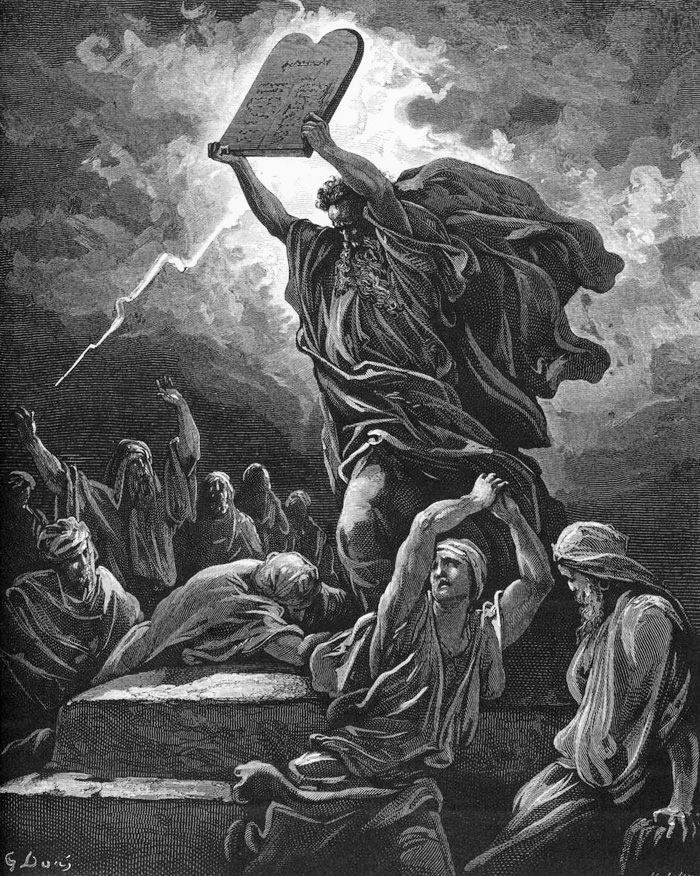
And then Moshe emerges, and in his own anger, he destroys the Luchot (tablets) and orders the killing of the worst offenders, which end up being around 3000 people. Leaving everything else aside, there is a certain irony in that the same man who petitioned that God spare and not destroy the nation is the one who presided over the deaths of half of a percent of the male population.
What led Moshe to think that he could stay and converse with God, after God told him to “Go down” in 32:7?
A very simple reading shows us that God spoke to Moshe in 32:7 using the verb “Vay’daber” (and He spoke) and continued speaking to him in 32:9 using the word “Va’yomer” (and He said). Since there was no interruption from Moshe in between these two introductory verbs, it stands to reason God had a change in attitude between 32:8, the conclusion of the “Vay’daber” portion, and 32:9, when we are told “va’yomer.”
This subtlety is similarly apparent in Shmot 6:2 when we see "Vay’daber" and "Va’yomer" both making an appearance, and the teaching that the former verb indicates God speaking harshly while the latter verb impresses us with God’s mercy is raised by several commentators. In other words, when God said, “Go down, for the people whom you brought out of Egypt have become corrupt. They have turned away from the way I have commanded them by making a golden mask,” God was really angry. But, when He saw that Moshe did not leave right away, and that Moshe was considering how to play his own hand, God saw a leader trying to figure out the best way to save his people. And so He switched gears, speaking to Moshe with “Vayomer,” indicating a compassionate attitude.
God says, “I have observed the people, and they are an unbending group. Now do not try to stop Me when I unleash my wrath against them to destroy them. I will then make you into a great nation.” (32:9-10)
I think what is going on here is quite clear. When God says, using language of compassion, “Do not try to stop Me,” what He is really saying is, “Now is your opportunity to stop Me. Give it your best shot.” And of course, Moshe comes up with a 3-part argument that removes the immediate danger to the nation: a. they are actually Your people whom You took out of Egypt, b. why should Egypt be given fuel to desecrate Your name with a claim that this was Your plan all along, to annihilate Israel in the wilderness?, and c. what ever happened to Your promise to the forefathers?
Let us be clear – the people were guilty of desecrating God’s name in the most egregious of ways. A punishment was in order. But in this particular case, the punishment through the hands of man was going to be far less encompassing and devastating than that which God might have otherwise wrought. (Compare the irony to David's decision in Samuel II 24:14)
Neither Moshe's breaking the tablets or ordering the deaths of thousands seem to weigh against him in the future. In fact the Rabbis taught that God was pleased with the choice Moshe made in smashing the Luchot. He gets overwhelmingly passing grades in this story, despite some of the eyebrow-raising details in his not listening to God, on the one hand, and in his wrath which unfolds against the people, on the other hand.
In terms of Aharon's role, he too is vindicated in his legacy. He certainly does not lose his high priest status, and to this day he continues to be revered as a lover of and pursuer of peace. However in Devarim 9:20 – Moshe tells the people that God got angry at Aharon, and Abravanel maintains the view that Aharon lost any rights to enter the land on account of his role in this story.
Perhaps the difference between the two brothers is that each one had a very different leadership role in relating to the people here. Vis-à-vis God, Aharon never lost his focus. As God sees to the heart, Aharon retained his status as high priest forever. But as a leader to the people, he seems to have given in to their whims a little too much.
Moshe, on the other hand, earned his best stripes here. He showed God how good of a shepherd he could be to his people, and he showed the people that sometimes a father has a right to get angry at his children. It is surely a difficult balance, to be a loving and caring shepherd while also being the disciplinarian father who must take a stand and defend everything that is holy.
But every indication in the story, especially at the end when Moshe's face is shining, demonstrates that Moshe did everything right here. His choices, his decisions, and his actions are all vindicated as he is elevated to the highest status a mortal could achieve.
May we be so lucky that our choices and decisions and actions always turn out to be the right ones.
Tuesday, January 5, 2016
Amram and Yocheved - A Forbidden Relationship?
Parshat Va'era
by Rabbi Avi Billet
Shmot Chapter 6 contains within it a family tree that seems to quickly plow through the families of Reuven and Shimon to get to the great detail which describes the family of Levi. It is important to know, for example, that Moshe is a human being, born of human parents, and to see his “yichus” (genealogy) in the context of seeing how he descended from Yaakov.
But there is one verse which stands out because it is a little odd.
"And Amram took Yocheved, his aunt, to be his wife." (6:20)
Considering a later verse in the Torah that Moshe would eventually teach to the Jewish people, how could Moshe record this little fact (which was also mentioned – though not as clearly – in 2:1) in the same Torah in which he’d declare “Do not commit incest with your father's sister, since she is your father's blood relative.” (Vayikra 18:12)?
by Rabbi Avi Billet
Shmot Chapter 6 contains within it a family tree that seems to quickly plow through the families of Reuven and Shimon to get to the great detail which describes the family of Levi. It is important to know, for example, that Moshe is a human being, born of human parents, and to see his “yichus” (genealogy) in the context of seeing how he descended from Yaakov.
But there is one verse which stands out because it is a little odd.
"And Amram took Yocheved, his aunt, to be his wife." (6:20)
Considering a later verse in the Torah that Moshe would eventually teach to the Jewish people, how could Moshe record this little fact (which was also mentioned – though not as clearly – in 2:1) in the same Torah in which he’d declare “Do not commit incest with your father's sister, since she is your father's blood relative.” (Vayikra 18:12)?
Thursday, December 31, 2015
Pharaoh as a Human Being? - Human Consideration of Egypt's Plight
Parshat Shmot
by Rabbi Avi Billet
After Moshe and Aharon are reunited and they convince the nation of Israel that they were sent by God to redeem them (4:30-31), they come and declare before Pharoah, “Send My nation to celebrate for me in the wilderness!” Pharaoh refuses, denying God’s divinity and existence, causing Moshe and Aharon to say, “The God of the Hebrews has called upon us, so let us go on a three day journey to bring offerings to our God, lest we be smitten by a plague or by the sword.” (5:1-3)
The two verses which follow this show Pharaoh’s response, but they are introduced with a subtle difference. And, while similar, have 3 other distinct differences.
The King of Egypt said to them, “Moshe and Aharon, why are you distracting the people (עם) from their work? Get back to your own business!' (5:4)
Pharaoh said, “The peasants (עם הארץ) are becoming more numerous, and you want them to take a vacation from their labors!” (5:5)
First the King of Egypt, then Pharaoh. Each one says something different. It would not be farfetched for the "king of Egypt" to say two different statements. But why does he need to be introduced twice, and each time a different way? There is particularly no need for a reintroduction since Moshe and Aharon do not respond to the things he says in verse 4.
Let us look at three different ways of understanding these noted differences.
Rav Samson Raphael Hirsch says verse 4 was the king speaking to Moshe and Aharon personally but publicly. You’re using this ‘God-talk’ to just disturb people. The king is having a premonition to the famous line uttered by Wesley at his capture in “The Princess Bride” – “We are men of action, lies do not become us.” Don’t bring some ridiculous unheard of God into any conversation of whom to worship. This is the king talking to those who have taken the role of leaders – this is a political conversation between the top diplomats of each nation.
As Pharaoh, on the other hand, he speaks to them confidentially, using the term “Am Haaretz” (which we defined above as ‘peasants’) to describe his own nation of Egyptians that has multiplied, forcing an economy that can only survive only if each subject works diligently at his occupation. You, Moshe and Aharon, are asking for the Hebrew slaves to get a week off (3 days journey, 1 day of worship, 3 days return journey). Were the slaves to get a week off, you can only imagine what kinds of vacation the Egyptian population would demand. Everyone needs to make their contribution to society! If they walk off the jobs, the economy would collapse!
The Alshikh views these verses similarly, though he reverses the interpretation, suggesting verse 4 describes the Egyptians, while verse 5 describes the Israelites.
Alshikh describes the scene in very plain terms, that Moshe and Aharon approaching the palace would cause a stir amongst the Egyptian population, many of whom would follow Moshe and Aharon to witness their impertinence in asking the king for favors, thereby abandoning their own tasks and jobs for the day. The king of the Egyptians is therefore blaming Moshe and Aharon for causing Egyptians to take a day off through distracting them.
As Pharaoh, who has caused the Israelites to be enslaved, he notes the impossibility of letting the Israelites take a day off, as they have increased manifold. Noting their increased numbers, Pharaoh then takes steps, in verses 6-9, to increase their labor, making it more difficult for them to rebel because their responsibilities – getting their own straw for the bricks instead of being supplied with it – make their brick tally so much more difficult to achieve.
Malbim notes the distinction between “Why are you distracting the people (ha’am) from their ‘work’ (‘ma’asav’ in Hebrew)?” (verse 4) and “you want the ‘am ha’aretz’ to take a vacation from their labors (‘mi’sivlotam’ in Hebrew)?” (verse 5)
‘Am’ refers to the tribe of Levi, who were exempt from labor, while ‘Am Ha’aretz’ are the poorest and lowliest of the nation, those whose labors are ‘sivlot.’ The ‘maasim’ of the Tribe of Levi refers to commerce, and work in the house and the field. ‘Sivlot’ is the back-breaking slave labor of the rest of the nation.
Being distracted (verse 4) is also different than taking a vacation (verse 5). A distraction is temporary, which is followed by the distracted person going back to work. But a vacation breaks the rhythm of never-ending labor, a rhythm which, once broken, is very difficult to return to.
Malbim argues that when Moshe came to speak to the people (in 4:30) to convince them of his being sent by God, there is no way he was able to communicate with the back-broken laborers, because they had no rest or respite from their slavery. He must have been speaking to his fellow tribesmen, Levi, who were not so consistently needed at their tasks, as they did not participate in the slave labor.
The king saying at the end of verse 4, “Go to your labors (l'sivloteicheim)!” was his way of saying, “You’re looking to get your otherwise excused tribe of Levi (the 'am') involved in slave labor? Watch yourself!” And then Pharaoh (verse 5) checked himself thinking, “If I employ the tribe of Levi and the elders, it will get the rest of the nation ('am ha'aretz'), who are many, to relax from their labors – either in protest, or because they’ll see an expansion of laborers which will cause them to take less responsibility for their own tasks.” In other words, the statement of Pharaoh (verse 5) was checking the hasty statement made by himself in his role as king (verse 4), essentially negating it so the labor will continue.
These perspectives show that there were political considerations beyond just pure evil ascribed to the king. This does not excuse how Pharaoh viewed his role, nor how Egypt as a whole enslaved the Israelites. But it is interesting to think that the people we read of were real, and were looking at a world that was not just black and white.
Every situation on a world stage is complicated. Evil can be viewed in black and white terms, but until people on different sides are able to talk to one another, understand the other perspective, and come to a table in which real agreements can be made (with each side needing to bend a bit), negotiations between opposing sides will remain difficult, if not impossibly insurmountable.
by Rabbi Avi Billet
After Moshe and Aharon are reunited and they convince the nation of Israel that they were sent by God to redeem them (4:30-31), they come and declare before Pharoah, “Send My nation to celebrate for me in the wilderness!” Pharaoh refuses, denying God’s divinity and existence, causing Moshe and Aharon to say, “The God of the Hebrews has called upon us, so let us go on a three day journey to bring offerings to our God, lest we be smitten by a plague or by the sword.” (5:1-3)
The two verses which follow this show Pharaoh’s response, but they are introduced with a subtle difference. And, while similar, have 3 other distinct differences.
The King of Egypt said to them, “Moshe and Aharon, why are you distracting the people (עם) from their work? Get back to your own business!' (5:4)
Pharaoh said, “The peasants (עם הארץ) are becoming more numerous, and you want them to take a vacation from their labors!” (5:5)
First the King of Egypt, then Pharaoh. Each one says something different. It would not be farfetched for the "king of Egypt" to say two different statements. But why does he need to be introduced twice, and each time a different way? There is particularly no need for a reintroduction since Moshe and Aharon do not respond to the things he says in verse 4.
Let us look at three different ways of understanding these noted differences.
Rav Samson Raphael Hirsch says verse 4 was the king speaking to Moshe and Aharon personally but publicly. You’re using this ‘God-talk’ to just disturb people. The king is having a premonition to the famous line uttered by Wesley at his capture in “The Princess Bride” – “We are men of action, lies do not become us.” Don’t bring some ridiculous unheard of God into any conversation of whom to worship. This is the king talking to those who have taken the role of leaders – this is a political conversation between the top diplomats of each nation.
As Pharaoh, on the other hand, he speaks to them confidentially, using the term “Am Haaretz” (which we defined above as ‘peasants’) to describe his own nation of Egyptians that has multiplied, forcing an economy that can only survive only if each subject works diligently at his occupation. You, Moshe and Aharon, are asking for the Hebrew slaves to get a week off (3 days journey, 1 day of worship, 3 days return journey). Were the slaves to get a week off, you can only imagine what kinds of vacation the Egyptian population would demand. Everyone needs to make their contribution to society! If they walk off the jobs, the economy would collapse!
The Alshikh views these verses similarly, though he reverses the interpretation, suggesting verse 4 describes the Egyptians, while verse 5 describes the Israelites.
Alshikh describes the scene in very plain terms, that Moshe and Aharon approaching the palace would cause a stir amongst the Egyptian population, many of whom would follow Moshe and Aharon to witness their impertinence in asking the king for favors, thereby abandoning their own tasks and jobs for the day. The king of the Egyptians is therefore blaming Moshe and Aharon for causing Egyptians to take a day off through distracting them.
As Pharaoh, who has caused the Israelites to be enslaved, he notes the impossibility of letting the Israelites take a day off, as they have increased manifold. Noting their increased numbers, Pharaoh then takes steps, in verses 6-9, to increase their labor, making it more difficult for them to rebel because their responsibilities – getting their own straw for the bricks instead of being supplied with it – make their brick tally so much more difficult to achieve.
Malbim notes the distinction between “Why are you distracting the people (ha’am) from their ‘work’ (‘ma’asav’ in Hebrew)?” (verse 4) and “you want the ‘am ha’aretz’ to take a vacation from their labors (‘mi’sivlotam’ in Hebrew)?” (verse 5)
‘Am’ refers to the tribe of Levi, who were exempt from labor, while ‘Am Ha’aretz’ are the poorest and lowliest of the nation, those whose labors are ‘sivlot.’ The ‘maasim’ of the Tribe of Levi refers to commerce, and work in the house and the field. ‘Sivlot’ is the back-breaking slave labor of the rest of the nation.
Being distracted (verse 4) is also different than taking a vacation (verse 5). A distraction is temporary, which is followed by the distracted person going back to work. But a vacation breaks the rhythm of never-ending labor, a rhythm which, once broken, is very difficult to return to.
Malbim argues that when Moshe came to speak to the people (in 4:30) to convince them of his being sent by God, there is no way he was able to communicate with the back-broken laborers, because they had no rest or respite from their slavery. He must have been speaking to his fellow tribesmen, Levi, who were not so consistently needed at their tasks, as they did not participate in the slave labor.
The king saying at the end of verse 4, “Go to your labors (l'sivloteicheim)!” was his way of saying, “You’re looking to get your otherwise excused tribe of Levi (the 'am') involved in slave labor? Watch yourself!” And then Pharaoh (verse 5) checked himself thinking, “If I employ the tribe of Levi and the elders, it will get the rest of the nation ('am ha'aretz'), who are many, to relax from their labors – either in protest, or because they’ll see an expansion of laborers which will cause them to take less responsibility for their own tasks.” In other words, the statement of Pharaoh (verse 5) was checking the hasty statement made by himself in his role as king (verse 4), essentially negating it so the labor will continue.
These perspectives show that there were political considerations beyond just pure evil ascribed to the king. This does not excuse how Pharaoh viewed his role, nor how Egypt as a whole enslaved the Israelites. But it is interesting to think that the people we read of were real, and were looking at a world that was not just black and white.
Every situation on a world stage is complicated. Evil can be viewed in black and white terms, but until people on different sides are able to talk to one another, understand the other perspective, and come to a table in which real agreements can be made (with each side needing to bend a bit), negotiations between opposing sides will remain difficult, if not impossibly insurmountable.
Thursday, October 1, 2015
To See vs To Experience: Learning the "Real" Goal in Life
Parshat V'Zot HaBracha
by Rabbi Avi Billet
What is better – to see something in its entirety, or to experience a smaller portion of that entity?
This is the debate which winds itself through the commentaries on Devarim 34, as Moshe’s ascent to Mt Nebo is described and the vision he is given is interpreted.
It is interesting that Moshe is shown places with names of the tribes already assigned. It seems that God was showing him the locations that would be occupied by the specific tribes mentioned by name – they are the outer borders of the land. And the Midrash notes that Moshe was also shown visions of how these lands would be in turmoil before the land would be settled peacefully, and what things would look like when the people are in place, in their homes and living life, under God.
We are told that Moshe saw the entire land. Chizkuni and others note that Moshe saw the entire land, while Yehoshua did not merit to walk along all the places Moshe saw. After all, Yehoshua was unsuccessful in conquering the entire land – it was one of his failures as a leader. And even if he had conquered all the land, would he have walked everywhere?
I have on my table a book called “Wonders of the World” by Sandra Forty. It has pictures of some of the most amazing natural phenomena and man-made structures on Earth. Turning the pages of this book, one marvels over the works of both Creator and man. It is very unlikely that I will see many of these places in person.
Who will be better off? Someone who goes through the expense, and who has the time, to see all of these amazing wonders in person, to touch them and see them in their majesty and glory? Or me, who gets to see them all and marvel over them through the course of 30 minutes by simply turning the hundred or so pages?
It depends on one’s goal. It seems that one of Moshe’s main intentions was to be able to fulfill the mitzvot associated with the Land of Israel. Without being there, some mitzvot never applied to him and he could never fulfill them. On the other hand, maybe he wanted to experience the land that Avraham, Yitzchak and Yaakov walked, where they had the most special relationship with God.
He could have had many goals.
Yehoshua merited to bring the people into the Land. But his experience was mired with battles and experiences that surely took away from his ability to enjoy the land in the manner Moshe would have liked. To the point, he never accomplished his goal of having the Israelites settle the entire land, and of driving out the enemies that remained a thorn in the Israelites’ side throughout Biblical history.
What is better – a helicopter ride or a drive through? With the former you see the magnitude, the grand scale of everything, while with the latter you are much closer to feeling the space, to identifying with every rock, shrub, tree, blade of grass.
Perhaps comparing experiences is not fair – everything is in the eye of the beholder. For Moshe, that he got to see more than what Yehoshua experienced did not matter. He wasn’t as interested in seeing the entire land as he was in getting closer to God through doing mitzvot.
That is the most important take-away lesson. Certain experiences could be replaced with knowledge and education, such as looking at a coffee table book which has incredible pictures of scenery and landscapes.
The question becomes what we do with our time beyond that? Moshe spent his last moments in quiet contemplation with the Master of the World. He had his helicopter ride, it was over almost as quickly as it begun. And then he experienced the ultimate connection with the Divine.
Yehoshua was in the trenches, living real life, suffering fallbacks and setbacks and never really accomplishing what was meant to be his goal. And yet, he had great moments as well, in the land promised to the forefathers.
Let us not fall into the debate of which is better, for each has its merits. Let us instead aim to challenge ourselves to make the most of our time on earth – no matter what we see, touch or experience – so we can get as close to God as possible.
by Rabbi Avi Billet
What is better – to see something in its entirety, or to experience a smaller portion of that entity?
This is the debate which winds itself through the commentaries on Devarim 34, as Moshe’s ascent to Mt Nebo is described and the vision he is given is interpreted.
It is interesting that Moshe is shown places with names of the tribes already assigned. It seems that God was showing him the locations that would be occupied by the specific tribes mentioned by name – they are the outer borders of the land. And the Midrash notes that Moshe was also shown visions of how these lands would be in turmoil before the land would be settled peacefully, and what things would look like when the people are in place, in their homes and living life, under God.
We are told that Moshe saw the entire land. Chizkuni and others note that Moshe saw the entire land, while Yehoshua did not merit to walk along all the places Moshe saw. After all, Yehoshua was unsuccessful in conquering the entire land – it was one of his failures as a leader. And even if he had conquered all the land, would he have walked everywhere?
I have on my table a book called “Wonders of the World” by Sandra Forty. It has pictures of some of the most amazing natural phenomena and man-made structures on Earth. Turning the pages of this book, one marvels over the works of both Creator and man. It is very unlikely that I will see many of these places in person.
Who will be better off? Someone who goes through the expense, and who has the time, to see all of these amazing wonders in person, to touch them and see them in their majesty and glory? Or me, who gets to see them all and marvel over them through the course of 30 minutes by simply turning the hundred or so pages?
It depends on one’s goal. It seems that one of Moshe’s main intentions was to be able to fulfill the mitzvot associated with the Land of Israel. Without being there, some mitzvot never applied to him and he could never fulfill them. On the other hand, maybe he wanted to experience the land that Avraham, Yitzchak and Yaakov walked, where they had the most special relationship with God.
He could have had many goals.
Yehoshua merited to bring the people into the Land. But his experience was mired with battles and experiences that surely took away from his ability to enjoy the land in the manner Moshe would have liked. To the point, he never accomplished his goal of having the Israelites settle the entire land, and of driving out the enemies that remained a thorn in the Israelites’ side throughout Biblical history.
What is better – a helicopter ride or a drive through? With the former you see the magnitude, the grand scale of everything, while with the latter you are much closer to feeling the space, to identifying with every rock, shrub, tree, blade of grass.
Perhaps comparing experiences is not fair – everything is in the eye of the beholder. For Moshe, that he got to see more than what Yehoshua experienced did not matter. He wasn’t as interested in seeing the entire land as he was in getting closer to God through doing mitzvot.
That is the most important take-away lesson. Certain experiences could be replaced with knowledge and education, such as looking at a coffee table book which has incredible pictures of scenery and landscapes.
The question becomes what we do with our time beyond that? Moshe spent his last moments in quiet contemplation with the Master of the World. He had his helicopter ride, it was over almost as quickly as it begun. And then he experienced the ultimate connection with the Divine.
Yehoshua was in the trenches, living real life, suffering fallbacks and setbacks and never really accomplishing what was meant to be his goal. And yet, he had great moments as well, in the land promised to the forefathers.
Let us not fall into the debate of which is better, for each has its merits. Let us instead aim to challenge ourselves to make the most of our time on earth – no matter what we see, touch or experience – so we can get as close to God as possible.
Thursday, September 24, 2015
How Moshe's Punishment Has Very Little to Do With a Rock
There is very compelling evidence that Moshe was never supposed to go into the land. So why does the Torah keep harping on the incident of Mei Merivah (Bamidbar 20)?
Parshat Ha'azinu
by Rabbi Avi Billet
The song of Haazinu is troubling because it seems to describe actions and behaviors of the nation of Israel that we have never seen before in the Torah. The punishments God declares He has given and will give seem unequal to the violations committed.
Equally disturbing is how the punishment to Moshe is described in our parsha – because it is not an accurate reflection of what happened in Bamidbar 20. In 32:50 Moshe is told he will die as his brother Aharon had died (see Bamaidbar 20:22-28). In 32:51, the reason is given: “because you broke faith with me (‘m’altem bi’) in the midst of the Israelites at the Waters of Dispute at Kadesh in the Tzin Desert, and because you did not sanctify Me (‘lo kidashtem oti’) among the Israelites.”
While it is true that the event described took place, the way it is described in Bamidbar is quite different from how it is presented here.
In Bamidbar 20:12-13 the Torah tells us “God said to Moses and Aaron, 'You did not cause there to be enough faith in Me (lo he’emantem’) to cause Me to be sanctified (‘l’hakdisheini’) in the presence of the Israelites! Therefore, you shall not bring this assembly to the land that I have given you.' These are the Waters of Dispute (Mey Meribhah) where the Israelites disputed with God, and where He was [nevertheless] sanctified (‘va’y’kadesh bam’).” Eleven verses later we are told that “'Aaron will [now die and] be gathered up to his people. He will not come to the land that I am giving the Israelites because you rebelled against My word (‘asher m’ritem et pi’) at the Waters of Dispute.”
It is important to note that when referring to this incident in Bamidbar 27:14, Moshe is also told “m’ritem pi” and that you failed “l’hakdisheini.”
Strangely, some of these formulations appear once more in the Torah, in Devarim 9:23, when Moshe recounts the events surrounding the Golden Calf, and he describes the guilt of the people as “but you rebelled against the word (“vatamru et pi”) of God your Lord, and did not have faith in Him (“lo he’emantem lo”) or obey Him.
To summarize, using the Hebrew verbs describing Moshe’s and Aharon’s guilt:
At the incident with the rock - lo he’emantem and l’hakdisheini, though the latter seems to be countered by v’y’kadesh bam
Aharon’s death – m’ritem et pi
Moshe’s first direct accusation of non-compliance other than the actual event, when he was told he could not bring the nation into the land – m’ritem pi and l’hakdisheini
Moshe reminding the people of their sin at Golden Calf – vatamru and lo he’emantem
Our parsha – m’altem bi and lo kidashtem oti
It is also noteworthy that until now Moshe has been told he will not bring the people to the land (Bamidbar 20:12), and that he will see the land and then die (Bamidbar 27:13). Both options leave open the possibility that he will enter the land as a private citizen (leader emeritus, perhaps) and that he can die shortly after he sees the land for himself, even from the inside. Only in our parsha, Devarim 32:52, is Moshe finally told point-blank, you will not be going into the land (in Devarim 1:37, Moshe says he was told he will not enter the land, but we never saw God actually tell him that). In Devarim 3:27, Moshe reported that God said “you will not be crossing the Jordan” – but Moshe still had hopes that he while he might not enter the Land alive, he would be buried in the Land. The idea of seeing the land from a distance and being buried outside the land is clarified for Moshe immediately before he dies, in Devarim 34:4.
So what is going on? Why do the reasons for not entering the land differ from explanation to explanation, and from person to person?
Abravanel’s approach to the punishment meted to Aharon and Moshe pins their non-entry status on the Golden Calf and the Spies incidents, respectively. He explains God’s constant reference to the Rock incident as a cover for the real reasons, to avoid embarrassment. But the Rock episode was very mild in comparison to those other nation-shattering events. [He compares this to the mystery surrounding the deaths of Nadav and Avihu. The Torah gives us very sketchy information, while the rabbis heap a slew of accusations upon the lads, indicating the real reason for their deaths was hidden by the Torah, as it was pinned on a minor violation.]
Considering that the verse tells us in Bamidbar 20:13 (Rock incident) that God was nonetheless sanctified, it is hard to imagine that they failed to cause the people to have faith in God there. Therefore the “lo heemantem” must be linked to the other time it appears, Devarim 9:23, referring to the Sin of the Golden Calf, when the people indeed lost their faith in God. Interestingly, Moshe reports about Aharon’s death there in 10:6, after recounting how he brought down the second Tablets, even though Aharon’s death occurred 40 years later.
The act of “Me’i’lah,” of which Moshe is accused in our parsha, refers to using something holy for a mundane act. Reading Devarim 1:19-38, it is clear that the holiness of the Land was rejected for mundane reasons by the people. Additionally, they are accused of “vatamru et pi Hashem” (rebelling against God) in Devarim 1:26, smack in the middle of the description of the Spies story. And, most obviously, Moshe attaches his non-entry to the land to this incident (1:37)
There are certainly eyebrow raising details in the Rock story of Bamidbar 20. But all told, God’s name IS sanctified there – as the verse plainly states – and the rebellion of Moshe and Aharon, the misuse of something holy, and the causing a lack of faith are simply not present. Those accusations refer to these other incidents of the Spies and Golden Calf.
Referring specifically to our Parsha, Abravanel says the following, as he utilizes a creative reading to understand the text: “There are two reasons attached to the deaths of Moshe and Aharon. An impersonal one – Mei Meribah (the Rock incident), and a personal one, their earlier sins [of Golden Calf and Spies]. For both of those they are accused of “Me’i’lah,” (using holy for mundane purposes), not sanctifying, rebelling, etc… Aharon had the opportunity to sanctify God’s Name through giving up his life in place of succumbing to making the Golden Calf. This is his special mitzvah, (Vayikra 22:32) to sanctify God’s Name and not desecrate it…. Moshe rebelled and caused lack of faith first when he added to questions for what the spies should be looking for, all of which caused the people not to have faith that the Land to which they were going was a good land.”
We now understand why the accusation hurled at Moshe in our parsha does not reflect what happened in Bamidbar 20. The Rock incident was minor and was a cover to shield Moshe and Aharon from more embarrassing episodes in their lives.
Even at the final hour, when there’s nothing to lose from getting everything out on the table, God still chooses to go the route of not embarrassing His most beloved Moshe. What a lesson in piety and respect in seeing that a person’s worth and dignity is worth preserving through death!
Parshat Ha'azinu
by Rabbi Avi Billet
The song of Haazinu is troubling because it seems to describe actions and behaviors of the nation of Israel that we have never seen before in the Torah. The punishments God declares He has given and will give seem unequal to the violations committed.
Equally disturbing is how the punishment to Moshe is described in our parsha – because it is not an accurate reflection of what happened in Bamidbar 20. In 32:50 Moshe is told he will die as his brother Aharon had died (see Bamaidbar 20:22-28). In 32:51, the reason is given: “because you broke faith with me (‘m’altem bi’) in the midst of the Israelites at the Waters of Dispute at Kadesh in the Tzin Desert, and because you did not sanctify Me (‘lo kidashtem oti’) among the Israelites.”
While it is true that the event described took place, the way it is described in Bamidbar is quite different from how it is presented here.
In Bamidbar 20:12-13 the Torah tells us “God said to Moses and Aaron, 'You did not cause there to be enough faith in Me (lo he’emantem’) to cause Me to be sanctified (‘l’hakdisheini’) in the presence of the Israelites! Therefore, you shall not bring this assembly to the land that I have given you.' These are the Waters of Dispute (Mey Meribhah) where the Israelites disputed with God, and where He was [nevertheless] sanctified (‘va’y’kadesh bam’).” Eleven verses later we are told that “'Aaron will [now die and] be gathered up to his people. He will not come to the land that I am giving the Israelites because you rebelled against My word (‘asher m’ritem et pi’) at the Waters of Dispute.”
It is important to note that when referring to this incident in Bamidbar 27:14, Moshe is also told “m’ritem pi” and that you failed “l’hakdisheini.”
Strangely, some of these formulations appear once more in the Torah, in Devarim 9:23, when Moshe recounts the events surrounding the Golden Calf, and he describes the guilt of the people as “but you rebelled against the word (“vatamru et pi”) of God your Lord, and did not have faith in Him (“lo he’emantem lo”) or obey Him.
To summarize, using the Hebrew verbs describing Moshe’s and Aharon’s guilt:
At the incident with the rock - lo he’emantem and l’hakdisheini, though the latter seems to be countered by v’y’kadesh bam
Aharon’s death – m’ritem et pi
Moshe’s first direct accusation of non-compliance other than the actual event, when he was told he could not bring the nation into the land – m’ritem pi and l’hakdisheini
Moshe reminding the people of their sin at Golden Calf – vatamru and lo he’emantem
Our parsha – m’altem bi and lo kidashtem oti
It is also noteworthy that until now Moshe has been told he will not bring the people to the land (Bamidbar 20:12), and that he will see the land and then die (Bamidbar 27:13). Both options leave open the possibility that he will enter the land as a private citizen (leader emeritus, perhaps) and that he can die shortly after he sees the land for himself, even from the inside. Only in our parsha, Devarim 32:52, is Moshe finally told point-blank, you will not be going into the land (in Devarim 1:37, Moshe says he was told he will not enter the land, but we never saw God actually tell him that). In Devarim 3:27, Moshe reported that God said “you will not be crossing the Jordan” – but Moshe still had hopes that he while he might not enter the Land alive, he would be buried in the Land. The idea of seeing the land from a distance and being buried outside the land is clarified for Moshe immediately before he dies, in Devarim 34:4.
So what is going on? Why do the reasons for not entering the land differ from explanation to explanation, and from person to person?
Abravanel’s approach to the punishment meted to Aharon and Moshe pins their non-entry status on the Golden Calf and the Spies incidents, respectively. He explains God’s constant reference to the Rock incident as a cover for the real reasons, to avoid embarrassment. But the Rock episode was very mild in comparison to those other nation-shattering events. [He compares this to the mystery surrounding the deaths of Nadav and Avihu. The Torah gives us very sketchy information, while the rabbis heap a slew of accusations upon the lads, indicating the real reason for their deaths was hidden by the Torah, as it was pinned on a minor violation.]
Considering that the verse tells us in Bamidbar 20:13 (Rock incident) that God was nonetheless sanctified, it is hard to imagine that they failed to cause the people to have faith in God there. Therefore the “lo heemantem” must be linked to the other time it appears, Devarim 9:23, referring to the Sin of the Golden Calf, when the people indeed lost their faith in God. Interestingly, Moshe reports about Aharon’s death there in 10:6, after recounting how he brought down the second Tablets, even though Aharon’s death occurred 40 years later.
The act of “Me’i’lah,” of which Moshe is accused in our parsha, refers to using something holy for a mundane act. Reading Devarim 1:19-38, it is clear that the holiness of the Land was rejected for mundane reasons by the people. Additionally, they are accused of “vatamru et pi Hashem” (rebelling against God) in Devarim 1:26, smack in the middle of the description of the Spies story. And, most obviously, Moshe attaches his non-entry to the land to this incident (1:37)
There are certainly eyebrow raising details in the Rock story of Bamidbar 20. But all told, God’s name IS sanctified there – as the verse plainly states – and the rebellion of Moshe and Aharon, the misuse of something holy, and the causing a lack of faith are simply not present. Those accusations refer to these other incidents of the Spies and Golden Calf.
Referring specifically to our Parsha, Abravanel says the following, as he utilizes a creative reading to understand the text: “There are two reasons attached to the deaths of Moshe and Aharon. An impersonal one – Mei Meribah (the Rock incident), and a personal one, their earlier sins [of Golden Calf and Spies]. For both of those they are accused of “Me’i’lah,” (using holy for mundane purposes), not sanctifying, rebelling, etc… Aharon had the opportunity to sanctify God’s Name through giving up his life in place of succumbing to making the Golden Calf. This is his special mitzvah, (Vayikra 22:32) to sanctify God’s Name and not desecrate it…. Moshe rebelled and caused lack of faith first when he added to questions for what the spies should be looking for, all of which caused the people not to have faith that the Land to which they were going was a good land.”
We now understand why the accusation hurled at Moshe in our parsha does not reflect what happened in Bamidbar 20. The Rock incident was minor and was a cover to shield Moshe and Aharon from more embarrassing episodes in their lives.
Even at the final hour, when there’s nothing to lose from getting everything out on the table, God still chooses to go the route of not embarrassing His most beloved Moshe. What a lesson in piety and respect in seeing that a person’s worth and dignity is worth preserving through death!
Friday, June 26, 2015
A Quick Punishment Leads Directly to Teshuvah
Parshat Chukat
by Rabbi Avi Billet
Bamidbar 21:5-8 contains what we might consider to be the
quickest sin, punishment, retribution, and repentant turnaround in all of the
Torah.
“The
people spoke out against God and Moses, 'Why did you take us out of Egypt to
die in the desert? There is no bread and no water! We are getting disgusted
with this wasteless/ insubstantial food.' God sent poisonous snakes against
the people, and when they began biting the people, a number of Israelites died.
The people came to Moses and said, 'We have sinned by speaking against God and
you. Pray to God, and have Him take the snakes away from us.'”
God then gives Moshe the
solution for those who have been bitten: a copper snake raised on a pole (one
international symbol for pharmacy), for people to gaze upon in order to be
healed (this is a simplistic understanding of how the snake “worked”).
Chasam Sofer asks, why now,
after 40 years in the wilderness, are the people complaining about the Manna?
To further his question, we can wonder how the new generation might be
expressing the sentiment that the manna doesn’t produce waste! If most of them
were born, and they all grew up in the wilderness, then this is the only
reality they know! How could they complain that the manna is just absorbed in
the body, if they’ve never experienced waste-producing food?
He suggests that once they
encountered other nations, and engaged with them in trade, they discovered the
foods the Edomites (and others) ate, and had their first major exposure to the
digestive system. However, the wheat they may have eaten did not produce waste,
so they felt the Manna had destroyed their bodies.
Rabbenu Bachaye notes that the
whole purpose of the Manna while they were traveling was to train them to have
trust and faith in God. The moment they spoke falsehoods about God, they were
punished with snakes, the symbol of speaking falsehoods (think Garden of Eden).
[He quotes the Medrash Tanchuma that the punishment of snakes is measure for
measure in a different way: the snake who eats anything and it all tastes the
same to him will come and punish those who complain about eating the one thing
that has many possible flavors.]
Rabbi Abraham Sabba (Tzror
Hamor) suggests that their immediate response to the snakes of “We have sinned”
brought immediate atonement for their sin. That God told Moshe to create a
“Saraph” (5:8), even though Moshe made a “Nachash” (5:9) (both words seem to
refer to a snake image) indicates that God’s intent was for the copper snake to
serve as a healer for their ailments of the soul (refuat ha’nefesh).
No matter what the copper snake
was meant to heal, and no matter the reason for the complaints at this time,
the fact remains that the whole ordeal seems to begin and end very quickly.
Even though the complaint about the Manna is understandable to us in 20/20
hindsight, the complaint about water makes no sense! Didn’t they see what just
happened a chapter ago when they complained about water?
Could it be that they’re
complaining about the new reality which will soon be upon them, that they’re
going to have to shlep water and actually work hard to get the food they need
once the Manna runs out and the well runs dry?
It’s hard to know, as the Torah
doesn’t give us much background to the complaining.
But one thing is clear. When the
guilty are punished with a swift retribution from God, without conversations or
confrontations, without raised voices and ire between sides, an understanding
is quickly reached.
Note how the Torah does not tell
us that their food situation or water situation changed or improved. The tale
concludes with the people owning up to their sin and with Moshe building the
copper snake to help heal those who were bitten.
Then they move on to their next
destination.
While I am not suggesting an
overhaul of the justice system in this country (though with DNA testing, we
often hear stories of innocent people sitting on death row for years), there
are times – such as in the recent horrific shooting in the Charleston, S.C
church, as well as other mass shootings in the country – where the perpetrator
is known, there are multiple witnesses, and the blood is on his hands, where
the swift punishment would drive the message home. A speedy trial without
lengthy deliberations, as necessary.
It worked in the Torah! For the
first time, the people immediately admit their guilt, and they don’t even get
what they want!
Alas, God is the only One Who
can be so sure. Until such a time when He chooses to punish accordingly again,
we can marvel at how quickly the lesson is learned, and hope that in our own
human way we can learn from His incredible example.
Tuesday, June 16, 2015
Tzaraat or Death? Disastrous Results of Haughtiness and Denying God
Parshat Korach
by Rabbi Avi Billet
After the Korach episode, Moshe is told by God to tell his nephew Elazar to take the fire pans of those who perished bringing the k’toret, and hammer them out in order for them to become covers for the miz’be’ach.
The phrase “And he will not be like Korach and like his cohorts” is also enigmatic. It could refer to Elazar who, unlike Korach, will be doing exactly what God instructed; it could refer to the non-Kohen who, unlike Korach, avoids bringing k’toret; it could refer to the punishment itself (as opposed to the behavior), that no perpetrator will be swallowed by the ground!
Rashi (and many others) focuses on the strange phrase “B’yad Moshe” (in the hand of Moshe), suggesting that the verse is teaching us that those who argue over Kohanic rights will be punished with Tzara’at, just as Moshe was punished “in his hand” with tzara’at in Shmot 4:6. This suggests that being swallowed by the ground or consumed by a fire is not a punishment which will be assigned to any future k'toret burners.
Rashi supports this teaching using the example of King Uzziah (Divrei Hayamim II:26:19) who was afflicted with tzara’at for the rest of his life after he approached the Temple to burn k’toret, despite not being a Kohen.
But there are problems with Rashi’s teaching. The phrase “B’yad Moshe” appears over 15 times in the Torah. It usually refers to how Moshe presented the law, which descended from the mountain “in Moshe’s hand,” and it doesn’t seem to ever refer to the “punishment” Moshe received at the burning bush. One could even argue that the tzara’at that Moshe received at the burning bush wasn’t even a punishment, as it only lasted for 5 seconds, and was meant to be a sign that God had sent him! Furthermore, where at the burning bush does Moshe burn k’toret or covet the Priesthood?
Rashi is likely referring to the passage in the Talmud Sanhedrin 110a that says
The Kli Yakar advances this question further, suggesting that if we’re going to try to learn a punishment of tzara’at for challenging authority, we’d be better off learning it from Miriam’s story, when she spoke about her brother’s leadership, claiming similar strengths as a prophetess, and got tzara’at as a result!
We know that tzara’at was a punishment for seven sins: lashon hora, murder, swearing in vain, immorality, haughtiness, theft and stinginess. (Arakhin 16a) Note that wanting the Priesthood is not on the list.
Kli Yakar notes that God’s worldview of punishment is “measure for measure.” The Talmud (Shabbat 97a) says, we learn from Moshe that one who suspects others unjustly is punished on his body. Moshe suspected that the Israelites would not believe he was sent by God (Shmot 4:1), assuming he had made everything up. This is exactly what Korach accused Moshe of – fabricating a law that serves his own purposes and makes him (and Aharon) important, without any real Divine instruction.
Were Moshe’s accusation at the burning bush true, the people would have been subject to tzara’at. Since it was not true, that punishment was put on Moshe, measure for measure. The Kli Yakar explains that this sort of pronouncement fits in with the sins of lashon hora and haughtiness, which the Israelites would have been displaying had they indeed not believed that Moshe was sent by God.
The reason why Korach and his cohorts met the end that they met was because in addition to bringing k’toret, they denied God completely. They were culpable for two punishments, (tzaraa'at and death) and they received the greater one (death) following the principle of “Kim leh b’d’raba mineh.”
The strange conclusion of our verse, therefore is teaching the following: the flattened out pans are meant to serve as a reminder for all non-Kohanim not to bring k’toret, because while we are confident they will not be like Korach and his cohorts who denied God’s law and were guilty of all kinds of sins, they are still challenging Moshe’s prophesy that the Priesthood belongs to the family of Aharon alone, as they are thinking their worthiness trumps the priestly bloodline. This is a sin of haughtiness which is punishable with tzara’at.
Elazar’s role, therefore, is significant only in that he is a Kohen who is representing that Moshe’s prophesy of the Divine assignment of the priesthood is true.
For everyone else, the lesson is clear. There are different ways of challenging authority. Asking legitimate questions in the pursuit of knowledge and understanding is not only valid. It is significantly important. And if there is something wrong with the authority, it is imperative to find the truth and to bring it out.
On the other hand, saying Moshe or Aharon are unworthy because “I am more worthy” or because “I deny God’s role in appointing you,” is an offense that is beyond the pale. It is not only arrogance which drives such an approach, but it comes from a place that is far deeper and darker than a respectable desire to understand.
There are no Moshes and Aharons today. No one is given Divine Authority for any position. When we need to challenge leadership, we must always come from the first approach – a genuine pursuit of truth aimed towards understanding, in order to know how to proceed.
Korach and his cohorts wanted to bring Moshe and Aharon down simply because they didn’t like them. We dare not look to destroy anyone’s life on account of any hateful vendetta.
by Rabbi Avi Billet
After the Korach episode, Moshe is told by God to tell his nephew Elazar to take the fire pans of those who perished bringing the k’toret, and hammer them out in order for them to become covers for the miz’be’ach.
“And Elazar the Kohen took the copper pans that were offered by those who were burned, and he hammered them into covers for the miz’be’ach. [It was to serve as] a reminder to the Children of Israel, in order that no stranger – who is not of the seed of Aharon – will come close to burn the k’toret before God. And he will not be like Korach and like his cohorts, as God spoke, in the hand of Moshe, to him.” (17:4-5)Many commentaries note that the last phrase, “as God spoke, in the hand of Moshe, to him,” seems out of place. Some, such as the Da’at Zekenim, suggest that though these words appear at the end of 17:5, they refer directly to Elazar’s actions of 17:4.
The phrase “And he will not be like Korach and like his cohorts” is also enigmatic. It could refer to Elazar who, unlike Korach, will be doing exactly what God instructed; it could refer to the non-Kohen who, unlike Korach, avoids bringing k’toret; it could refer to the punishment itself (as opposed to the behavior), that no perpetrator will be swallowed by the ground!
Rashi (and many others) focuses on the strange phrase “B’yad Moshe” (in the hand of Moshe), suggesting that the verse is teaching us that those who argue over Kohanic rights will be punished with Tzara’at, just as Moshe was punished “in his hand” with tzara’at in Shmot 4:6. This suggests that being swallowed by the ground or consumed by a fire is not a punishment which will be assigned to any future k'toret burners.
Rashi supports this teaching using the example of King Uzziah (Divrei Hayamim II:26:19) who was afflicted with tzara’at for the rest of his life after he approached the Temple to burn k’toret, despite not being a Kohen.
But there are problems with Rashi’s teaching. The phrase “B’yad Moshe” appears over 15 times in the Torah. It usually refers to how Moshe presented the law, which descended from the mountain “in Moshe’s hand,” and it doesn’t seem to ever refer to the “punishment” Moshe received at the burning bush. One could even argue that the tzara’at that Moshe received at the burning bush wasn’t even a punishment, as it only lasted for 5 seconds, and was meant to be a sign that God had sent him! Furthermore, where at the burning bush does Moshe burn k’toret or covet the Priesthood?
Rashi is likely referring to the passage in the Talmud Sanhedrin 110a that says
“someone who hangs on to ‘machloket’ (the need to maintain a fight) violates the rule to not be like Korach and his cohorts. Rav Ashi says, he deserves to get tzara’at – because in this case it refers to [a punishment literally] in the hand of Moshe, and in Shmot Moshe was told to bring his hand into his shirt [in order to receive the tzara’at].”How is one parallel to the other? Even if Moshe was punished, how is his circumstance similar to Korach’s?
The Kli Yakar advances this question further, suggesting that if we’re going to try to learn a punishment of tzara’at for challenging authority, we’d be better off learning it from Miriam’s story, when she spoke about her brother’s leadership, claiming similar strengths as a prophetess, and got tzara’at as a result!
We know that tzara’at was a punishment for seven sins: lashon hora, murder, swearing in vain, immorality, haughtiness, theft and stinginess. (Arakhin 16a) Note that wanting the Priesthood is not on the list.
Kli Yakar notes that God’s worldview of punishment is “measure for measure.” The Talmud (Shabbat 97a) says, we learn from Moshe that one who suspects others unjustly is punished on his body. Moshe suspected that the Israelites would not believe he was sent by God (Shmot 4:1), assuming he had made everything up. This is exactly what Korach accused Moshe of – fabricating a law that serves his own purposes and makes him (and Aharon) important, without any real Divine instruction.
Were Moshe’s accusation at the burning bush true, the people would have been subject to tzara’at. Since it was not true, that punishment was put on Moshe, measure for measure. The Kli Yakar explains that this sort of pronouncement fits in with the sins of lashon hora and haughtiness, which the Israelites would have been displaying had they indeed not believed that Moshe was sent by God.
The reason why Korach and his cohorts met the end that they met was because in addition to bringing k’toret, they denied God completely. They were culpable for two punishments, (tzaraa'at and death) and they received the greater one (death) following the principle of “Kim leh b’d’raba mineh.”
The strange conclusion of our verse, therefore is teaching the following: the flattened out pans are meant to serve as a reminder for all non-Kohanim not to bring k’toret, because while we are confident they will not be like Korach and his cohorts who denied God’s law and were guilty of all kinds of sins, they are still challenging Moshe’s prophesy that the Priesthood belongs to the family of Aharon alone, as they are thinking their worthiness trumps the priestly bloodline. This is a sin of haughtiness which is punishable with tzara’at.
Elazar’s role, therefore, is significant only in that he is a Kohen who is representing that Moshe’s prophesy of the Divine assignment of the priesthood is true.
For everyone else, the lesson is clear. There are different ways of challenging authority. Asking legitimate questions in the pursuit of knowledge and understanding is not only valid. It is significantly important. And if there is something wrong with the authority, it is imperative to find the truth and to bring it out.
On the other hand, saying Moshe or Aharon are unworthy because “I am more worthy” or because “I deny God’s role in appointing you,” is an offense that is beyond the pale. It is not only arrogance which drives such an approach, but it comes from a place that is far deeper and darker than a respectable desire to understand.
There are no Moshes and Aharons today. No one is given Divine Authority for any position. When we need to challenge leadership, we must always come from the first approach – a genuine pursuit of truth aimed towards understanding, in order to know how to proceed.
Korach and his cohorts wanted to bring Moshe and Aharon down simply because they didn’t like them. We dare not look to destroy anyone’s life on account of any hateful vendetta.
Friday, June 5, 2015
Plan A, B, C... (ad hasof), Because You Never Know...
Parshat Be'haalotkha
by Rabbi Avi Billet
Before things begin to go sour with the complaints and offensive ways of the Jewish people in the wilderness, Moshe invites his father in law to join the Nation of Israel, and “to be our eyes.” (10:31) The simple understanding is that Moshe is asking Chovav/Yitro to be a guide for the Jewish people.
Rabbenu Bachaye asks the almost obvious question: If the people are traveling based on the clouds (9:17-23), what need do they have for Yitro to be a guide?
He gives four answers, the last two coming from the Midrash:
For the most part, these answers put Moshe’s request in a very different light. With the exception of the first approach, Moshe is not asking Yitro to be a guide for the people. In all the explanations, he is asking Yitro to serve as some kind of inspiration for whoever sees him at the shared helm of the Israelite nation.
One might think that the first answer is quite problematic. Why accede to the of-little- faith-folk just because they need to see a figure head in front of them? Wouldn’t Moshe be good enough? And even if he doesn’t technically know the way, he seems to have found Mt. Sinai with God’s direction. Perhaps it would be good for the people not to second-guess his leadership! So why would Moshe yield to this idea, particularly since it seems to be his own initiative, and not coming from the people themselves?
Maybe it was a premonition. The faith of the people changed very quickly after this exchange. Maybe Moshe knew that the people would start doing the wrong thing, might make poor choices, might slowly challenge his leadership. Maybe he was aware and was trying to nip the problem in the bud. In hindsight, of course, we don’t know what Yitro chose to do. Knowing the rest of the story, the first interpretation could suggest either that Yitro left, or that Moshe’s idea did not last long. Any inspiration was quickly lost to those of little faith.
The other interpretations have a much more positive outlook of the role Yitro could have served for the mutual benefit of himself, the nation of Israel, and the nations they would encounter. Once again, not knowing what he chose to do, our hindsight could indicate either that the thought was nice, but he didn’t show up, or that Moshe’s thought didn’t pan out for other reasons.
The take-home lesson is that for any logistical arrangement, it is always a good idea to have a “Plan B.” There is evidence (see Rashi, Chizkuni) that Moshe was already aware that he was not going to enter the land (predating the spies incident and the hitting-the-rock incident). As Yehoshua had not yet been appointed successor, maybe Moshe was trying to give leadership to a man he trusted, who knew the terrain. Maybe he felt that there was a disconnect between himself and the people. Maybe he felt that a person of Yitro’s stature could best demonstrate a positive image of this nation that might otherwise soon strike fear in the hearts of the nations of Canaan.
From his own people, and even from God’s vantage-point, Moshe’s plan had too many holes in it. Would the people be happy with extended travel? Did they like the format of travel? Were they content with the leadership? Could they offer a face to the world that would be appealing, for other nations to embrace?
Moshe seems to have revered his father in law, so he invites him to be the solution to all the problems.
But even Plan B doesn’t work, and there is no Plan C. And the proof is how quickly things sour, when Yitro’s role is not realized the way we anticipate, and the people quickly lose faith in Moshe’s leadership in the coming chapters.
Too much of life is lost to poor planning and lack of contingency foresight. With the right systems and groups in place, we can hopefully fulfill the dictum of Tamid 32a – “Who is wise? One who anticipates what is coming.”
If only we could be blessed to be so insightful. If only we could plan for every possible outcome, and always be on top, no matter what curve ball life throws our way!
by Rabbi Avi Billet
Before things begin to go sour with the complaints and offensive ways of the Jewish people in the wilderness, Moshe invites his father in law to join the Nation of Israel, and “to be our eyes.” (10:31) The simple understanding is that Moshe is asking Chovav/Yitro to be a guide for the Jewish people.
Rabbenu Bachaye asks the almost obvious question: If the people are traveling based on the clouds (9:17-23), what need do they have for Yitro to be a guide?
He gives four answers, the last two coming from the Midrash:
- Moshe wanted to give encouragement to those who were of lesser faith, who were more comfortable following a human being than a cloud.
- “To be eyes for us” (an alternative translation) means to serve as a witness for the nations of what you’ve seen with your own eyes, such as the signs and great wonders. This would allow the nations to learn the lesson that Korach experienced, and be inspired to join the Jewish people.
- “You’ll be our eyes” in that anything our eyes miss (or perhaps don’t understand), you will enlighten for us.
- (loose translation) “You will be as beloved to us as the apple of our eyes” as the Torah says (Devarim 10:19) “You shall love the convert.”
For the most part, these answers put Moshe’s request in a very different light. With the exception of the first approach, Moshe is not asking Yitro to be a guide for the people. In all the explanations, he is asking Yitro to serve as some kind of inspiration for whoever sees him at the shared helm of the Israelite nation.
One might think that the first answer is quite problematic. Why accede to the of-little- faith-folk just because they need to see a figure head in front of them? Wouldn’t Moshe be good enough? And even if he doesn’t technically know the way, he seems to have found Mt. Sinai with God’s direction. Perhaps it would be good for the people not to second-guess his leadership! So why would Moshe yield to this idea, particularly since it seems to be his own initiative, and not coming from the people themselves?
Maybe it was a premonition. The faith of the people changed very quickly after this exchange. Maybe Moshe knew that the people would start doing the wrong thing, might make poor choices, might slowly challenge his leadership. Maybe he was aware and was trying to nip the problem in the bud. In hindsight, of course, we don’t know what Yitro chose to do. Knowing the rest of the story, the first interpretation could suggest either that Yitro left, or that Moshe’s idea did not last long. Any inspiration was quickly lost to those of little faith.
The other interpretations have a much more positive outlook of the role Yitro could have served for the mutual benefit of himself, the nation of Israel, and the nations they would encounter. Once again, not knowing what he chose to do, our hindsight could indicate either that the thought was nice, but he didn’t show up, or that Moshe’s thought didn’t pan out for other reasons.
The take-home lesson is that for any logistical arrangement, it is always a good idea to have a “Plan B.” There is evidence (see Rashi, Chizkuni) that Moshe was already aware that he was not going to enter the land (predating the spies incident and the hitting-the-rock incident). As Yehoshua had not yet been appointed successor, maybe Moshe was trying to give leadership to a man he trusted, who knew the terrain. Maybe he felt that there was a disconnect between himself and the people. Maybe he felt that a person of Yitro’s stature could best demonstrate a positive image of this nation that might otherwise soon strike fear in the hearts of the nations of Canaan.
From his own people, and even from God’s vantage-point, Moshe’s plan had too many holes in it. Would the people be happy with extended travel? Did they like the format of travel? Were they content with the leadership? Could they offer a face to the world that would be appealing, for other nations to embrace?
Moshe seems to have revered his father in law, so he invites him to be the solution to all the problems.
But even Plan B doesn’t work, and there is no Plan C. And the proof is how quickly things sour, when Yitro’s role is not realized the way we anticipate, and the people quickly lose faith in Moshe’s leadership in the coming chapters.
Too much of life is lost to poor planning and lack of contingency foresight. With the right systems and groups in place, we can hopefully fulfill the dictum of Tamid 32a – “Who is wise? One who anticipates what is coming.”
If only we could be blessed to be so insightful. If only we could plan for every possible outcome, and always be on top, no matter what curve ball life throws our way!
Thursday, January 29, 2015
מרים - Bitterness, Rebellion, and Miriam
Parshat Beshalach
by Rabbi Avi Billet
A heteronym in the Torah appears in three contexts which have too many parallels to be ignored. The prophetess Miriam (M-R-Y-M) appears on the scene to sing a song about the splitting of the sea, and then we are immediately told that the people arrived in Marah to find that “Marim Hem” - the water (or, according to some, the people) were bitter. The Hebrew for bitter appears here as M-R-Y-M, spelled the same as “Miriam.”
If it was people who were bitter, one wonders if the water was really bitter, or if it was only perceived as bitter until Moshe put the stick/tree in it.
Elsewhere in the Torah, in the chapter on Sotah, the accused adulteress, the water-solution she is given to drink is called “Mei HaMarim (M-R-Y-M) Ha’Meor’r’im," sometimes called the “bitter waters.” (Bamidbar 5:18)
Finally, shortly after the death of Miriam (Bamidbar 20:1), when the people complain about lack of water, Moshe chastises them saying, “Shimu na HaMaurim (M-R-Y-M)” – listen you rebels!
Miriam dances in celebration over a miracle with water, there is bitterness over water (twice), and people are rebels over lack of water. All these episodes present the M-R-Y-M heteronym in different forms.
Why? Is Miriam meant to be a representative of bitterness? Is there a tinge of rebelliousness in her? What is Miriam’s connection to water? Why is the Sotah water called bitter – when perhaps the second adjective for the water – Meor’r’im (revealing) is more important? Why do the people seem – at least in Moshe’s eyes – to be rebels when asking for water in Bamidbar 20, when they are clearly not rebels when they arrive in Marah and find nothing to drink? Is there a connection between bitterness, rebelliousness, water and Miriam, perhaps a latent commonality they all share?
Miriam is referred to as “Achot Aharon” – the sister of Aharon – when she leads the women in dancing after the splitting of the sea. (15:20) Rashi et al suggests she was “Miriam the prophetess” when she was only Aharon’s sister, because she prophesied about the birth of her brother who would become the Deliverer. On the other hand, the Midrash Aggadah (15:20) says she was a prophetess until Moshe was born, at which point the power of prophesy was taken from her and bestowed upon Moshe. Was she jealous over his success?
Perhaps here is the source of our connection. What does losing prophesy do to one’s personality? It could certainly make Miriam bitter. And, for all the women who joined Miriam in her dance, not seeing her as the leader Moshe is may have also made them bitter! And legitimately so! Did Miriam’s bitterness towards Moshe ever come through?
The Midrash is very critical of Miriam’s speaking of Moshe’s marital relations when she spoke ill of him in Bamidbar 12.
The Sotah is accused of being rebellious. She may have bitterness because she feels squelched by her husband, she feels no sense of self, no sense of freedom, no sense of trust. Her husband is so jealous of her, and so doesn’t trust her, that he does not let go of the strings that allow her personality to shine, that give her the chance to become herself. Certainly she too is bitter.
And even if she is innocent we ought to consider how does the commitment of marriage – the public declaration that I am dedicated to one person, and not available to others – change how one relates to members of the other gender? One’s personality must always shine through!
Of course it must – but it must in different ways. Those who think that marriage suppresses them (though marriage isn’t the culprit – abusive spouses are) have not figured out how to balance marriage responsibilities with appropriate social engagement with others.
Bitterness only brings people down and prevents them from moving on with life. Did a collective bitterness prevent people from seeing sweet water in Marah? Did the death of the 40-year female leader, leaving no female heir to her position, cause bitterness and a rebellion over the loss of the symbol Miriam represented? (See Taanit 9a for Miriam’s connection to the well).
There have been a number of articles written over the last few years – in blogs and more famous media outlets – by women who are “freeing themselves” from the “shackles” of Orthodoxy. A famous singer embraced Reform Judaism, a woman chose to cover her hair when she married and then uncovered it to not lose her personality, a woman felt silenced by husband and faith and found her voice through singing on a reality tv show in Israel (and subsequently divorced to complete her personality), or the regular bloggers who find every fault and flaw in the system of Judaism most people who buy into accept completely. [an exhausting search through timesofisrael blogs]
Is it perfect? Nothing is. But instead of being bitter about rabbis and halakha and beit din and tefillin and mikveh and “get”s and singing, perhaps we can tap into the amazing creativity and innovation that has broadened the playing field. There are Orthodox women who serve as halakhic advisors, the mikveh in many communities is comprised of an incredible sisterhood, the pre-nuptial agreement (see doc here) and the post-nuptial agreement have saved many a heartache over the deliverance of gittin, and there are a good number of talented women who perform in public as actors, dancers, musicians and singers, without compromising their faith and commitment to our Halakhic system.
See the power of an incredible woman in the film “Brave Miss World” in which a former Miss Israel, who became Miss World, and who has subsequently embraced the Orthodox lifestyle, takes on a most important subject and has inspired perhaps millions of people through her personal experience and her advocacy.
Miriam is an incredible heroine in the Torah. Her concern for her people when she was only a child, for her brother when he was a baby, for the women she led at the Sea, and in whatever else she did makes her a model for all time. But she was also human.
Whether it’s the subtlety of being called “Aharon’s sister,” or her lashon hara episode about Moshe, there was something lying beneath the surface. Did she ever move past it? I think she did. I think her getting tzaraat taught her an important lesson. And the fact that both her brothers prayed for her indicates a filial relationship that never waned through thick and thin.
Miriam the prophetess proves that there can be a very prominent place for women in Judaism – and the women I have encountered who put their hearts into the system and become the most educated about it (flaws it has and all!) have found the life to be overwhelmingly a good one.
by Rabbi Avi Billet
A heteronym in the Torah appears in three contexts which have too many parallels to be ignored. The prophetess Miriam (M-R-Y-M) appears on the scene to sing a song about the splitting of the sea, and then we are immediately told that the people arrived in Marah to find that “Marim Hem” - the water (or, according to some, the people) were bitter. The Hebrew for bitter appears here as M-R-Y-M, spelled the same as “Miriam.”
If it was people who were bitter, one wonders if the water was really bitter, or if it was only perceived as bitter until Moshe put the stick/tree in it.
Elsewhere in the Torah, in the chapter on Sotah, the accused adulteress, the water-solution she is given to drink is called “Mei HaMarim (M-R-Y-M) Ha’Meor’r’im," sometimes called the “bitter waters.” (Bamidbar 5:18)
Finally, shortly after the death of Miriam (Bamidbar 20:1), when the people complain about lack of water, Moshe chastises them saying, “Shimu na HaMaurim (M-R-Y-M)” – listen you rebels!
Miriam dances in celebration over a miracle with water, there is bitterness over water (twice), and people are rebels over lack of water. All these episodes present the M-R-Y-M heteronym in different forms.
Why? Is Miriam meant to be a representative of bitterness? Is there a tinge of rebelliousness in her? What is Miriam’s connection to water? Why is the Sotah water called bitter – when perhaps the second adjective for the water – Meor’r’im (revealing) is more important? Why do the people seem – at least in Moshe’s eyes – to be rebels when asking for water in Bamidbar 20, when they are clearly not rebels when they arrive in Marah and find nothing to drink? Is there a connection between bitterness, rebelliousness, water and Miriam, perhaps a latent commonality they all share?
Miriam is referred to as “Achot Aharon” – the sister of Aharon – when she leads the women in dancing after the splitting of the sea. (15:20) Rashi et al suggests she was “Miriam the prophetess” when she was only Aharon’s sister, because she prophesied about the birth of her brother who would become the Deliverer. On the other hand, the Midrash Aggadah (15:20) says she was a prophetess until Moshe was born, at which point the power of prophesy was taken from her and bestowed upon Moshe. Was she jealous over his success?
Perhaps here is the source of our connection. What does losing prophesy do to one’s personality? It could certainly make Miriam bitter. And, for all the women who joined Miriam in her dance, not seeing her as the leader Moshe is may have also made them bitter! And legitimately so! Did Miriam’s bitterness towards Moshe ever come through?
The Midrash is very critical of Miriam’s speaking of Moshe’s marital relations when she spoke ill of him in Bamidbar 12.
The Sotah is accused of being rebellious. She may have bitterness because she feels squelched by her husband, she feels no sense of self, no sense of freedom, no sense of trust. Her husband is so jealous of her, and so doesn’t trust her, that he does not let go of the strings that allow her personality to shine, that give her the chance to become herself. Certainly she too is bitter.
And even if she is innocent we ought to consider how does the commitment of marriage – the public declaration that I am dedicated to one person, and not available to others – change how one relates to members of the other gender? One’s personality must always shine through!
Of course it must – but it must in different ways. Those who think that marriage suppresses them (though marriage isn’t the culprit – abusive spouses are) have not figured out how to balance marriage responsibilities with appropriate social engagement with others.
Bitterness only brings people down and prevents them from moving on with life. Did a collective bitterness prevent people from seeing sweet water in Marah? Did the death of the 40-year female leader, leaving no female heir to her position, cause bitterness and a rebellion over the loss of the symbol Miriam represented? (See Taanit 9a for Miriam’s connection to the well).
There have been a number of articles written over the last few years – in blogs and more famous media outlets – by women who are “freeing themselves” from the “shackles” of Orthodoxy. A famous singer embraced Reform Judaism, a woman chose to cover her hair when she married and then uncovered it to not lose her personality, a woman felt silenced by husband and faith and found her voice through singing on a reality tv show in Israel (and subsequently divorced to complete her personality), or the regular bloggers who find every fault and flaw in the system of Judaism most people who buy into accept completely. [an exhausting search through timesofisrael blogs]
Is it perfect? Nothing is. But instead of being bitter about rabbis and halakha and beit din and tefillin and mikveh and “get”s and singing, perhaps we can tap into the amazing creativity and innovation that has broadened the playing field. There are Orthodox women who serve as halakhic advisors, the mikveh in many communities is comprised of an incredible sisterhood, the pre-nuptial agreement (see doc here) and the post-nuptial agreement have saved many a heartache over the deliverance of gittin, and there are a good number of talented women who perform in public as actors, dancers, musicians and singers, without compromising their faith and commitment to our Halakhic system.
See the power of an incredible woman in the film “Brave Miss World” in which a former Miss Israel, who became Miss World, and who has subsequently embraced the Orthodox lifestyle, takes on a most important subject and has inspired perhaps millions of people through her personal experience and her advocacy.
Miriam is an incredible heroine in the Torah. Her concern for her people when she was only a child, for her brother when he was a baby, for the women she led at the Sea, and in whatever else she did makes her a model for all time. But she was also human.
Whether it’s the subtlety of being called “Aharon’s sister,” or her lashon hara episode about Moshe, there was something lying beneath the surface. Did she ever move past it? I think she did. I think her getting tzaraat taught her an important lesson. And the fact that both her brothers prayed for her indicates a filial relationship that never waned through thick and thin.
Miriam the prophetess proves that there can be a very prominent place for women in Judaism – and the women I have encountered who put their hearts into the system and become the most educated about it (flaws it has and all!) have found the life to be overwhelmingly a good one.
Thursday, March 20, 2014
What is My Destiny?
Being Honest About the Roles We Play in Our Lives
(It May Take a Week to Figure It Out)
Parshat Shmini
by Rabbi Avi Billet
Rabbi Yudan in the name of Rabbi Yosi bar Yehuda, and Rabbi Berachia in the name of Rabbi Yehoshua ben Korkha said, All the years in the desert, Moshe served as co-Kohen Gadol as well (based on Tehillim 99:6 or Divrei Hayamim I 23:13-14).
Rabbi Yudan further notes that Moshe served for the 7 days of the Miluim (Dedication of the Mishkan). Rabbi Shmuel bar Nachman compares this to the Midrashic approach that Moshe conversed with God for 7 days at the Burning Bush. At that time, God spent six days trying to convince Moshe he was the right man for the job. On the seventh day, Moshe said, “Send someone else.”
The Midrash claims God’s unstated response was, “I swear I will clip your wings [when you want it most].” Rabbi Levi explains that for the first six days of the last Adar of his life Moshe prayed before God that he should be allowed to enter the Land of Israel. It was on the seventh day of Adar that God said to him, “You will not cross this River.”
Rabbi Chelbo said the same thing was going on in our parsha. For seven days Moshe served as Kohen Gadol and thought the position was his. On the seventh day, however, he was told, “The job is not yours. It belongs to Aharon your brother.” Thus, “And it was on the eighth day that Moshe called to Aharon and his sons, and told them…” the instructions that begin our parsha.
The combination of Rabbis Yudan, Shmuel, Levi and Chelbo leaves us wondering: what kind of games are being played in these Midrashim? Did God really punish Moshe for his hesitation to go before Pharaoh at the burning Bush? And even if God did punish him (see Rashi Shmot 4:14), is this kind of measure for measure really necessary? You, Moshe, played on God’s hopes for 6 days, and then let Him down on day 7, so He is going to play on your hopes for 6 days and let you down on day 7! Ha! Gotcha!
Really?!
One piece of this Midrash – which stands almost as an aside to the Midrash’s narrative – could provide the answer to our question (also in Yerushalmi Yoma 1:1). “Rabbi Tanchum said that Moshe served all 7 days as Kohen Gadol, and God’s presence was not apparent through his hand.”
There is an opinion (Shemot Rabba 37:1, Rashi Zevachim 19b sv “Moshe V’Aharon”), which Rabbi Zev Volf of Horadna (commentary on the Midrash) attributes to Rabbi Eliezer b’rabi Yehuda, that Moshe only served during that 7-day period. Perhaps this approach – rather than the one that he was an equal Kohen Gadol for 39 years – can help us resolve our quandary.
It is only after Moshe lets go, when Moshe resigns himself to the reality that he and Aharon have separate roles and that Moshe does not need to do everything, that he can once again serve in the role he was meant to serve, to bring the presence of God down to the people.
If his cup is too full, if he is trying to serve as leader and as Kohen Gadol, God’s presence can not be felt. Moshe is too distracted.
So why the week-long game? Why does Moshe need to be played in the same manner that he “played” God into thinking he wanted the role of leader at the Burning Bush?
Because 6-7 days is a decent amount of time to know whether a person likes something, whether it is something a person can go with, continue doing, or whether it is something that is just wrong.
For 6 days at the Burning Bush, Moshe raised every objection, and each one was answered. No one will believe you? Here are signs. You can’t speak? Your brother Aharon will be with you. You don’t know my name? Here it is. Pharaoh won’t believe you? I have a plan.
Moshe holds out for six days, and on the last day he throws in the zinger, “Eh, I never wanted the job to begin with.” Moshe, how could you say such a thing to God?
Therefore Moshe is given the message twice – once at the beginning of his career, and once at the end of his career. You never wanted the job – and it took you six days to actually say the truth? Now that you want the job of Kohen Gadol, or the right to go into the Land, it will take six days until God reveals the truth to you.
At the same time, you need to understand that it’s not your destiny. There are other factors at play. Aharon is Kohen Gadol because you can’t double up. And you can’t lead the people in to the Land, because that role requires a different kind of leader – a person who lives in the trenches, who identifies with the people in a way you could not when your leadership was called into question. Rashi on Devarim 2:16 says that God did not communicate with Moshe in a significant way for 38 years. He only got his last hurrah and final communication with God when he was about to die.
Be a straight shooter, know your role, don’t seek more than necessary, understand where your strengths fit into your destiny, and carve out a life that puts together all of these ingredients. These are the important lessons we can learn from Moshe’s occupational revelation at the beginning of Parshat Shemini.
Friday, February 28, 2014
Moshe's Blessing
Parshat Fekudei
by Rabbi Avi Billet
“Moshe saw all the work, and behold they had done it. Just as God
commanded, so they did. And Moshe blessed them.” (39:43)
The second to last chapter of the book of Shmot ends with an odd statement, essentially repeating that the people did as they were supposed to. On the one hand, they completed the work (which had obviously been put in motion because God commanded it). On the other hand, they did it just as God commanded. And they were blessed for it. Or HaChaim notes that plain blessings exchanged between people do not normally get mention in the Torah, but this blessing, because it is coming from Moshe, is clearly deserving of honorable mention.
What was the blessing?
The Zror HaMor suggests it was simply a hearty “Yasher Koiach” – amazing job sentiment.
Most commentaries raise one of two related possibilities. Firstly, “The Shechinah should rest in the product of your handiwork.” (Midrash Aggadah). Rashi’s elaboration of this is the second most popular "blessing possibility," that Moshe declared one of the 11 “songs” of Tehillim 90, specifically verse 17, “And may the pleasantness of the Lord our God be upon us, and the work of our hands establish for us, and the work of our hands establish it.” (The “Vihi Noam” verse). These approaches will be explained further after we explore other possibilities of what Moshe’s blessing was.
Midrash Aggadah raises a different possibility, “That the Ayin Hara (Evil Eye) should not have any dominion over you, and should not be an enemy to your handiwork.” The Midrash here notes that this was also a blessing for the future treatment of the Mishkan when it would be stored away in the tunnels of the Temple after it will have been retired.
Utilizing the formulation of Rabbenu Bachaye, the Kli Yakar postulates that the double usage of language of completed work, Avodah (39:42) and Melacha (39:43), is meant to reflect similar language as utilized in the depiction of Maaseh Bereshit (the account of Creation in Bereshit 1-2). In this sense, when Moshe is looking over what they’ve accomplished, he sees how they have completed the model of the Mishkan, which is a reflection of Creation. Perhaps his blessing them after the work is done, echoes God’s blessing the Sabbath when He finished His work of the 6-days of creation. This would indicate a blessing supporting their efforts, and a sanctification of what they've done in the parallel to Shabbat.
Rabbi Pinchas Horowitz (Panim Yafos) notes that Moshe looked out upon the people, who somehow fit in the courtyard of the Mishkan, and utilizing mathematics of such a miraculous impossibility, he quotes Rabbi Yosi (ala the Yalkut Shimoni) who says the blessing was “May the Lord God of your forefathers add to you a thousandfold as many as you are, and may He bless you, as He spoke concerning you!” (Devarim 1:11)
The Alshich begins with a unique possibility, that Moshe blessed both God and Israel. To God: “You should continue Your abundant blessings to Your people below.” To the people: he blessed them for their efforts.
In his view, the two verses that started the command for making the Mishkan (25:8-9) were in fact a two-part blessing. God had said, “They shall make for me a sanctuary” and “And I will dwell amongst them.” God’s blessing, as it were, was that they people should merit to be so righteous, to be worthy of such a blessing of having His presence be amongst them. The verse which follows is the instructions for how to achieve the two-sided blessing. Do “As all that I will show you” [make the sanctuary] and “So should you do” [Have Me dwell amongst you.]
“Moshe saw they had done it and behold they did it” (39:43), namely that they made the Sanctuary and merited to have God’s presence descend to the Mishkan, but it was only Moshe who saw this because he was blessed with the Divine spirit (Ruach Hakodesh). This is why Moshe knew they were worthy of being blessed.
Alshich goes on to analyze how “Vihi Noam” was the blessing. (See Rashi as noted above) Moshe emphasized “Maaseh Yadeinu” (the work of our hands) because the Israelites were afraid that God’s Shechina would not make an appearance on account of the aftermath of the Eigel (Golden Calf). The Shechinah (as it were) did not appear in the 7 Inauguration Days. So perhaps Moshe was intimating that since the Eigel emerged from the fire on its own (32:24) – and since it wasn’t “us” but “them” (ie the Erev Rav) who made it – the Mishkan should bring the Shechinah. In every sense the Mishkan is the antithesis of the Eigel. We “made it” (it didn’t emerge). And “we” made it (not the Erev Rav).
Jumping on this band wagon, The Chasam Sofer notes that the blessing came because their work had all been done “l’shem shamayim” – with the proper intentions, untainted by ulterior motives or thoughts. Netziv adds, “You did this all out of your love for God.”
Moshe was blessing the people that God should look at what this is, in comparison to what it is not (Eigel), and He should “Establish it.”
Perhaps all of this blessing of the people really inspired Moshe, as he noted their dual behavior which – in his view – clearly warranted a blessing. Their having built the Mishkan, and their having brought God’s presence was so noteworthy, that “Moshe did all that God commanded him. So he did.” (40:16)
When it comes down to being inspired, imitation is the best form of flattery. Moshe clearly noted that the behavior of the Bnei Yisrael in making the Mishkan was something he admired. When it was his turn to put together the Mishkan, he too wanted to behave in a manner which, in his mind, was clearly worthy of a blessing.
We should all be similarly inspired to imitate those whose behavior and whose service of God is worthy of blessings.
Subscribe to:
Posts (Atom)