Parshat Lekh Lekha
by Rabbi Avi Billet
In our parsha we read about how when Avraham and Sarah embarked on their journey to the Land God will show them, they brought with them the “souls they made in Charan.”
Who these people were is unclear – though there are a number of possibilities that the Midrash and meforshim advance, depending on how they define the word “Asu” – “they made.”
They were people who had been converted by Avraham and Sarah to monotheism.
Or people who had been taught to do what is right – perhaps a group of humanitarians.
Rashi suggests they were Avraham’s and Sarah’s servants because “Asah – to make” (עשה) can be understood to mean “an acquisition.”
Rabbi Samson Raphael Hirsch notes how their “souls were created” – that people who had no spirituality in their lives had a fire lit inside them by Avraham and Sarah. Each “soul” was truly “created” by their mentors.
The Talmud (Avodah Zarah 9a) says that the world is supposed to last 6,000 years from Adam until the Messiah. The first 2000 years were emptiness, the next 2000 years were years of Torah, and the final 2000 years are called Y’mot Hamoshiach – the Days of the Messiah. The Talmud suggests that Avraham was 52 when these souls were “created,” since he was born in the year 1948 from the creation of Adam. 1948 plus 52 equals 2000, and at that age the 2000 years of Torah began.
Midrash goes into specific detail as to how Avraham brought these people in, and showed them love (Midrash Rabba 84 – Vayeshev). “Avraham would bring them into his home, feed them, give them to drink, bring them close, and enter them under the wings of the divine.”
So what happened to these people? Why is this the only reference to them in the Torah? Where were they in all of Avraham’s adventures – maybe they make an appearance in the war to save Lot. Maybe some of them are circumcised when Avraham circumcises himself. But otherwise they disappear. We don’t hear about this group in Yitzchak’s time. They certainly don’t accompany Yaakov down to Egypt.
In his Pardes Yosef, Rabbi Yosef Pazanowski quotes the Alexander Rebbe who says that after Avraham died, Avraham’s converts did not want to learn from Yitzchak. They never saw him like Avraham. They stayed in their homes, “because they didn’t think of him as they thought of Avraham, and they sat in their homes until their (souls) became cold and they returned to their old ways.”
Rav Chanokh Henikh Alexander said, “This teaches us that a person should never say that the righteous person of today is not like the tzaddik of previous generations. A person must glean what he or she can out of the tzaddik of the current times.”
This is a very important lesson about perspective. We know there are no Rav Moshe Feinsteins today, no Rav Shlomo Zalman Auerbachs, no Rav Yosef Dov Soloveitchiks, no Rav Ovadiah Yosefs. But there are people we can learn from. Who can inspire us in our times. If we pine only for the days of yesteryear, we can never grow in the times in which we are living. Because we are only living in the past. And that is not a healthy approach to living.
There is another important lesson as well, one that perhaps we should have learned before the election of this week. And maybe, now that it is over, we can try again. And that is that we should find ways to look past the negative things we see in others, embrace our commonalities, and even embrace our differences! I have seen vitriol the likes of which I haven’t seen in any election in my lifetime. Even Bill Maher, the very liberal liberal, noted of late that the way he threw John McCain and Mitt Romney under the bus, two honorable men with whom he had many differences, was disgraceful in the previous two elections. (What he has said in this election is similarly disgraceful)
Political discussions should be a space in which people can respectfully express their views and, when necessary, debate, without having their character assaulted just because they have such a view. Anyone who voted for the main party candidates (Democrat and Republican) in this election had to look past MANY character flaws and disturbing personal history to cast a vote. Anyone who doesn’t see the looming inadequacies of each candidate is living with blinders.
The inability to see past a difference in worldview and to find common ground is what caused the souls Avraham and Sarah had brought with them to be lost to their ways once they were gone. This is also the danger of a cult of personality we see so often today, where people attach themselves to a rabbi or some kind of charismatic leader, and are aimless, hopeless and helpless when that leader dies, leaves the spotlight, or turns out to be corrupt.
So let us make a commitment to be like Avraham as described in the Midrash – and not like Yitzchak, who dropped the ball on Avraham’s people – to embrace people no matter where they are, and bring them up in their experience, whether religious or in general, and not put them down.
And with the new leadership which will be upon this nation come January, may God bless the United States of America. We’ll need all the divine help we can get.
Showing posts with label leadership. Show all posts
Showing posts with label leadership. Show all posts
Monday, November 21, 2016


Thursday, April 14, 2016
Motzi Ra or Motzi Tov - Bringing Out the Best in Others
Parshat Metzora
by Rabbi Avi Billet
When we encounter the parshas of Tazria and Metzora, our thoughts typically run to Lashon Hara (speech that brings people down), which is argued by the Talmud (Arakhin 15-16) to be the main impetus for the Biblical punishment of “tzara’at” afflicting a person back in the day (tzara’at’s seven causes will be discussed below).
The word “Metzora,” which describes the person carrying the disease of tzara’at is noted by the midrash and many commentaries as being a condensed form of the words “motzi ra” – to bring out evil. Some say the person became a metzora because of being "motzi ra" - bringing evil out of one's lips. Most will say that the idea of being “motzi ra” is meant to be the result of having tzara’at, that the person with the ailment gets the message as delivered through this God-sent spiritual disease, and makes a conscious decision to remove the evil-from-within which caused the individual to sin.
But there is also the possibility that the problem facing the Metzora, and one of the reasons why the disease comes is because the sin also brings out the bad in others. How does a victim of Lashon hora (slander and gossip) respond to people talking about him? Murder sometimes causes others to murder in vengeance. Swearing in vain promotes a culture in which people are not careful about their speech. For sins of immorality – if it only took one to tango, perhaps it wouldn’t bring out the evil in others. But it takes two to tango. Haughtiness or stinginess of the sinner causes others to feel belittled, to get angry, or to experience jealousy. Thievery may cause vigilantism, with people taking the law into their own hands.
And so, perhaps, we can all benefit from asking ourselves if we are doing our part to bring the best out of people, or are we, heaven forfend, bringing out the worst in others? All questions presented are being asked in no particular order. And yes, I’m talking to myself.
Parents: Do we encourage our children to make good decisions? Do we allow them to make bad decisions, so they can learn from their mistakes? Do we compliment them when they do well, so they don’t only hear criticism from us? Do we put them up much much more than we put them down? Do we make reasonable demands – religiously, academically, in the pursuit of hobbies? Do we express our disappointment with love and care, while explaining why sometimes bad choices, or irresponsibility may have fair and reasonable consequences? Are we overly-sarcastic (when it’s not a symptom of a sense-of-humor we share with our children)? Do we do our part to improve our own parenting skills – such as developing more patience, controlling our anger, learning the art of communication, and realizing that we teach more by example than anything else?
Teachers and educators: All the parenting questions. Plus. (Parents – we can all read these too!) Do we have patience for kids who learn differently, and at different paces? Do we recognize the differences that make each child unique? Do we know how recognize the beauty in each child? Do we know how to tap into a child’s strengths? Are we able to encourage creativity, and not stifle it?
Rabbis: Do we encourage positive speech and respectful dialogue in our shuls? Do we respect the fact that our members may have different political views, religious backgrounds, spiritual expectations and needs? Do we remember to be cautious of the rules of lashon hora when dealing with different personalities and the ways in which they sometimes conflict in shul-operations? Do we challenge those who don't normally serve as bal-tefillah or read the Torah to take a time-slot and take the lead of the davening? Do we encourage others to give a dvar torah in settings in which that would be acceptable (it doesn't always have to be the rabbi!) - such as at a shalom zachar, a seudah shlishit, Shavuos night?
Everyone not in these kinds of leadership roles: Are we good friends? Do we encourage good behaviors? Do we know when to set limits – to pull back and say, this conversation is not for me, these activities are not for me, I don’t agree with these decisions? Do we know when to say Yes and when to say No? Are we supportive when we need to be? For those with really close relationships – are we able express to our friends when we feel they’re doing things that are harmful to themselves or their children? Are we willing to listen (even if we disagree) when a friend raises points the friend is concerned about?
For all: Are we there for each other in the labyrinth of life?
May we all be blessed to be a Motzi Tov (one who brings out the good) in ourselves and in others, especially in those we love and care about the most
by Rabbi Avi Billet
When we encounter the parshas of Tazria and Metzora, our thoughts typically run to Lashon Hara (speech that brings people down), which is argued by the Talmud (Arakhin 15-16) to be the main impetus for the Biblical punishment of “tzara’at” afflicting a person back in the day (tzara’at’s seven causes will be discussed below).
The word “Metzora,” which describes the person carrying the disease of tzara’at is noted by the midrash and many commentaries as being a condensed form of the words “motzi ra” – to bring out evil. Some say the person became a metzora because of being "motzi ra" - bringing evil out of one's lips. Most will say that the idea of being “motzi ra” is meant to be the result of having tzara’at, that the person with the ailment gets the message as delivered through this God-sent spiritual disease, and makes a conscious decision to remove the evil-from-within which caused the individual to sin.
But there is also the possibility that the problem facing the Metzora, and one of the reasons why the disease comes is because the sin also brings out the bad in others. How does a victim of Lashon hora (slander and gossip) respond to people talking about him? Murder sometimes causes others to murder in vengeance. Swearing in vain promotes a culture in which people are not careful about their speech. For sins of immorality – if it only took one to tango, perhaps it wouldn’t bring out the evil in others. But it takes two to tango. Haughtiness or stinginess of the sinner causes others to feel belittled, to get angry, or to experience jealousy. Thievery may cause vigilantism, with people taking the law into their own hands.
And so, perhaps, we can all benefit from asking ourselves if we are doing our part to bring the best out of people, or are we, heaven forfend, bringing out the worst in others? All questions presented are being asked in no particular order. And yes, I’m talking to myself.
Parents: Do we encourage our children to make good decisions? Do we allow them to make bad decisions, so they can learn from their mistakes? Do we compliment them when they do well, so they don’t only hear criticism from us? Do we put them up much much more than we put them down? Do we make reasonable demands – religiously, academically, in the pursuit of hobbies? Do we express our disappointment with love and care, while explaining why sometimes bad choices, or irresponsibility may have fair and reasonable consequences? Are we overly-sarcastic (when it’s not a symptom of a sense-of-humor we share with our children)? Do we do our part to improve our own parenting skills – such as developing more patience, controlling our anger, learning the art of communication, and realizing that we teach more by example than anything else?
Teachers and educators: All the parenting questions. Plus. (Parents – we can all read these too!) Do we have patience for kids who learn differently, and at different paces? Do we recognize the differences that make each child unique? Do we know how recognize the beauty in each child? Do we know how to tap into a child’s strengths? Are we able to encourage creativity, and not stifle it?
Rabbis: Do we encourage positive speech and respectful dialogue in our shuls? Do we respect the fact that our members may have different political views, religious backgrounds, spiritual expectations and needs? Do we remember to be cautious of the rules of lashon hora when dealing with different personalities and the ways in which they sometimes conflict in shul-operations? Do we challenge those who don't normally serve as bal-tefillah or read the Torah to take a time-slot and take the lead of the davening? Do we encourage others to give a dvar torah in settings in which that would be acceptable (it doesn't always have to be the rabbi!) - such as at a shalom zachar, a seudah shlishit, Shavuos night?
Everyone not in these kinds of leadership roles: Are we good friends? Do we encourage good behaviors? Do we know when to set limits – to pull back and say, this conversation is not for me, these activities are not for me, I don’t agree with these decisions? Do we know when to say Yes and when to say No? Are we supportive when we need to be? For those with really close relationships – are we able express to our friends when we feel they’re doing things that are harmful to themselves or their children? Are we willing to listen (even if we disagree) when a friend raises points the friend is concerned about?
For all: Are we there for each other in the labyrinth of life?
May we all be blessed to be a Motzi Tov (one who brings out the good) in ourselves and in others, especially in those we love and care about the most
Thursday, February 25, 2016
Moshe Earns His Stripes
Parshat Ki Tisa
by Rabbi Avi Billet
Through much of the story of the Golden Calf, the focus is often Aharon. What was he thinking? What was his plan? How could he do what he did? Was he ever blamed for his role? Was he justified or vindicated in the end?
While that is certainly an important discussion, those questions have been addressed in this column in the past. (Linked above and below) However, the same questions can also be applied to Moshe.
Think about it. He was on the mountain, oblivious of any tumult down below. He is informed by God, at a peak in his “chavrusa” (personal study session) with God, “Go down, for the people whom you brought out of Egypt have become corrupt.”
Moshe chooses to listen to everything God has to say before deciding if he’s actually going to go down to watch his people face the music. However, he also makes the choice to stay and talk to God about His plan to destroy the nation, creating a new nation of the Children of Moses. He talks to God, seems to convince God to change His mind, but also even His Middot (character traits, how He operates), to the point that God no longer intends to destroy the people.
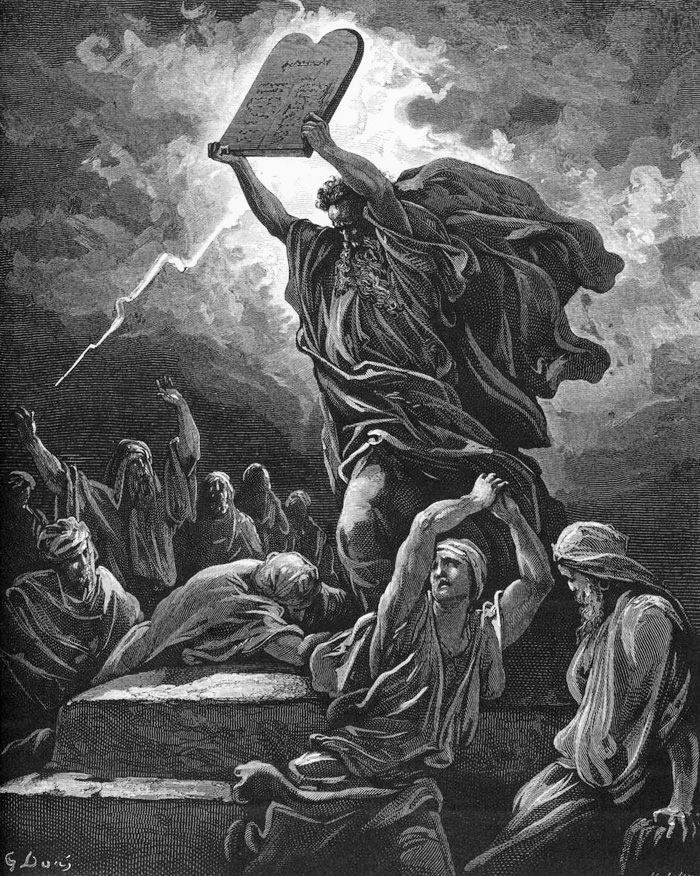
And then Moshe emerges, and in his own anger, he destroys the Luchot (tablets) and orders the killing of the worst offenders, which end up being around 3000 people. Leaving everything else aside, there is a certain irony in that the same man who petitioned that God spare and not destroy the nation is the one who presided over the deaths of half of a percent of the male population.
What led Moshe to think that he could stay and converse with God, after God told him to “Go down” in 32:7?
A very simple reading shows us that God spoke to Moshe in 32:7 using the verb “Vay’daber” (and He spoke) and continued speaking to him in 32:9 using the word “Va’yomer” (and He said). Since there was no interruption from Moshe in between these two introductory verbs, it stands to reason God had a change in attitude between 32:8, the conclusion of the “Vay’daber” portion, and 32:9, when we are told “va’yomer.”
This subtlety is similarly apparent in Shmot 6:2 when we see "Vay’daber" and "Va’yomer" both making an appearance, and the teaching that the former verb indicates God speaking harshly while the latter verb impresses us with God’s mercy is raised by several commentators. In other words, when God said, “Go down, for the people whom you brought out of Egypt have become corrupt. They have turned away from the way I have commanded them by making a golden mask,” God was really angry. But, when He saw that Moshe did not leave right away, and that Moshe was considering how to play his own hand, God saw a leader trying to figure out the best way to save his people. And so He switched gears, speaking to Moshe with “Vayomer,” indicating a compassionate attitude.
God says, “I have observed the people, and they are an unbending group. Now do not try to stop Me when I unleash my wrath against them to destroy them. I will then make you into a great nation.” (32:9-10)
I think what is going on here is quite clear. When God says, using language of compassion, “Do not try to stop Me,” what He is really saying is, “Now is your opportunity to stop Me. Give it your best shot.” And of course, Moshe comes up with a 3-part argument that removes the immediate danger to the nation: a. they are actually Your people whom You took out of Egypt, b. why should Egypt be given fuel to desecrate Your name with a claim that this was Your plan all along, to annihilate Israel in the wilderness?, and c. what ever happened to Your promise to the forefathers?
Let us be clear – the people were guilty of desecrating God’s name in the most egregious of ways. A punishment was in order. But in this particular case, the punishment through the hands of man was going to be far less encompassing and devastating than that which God might have otherwise wrought. (Compare the irony to David's decision in Samuel II 24:14)
Neither Moshe's breaking the tablets or ordering the deaths of thousands seem to weigh against him in the future. In fact the Rabbis taught that God was pleased with the choice Moshe made in smashing the Luchot. He gets overwhelmingly passing grades in this story, despite some of the eyebrow-raising details in his not listening to God, on the one hand, and in his wrath which unfolds against the people, on the other hand.
In terms of Aharon's role, he too is vindicated in his legacy. He certainly does not lose his high priest status, and to this day he continues to be revered as a lover of and pursuer of peace. However in Devarim 9:20 – Moshe tells the people that God got angry at Aharon, and Abravanel maintains the view that Aharon lost any rights to enter the land on account of his role in this story.
Perhaps the difference between the two brothers is that each one had a very different leadership role in relating to the people here. Vis-à-vis God, Aharon never lost his focus. As God sees to the heart, Aharon retained his status as high priest forever. But as a leader to the people, he seems to have given in to their whims a little too much.
Moshe, on the other hand, earned his best stripes here. He showed God how good of a shepherd he could be to his people, and he showed the people that sometimes a father has a right to get angry at his children. It is surely a difficult balance, to be a loving and caring shepherd while also being the disciplinarian father who must take a stand and defend everything that is holy.
But every indication in the story, especially at the end when Moshe's face is shining, demonstrates that Moshe did everything right here. His choices, his decisions, and his actions are all vindicated as he is elevated to the highest status a mortal could achieve.
May we be so lucky that our choices and decisions and actions always turn out to be the right ones.
Tuesday, June 16, 2015
Tzaraat or Death? Disastrous Results of Haughtiness and Denying God
Parshat Korach
by Rabbi Avi Billet
After the Korach episode, Moshe is told by God to tell his nephew Elazar to take the fire pans of those who perished bringing the k’toret, and hammer them out in order for them to become covers for the miz’be’ach.
The phrase “And he will not be like Korach and like his cohorts” is also enigmatic. It could refer to Elazar who, unlike Korach, will be doing exactly what God instructed; it could refer to the non-Kohen who, unlike Korach, avoids bringing k’toret; it could refer to the punishment itself (as opposed to the behavior), that no perpetrator will be swallowed by the ground!
Rashi (and many others) focuses on the strange phrase “B’yad Moshe” (in the hand of Moshe), suggesting that the verse is teaching us that those who argue over Kohanic rights will be punished with Tzara’at, just as Moshe was punished “in his hand” with tzara’at in Shmot 4:6. This suggests that being swallowed by the ground or consumed by a fire is not a punishment which will be assigned to any future k'toret burners.
Rashi supports this teaching using the example of King Uzziah (Divrei Hayamim II:26:19) who was afflicted with tzara’at for the rest of his life after he approached the Temple to burn k’toret, despite not being a Kohen.
But there are problems with Rashi’s teaching. The phrase “B’yad Moshe” appears over 15 times in the Torah. It usually refers to how Moshe presented the law, which descended from the mountain “in Moshe’s hand,” and it doesn’t seem to ever refer to the “punishment” Moshe received at the burning bush. One could even argue that the tzara’at that Moshe received at the burning bush wasn’t even a punishment, as it only lasted for 5 seconds, and was meant to be a sign that God had sent him! Furthermore, where at the burning bush does Moshe burn k’toret or covet the Priesthood?
Rashi is likely referring to the passage in the Talmud Sanhedrin 110a that says
The Kli Yakar advances this question further, suggesting that if we’re going to try to learn a punishment of tzara’at for challenging authority, we’d be better off learning it from Miriam’s story, when she spoke about her brother’s leadership, claiming similar strengths as a prophetess, and got tzara’at as a result!
We know that tzara’at was a punishment for seven sins: lashon hora, murder, swearing in vain, immorality, haughtiness, theft and stinginess. (Arakhin 16a) Note that wanting the Priesthood is not on the list.
Kli Yakar notes that God’s worldview of punishment is “measure for measure.” The Talmud (Shabbat 97a) says, we learn from Moshe that one who suspects others unjustly is punished on his body. Moshe suspected that the Israelites would not believe he was sent by God (Shmot 4:1), assuming he had made everything up. This is exactly what Korach accused Moshe of – fabricating a law that serves his own purposes and makes him (and Aharon) important, without any real Divine instruction.
Were Moshe’s accusation at the burning bush true, the people would have been subject to tzara’at. Since it was not true, that punishment was put on Moshe, measure for measure. The Kli Yakar explains that this sort of pronouncement fits in with the sins of lashon hora and haughtiness, which the Israelites would have been displaying had they indeed not believed that Moshe was sent by God.
The reason why Korach and his cohorts met the end that they met was because in addition to bringing k’toret, they denied God completely. They were culpable for two punishments, (tzaraa'at and death) and they received the greater one (death) following the principle of “Kim leh b’d’raba mineh.”
The strange conclusion of our verse, therefore is teaching the following: the flattened out pans are meant to serve as a reminder for all non-Kohanim not to bring k’toret, because while we are confident they will not be like Korach and his cohorts who denied God’s law and were guilty of all kinds of sins, they are still challenging Moshe’s prophesy that the Priesthood belongs to the family of Aharon alone, as they are thinking their worthiness trumps the priestly bloodline. This is a sin of haughtiness which is punishable with tzara’at.
Elazar’s role, therefore, is significant only in that he is a Kohen who is representing that Moshe’s prophesy of the Divine assignment of the priesthood is true.
For everyone else, the lesson is clear. There are different ways of challenging authority. Asking legitimate questions in the pursuit of knowledge and understanding is not only valid. It is significantly important. And if there is something wrong with the authority, it is imperative to find the truth and to bring it out.
On the other hand, saying Moshe or Aharon are unworthy because “I am more worthy” or because “I deny God’s role in appointing you,” is an offense that is beyond the pale. It is not only arrogance which drives such an approach, but it comes from a place that is far deeper and darker than a respectable desire to understand.
There are no Moshes and Aharons today. No one is given Divine Authority for any position. When we need to challenge leadership, we must always come from the first approach – a genuine pursuit of truth aimed towards understanding, in order to know how to proceed.
Korach and his cohorts wanted to bring Moshe and Aharon down simply because they didn’t like them. We dare not look to destroy anyone’s life on account of any hateful vendetta.
by Rabbi Avi Billet
After the Korach episode, Moshe is told by God to tell his nephew Elazar to take the fire pans of those who perished bringing the k’toret, and hammer them out in order for them to become covers for the miz’be’ach.
“And Elazar the Kohen took the copper pans that were offered by those who were burned, and he hammered them into covers for the miz’be’ach. [It was to serve as] a reminder to the Children of Israel, in order that no stranger – who is not of the seed of Aharon – will come close to burn the k’toret before God. And he will not be like Korach and like his cohorts, as God spoke, in the hand of Moshe, to him.” (17:4-5)Many commentaries note that the last phrase, “as God spoke, in the hand of Moshe, to him,” seems out of place. Some, such as the Da’at Zekenim, suggest that though these words appear at the end of 17:5, they refer directly to Elazar’s actions of 17:4.
The phrase “And he will not be like Korach and like his cohorts” is also enigmatic. It could refer to Elazar who, unlike Korach, will be doing exactly what God instructed; it could refer to the non-Kohen who, unlike Korach, avoids bringing k’toret; it could refer to the punishment itself (as opposed to the behavior), that no perpetrator will be swallowed by the ground!
Rashi (and many others) focuses on the strange phrase “B’yad Moshe” (in the hand of Moshe), suggesting that the verse is teaching us that those who argue over Kohanic rights will be punished with Tzara’at, just as Moshe was punished “in his hand” with tzara’at in Shmot 4:6. This suggests that being swallowed by the ground or consumed by a fire is not a punishment which will be assigned to any future k'toret burners.
Rashi supports this teaching using the example of King Uzziah (Divrei Hayamim II:26:19) who was afflicted with tzara’at for the rest of his life after he approached the Temple to burn k’toret, despite not being a Kohen.
But there are problems with Rashi’s teaching. The phrase “B’yad Moshe” appears over 15 times in the Torah. It usually refers to how Moshe presented the law, which descended from the mountain “in Moshe’s hand,” and it doesn’t seem to ever refer to the “punishment” Moshe received at the burning bush. One could even argue that the tzara’at that Moshe received at the burning bush wasn’t even a punishment, as it only lasted for 5 seconds, and was meant to be a sign that God had sent him! Furthermore, where at the burning bush does Moshe burn k’toret or covet the Priesthood?
Rashi is likely referring to the passage in the Talmud Sanhedrin 110a that says
“someone who hangs on to ‘machloket’ (the need to maintain a fight) violates the rule to not be like Korach and his cohorts. Rav Ashi says, he deserves to get tzara’at – because in this case it refers to [a punishment literally] in the hand of Moshe, and in Shmot Moshe was told to bring his hand into his shirt [in order to receive the tzara’at].”How is one parallel to the other? Even if Moshe was punished, how is his circumstance similar to Korach’s?
The Kli Yakar advances this question further, suggesting that if we’re going to try to learn a punishment of tzara’at for challenging authority, we’d be better off learning it from Miriam’s story, when she spoke about her brother’s leadership, claiming similar strengths as a prophetess, and got tzara’at as a result!
We know that tzara’at was a punishment for seven sins: lashon hora, murder, swearing in vain, immorality, haughtiness, theft and stinginess. (Arakhin 16a) Note that wanting the Priesthood is not on the list.
Kli Yakar notes that God’s worldview of punishment is “measure for measure.” The Talmud (Shabbat 97a) says, we learn from Moshe that one who suspects others unjustly is punished on his body. Moshe suspected that the Israelites would not believe he was sent by God (Shmot 4:1), assuming he had made everything up. This is exactly what Korach accused Moshe of – fabricating a law that serves his own purposes and makes him (and Aharon) important, without any real Divine instruction.
Were Moshe’s accusation at the burning bush true, the people would have been subject to tzara’at. Since it was not true, that punishment was put on Moshe, measure for measure. The Kli Yakar explains that this sort of pronouncement fits in with the sins of lashon hora and haughtiness, which the Israelites would have been displaying had they indeed not believed that Moshe was sent by God.
The reason why Korach and his cohorts met the end that they met was because in addition to bringing k’toret, they denied God completely. They were culpable for two punishments, (tzaraa'at and death) and they received the greater one (death) following the principle of “Kim leh b’d’raba mineh.”
The strange conclusion of our verse, therefore is teaching the following: the flattened out pans are meant to serve as a reminder for all non-Kohanim not to bring k’toret, because while we are confident they will not be like Korach and his cohorts who denied God’s law and were guilty of all kinds of sins, they are still challenging Moshe’s prophesy that the Priesthood belongs to the family of Aharon alone, as they are thinking their worthiness trumps the priestly bloodline. This is a sin of haughtiness which is punishable with tzara’at.
Elazar’s role, therefore, is significant only in that he is a Kohen who is representing that Moshe’s prophesy of the Divine assignment of the priesthood is true.
For everyone else, the lesson is clear. There are different ways of challenging authority. Asking legitimate questions in the pursuit of knowledge and understanding is not only valid. It is significantly important. And if there is something wrong with the authority, it is imperative to find the truth and to bring it out.
On the other hand, saying Moshe or Aharon are unworthy because “I am more worthy” or because “I deny God’s role in appointing you,” is an offense that is beyond the pale. It is not only arrogance which drives such an approach, but it comes from a place that is far deeper and darker than a respectable desire to understand.
There are no Moshes and Aharons today. No one is given Divine Authority for any position. When we need to challenge leadership, we must always come from the first approach – a genuine pursuit of truth aimed towards understanding, in order to know how to proceed.
Korach and his cohorts wanted to bring Moshe and Aharon down simply because they didn’t like them. We dare not look to destroy anyone’s life on account of any hateful vendetta.
Friday, June 5, 2015
Plan A, B, C... (ad hasof), Because You Never Know...
Parshat Be'haalotkha
by Rabbi Avi Billet
Before things begin to go sour with the complaints and offensive ways of the Jewish people in the wilderness, Moshe invites his father in law to join the Nation of Israel, and “to be our eyes.” (10:31) The simple understanding is that Moshe is asking Chovav/Yitro to be a guide for the Jewish people.
Rabbenu Bachaye asks the almost obvious question: If the people are traveling based on the clouds (9:17-23), what need do they have for Yitro to be a guide?
He gives four answers, the last two coming from the Midrash:
For the most part, these answers put Moshe’s request in a very different light. With the exception of the first approach, Moshe is not asking Yitro to be a guide for the people. In all the explanations, he is asking Yitro to serve as some kind of inspiration for whoever sees him at the shared helm of the Israelite nation.
One might think that the first answer is quite problematic. Why accede to the of-little- faith-folk just because they need to see a figure head in front of them? Wouldn’t Moshe be good enough? And even if he doesn’t technically know the way, he seems to have found Mt. Sinai with God’s direction. Perhaps it would be good for the people not to second-guess his leadership! So why would Moshe yield to this idea, particularly since it seems to be his own initiative, and not coming from the people themselves?
Maybe it was a premonition. The faith of the people changed very quickly after this exchange. Maybe Moshe knew that the people would start doing the wrong thing, might make poor choices, might slowly challenge his leadership. Maybe he was aware and was trying to nip the problem in the bud. In hindsight, of course, we don’t know what Yitro chose to do. Knowing the rest of the story, the first interpretation could suggest either that Yitro left, or that Moshe’s idea did not last long. Any inspiration was quickly lost to those of little faith.
The other interpretations have a much more positive outlook of the role Yitro could have served for the mutual benefit of himself, the nation of Israel, and the nations they would encounter. Once again, not knowing what he chose to do, our hindsight could indicate either that the thought was nice, but he didn’t show up, or that Moshe’s thought didn’t pan out for other reasons.
The take-home lesson is that for any logistical arrangement, it is always a good idea to have a “Plan B.” There is evidence (see Rashi, Chizkuni) that Moshe was already aware that he was not going to enter the land (predating the spies incident and the hitting-the-rock incident). As Yehoshua had not yet been appointed successor, maybe Moshe was trying to give leadership to a man he trusted, who knew the terrain. Maybe he felt that there was a disconnect between himself and the people. Maybe he felt that a person of Yitro’s stature could best demonstrate a positive image of this nation that might otherwise soon strike fear in the hearts of the nations of Canaan.
From his own people, and even from God’s vantage-point, Moshe’s plan had too many holes in it. Would the people be happy with extended travel? Did they like the format of travel? Were they content with the leadership? Could they offer a face to the world that would be appealing, for other nations to embrace?
Moshe seems to have revered his father in law, so he invites him to be the solution to all the problems.
But even Plan B doesn’t work, and there is no Plan C. And the proof is how quickly things sour, when Yitro’s role is not realized the way we anticipate, and the people quickly lose faith in Moshe’s leadership in the coming chapters.
Too much of life is lost to poor planning and lack of contingency foresight. With the right systems and groups in place, we can hopefully fulfill the dictum of Tamid 32a – “Who is wise? One who anticipates what is coming.”
If only we could be blessed to be so insightful. If only we could plan for every possible outcome, and always be on top, no matter what curve ball life throws our way!
by Rabbi Avi Billet
Before things begin to go sour with the complaints and offensive ways of the Jewish people in the wilderness, Moshe invites his father in law to join the Nation of Israel, and “to be our eyes.” (10:31) The simple understanding is that Moshe is asking Chovav/Yitro to be a guide for the Jewish people.
Rabbenu Bachaye asks the almost obvious question: If the people are traveling based on the clouds (9:17-23), what need do they have for Yitro to be a guide?
He gives four answers, the last two coming from the Midrash:
- Moshe wanted to give encouragement to those who were of lesser faith, who were more comfortable following a human being than a cloud.
- “To be eyes for us” (an alternative translation) means to serve as a witness for the nations of what you’ve seen with your own eyes, such as the signs and great wonders. This would allow the nations to learn the lesson that Korach experienced, and be inspired to join the Jewish people.
- “You’ll be our eyes” in that anything our eyes miss (or perhaps don’t understand), you will enlighten for us.
- (loose translation) “You will be as beloved to us as the apple of our eyes” as the Torah says (Devarim 10:19) “You shall love the convert.”
For the most part, these answers put Moshe’s request in a very different light. With the exception of the first approach, Moshe is not asking Yitro to be a guide for the people. In all the explanations, he is asking Yitro to serve as some kind of inspiration for whoever sees him at the shared helm of the Israelite nation.
One might think that the first answer is quite problematic. Why accede to the of-little- faith-folk just because they need to see a figure head in front of them? Wouldn’t Moshe be good enough? And even if he doesn’t technically know the way, he seems to have found Mt. Sinai with God’s direction. Perhaps it would be good for the people not to second-guess his leadership! So why would Moshe yield to this idea, particularly since it seems to be his own initiative, and not coming from the people themselves?
Maybe it was a premonition. The faith of the people changed very quickly after this exchange. Maybe Moshe knew that the people would start doing the wrong thing, might make poor choices, might slowly challenge his leadership. Maybe he was aware and was trying to nip the problem in the bud. In hindsight, of course, we don’t know what Yitro chose to do. Knowing the rest of the story, the first interpretation could suggest either that Yitro left, or that Moshe’s idea did not last long. Any inspiration was quickly lost to those of little faith.
The other interpretations have a much more positive outlook of the role Yitro could have served for the mutual benefit of himself, the nation of Israel, and the nations they would encounter. Once again, not knowing what he chose to do, our hindsight could indicate either that the thought was nice, but he didn’t show up, or that Moshe’s thought didn’t pan out for other reasons.
The take-home lesson is that for any logistical arrangement, it is always a good idea to have a “Plan B.” There is evidence (see Rashi, Chizkuni) that Moshe was already aware that he was not going to enter the land (predating the spies incident and the hitting-the-rock incident). As Yehoshua had not yet been appointed successor, maybe Moshe was trying to give leadership to a man he trusted, who knew the terrain. Maybe he felt that there was a disconnect between himself and the people. Maybe he felt that a person of Yitro’s stature could best demonstrate a positive image of this nation that might otherwise soon strike fear in the hearts of the nations of Canaan.
From his own people, and even from God’s vantage-point, Moshe’s plan had too many holes in it. Would the people be happy with extended travel? Did they like the format of travel? Were they content with the leadership? Could they offer a face to the world that would be appealing, for other nations to embrace?
Moshe seems to have revered his father in law, so he invites him to be the solution to all the problems.
But even Plan B doesn’t work, and there is no Plan C. And the proof is how quickly things sour, when Yitro’s role is not realized the way we anticipate, and the people quickly lose faith in Moshe’s leadership in the coming chapters.
Too much of life is lost to poor planning and lack of contingency foresight. With the right systems and groups in place, we can hopefully fulfill the dictum of Tamid 32a – “Who is wise? One who anticipates what is coming.”
If only we could be blessed to be so insightful. If only we could plan for every possible outcome, and always be on top, no matter what curve ball life throws our way!
Thursday, March 20, 2014
What is My Destiny?
Being Honest About the Roles We Play in Our Lives
(It May Take a Week to Figure It Out)
Parshat Shmini
by Rabbi Avi Billet
Rabbi Yudan in the name of Rabbi Yosi bar Yehuda, and Rabbi Berachia in the name of Rabbi Yehoshua ben Korkha said, All the years in the desert, Moshe served as co-Kohen Gadol as well (based on Tehillim 99:6 or Divrei Hayamim I 23:13-14).
Rabbi Yudan further notes that Moshe served for the 7 days of the Miluim (Dedication of the Mishkan). Rabbi Shmuel bar Nachman compares this to the Midrashic approach that Moshe conversed with God for 7 days at the Burning Bush. At that time, God spent six days trying to convince Moshe he was the right man for the job. On the seventh day, Moshe said, “Send someone else.”
The Midrash claims God’s unstated response was, “I swear I will clip your wings [when you want it most].” Rabbi Levi explains that for the first six days of the last Adar of his life Moshe prayed before God that he should be allowed to enter the Land of Israel. It was on the seventh day of Adar that God said to him, “You will not cross this River.”
Rabbi Chelbo said the same thing was going on in our parsha. For seven days Moshe served as Kohen Gadol and thought the position was his. On the seventh day, however, he was told, “The job is not yours. It belongs to Aharon your brother.” Thus, “And it was on the eighth day that Moshe called to Aharon and his sons, and told them…” the instructions that begin our parsha.
The combination of Rabbis Yudan, Shmuel, Levi and Chelbo leaves us wondering: what kind of games are being played in these Midrashim? Did God really punish Moshe for his hesitation to go before Pharaoh at the burning Bush? And even if God did punish him (see Rashi Shmot 4:14), is this kind of measure for measure really necessary? You, Moshe, played on God’s hopes for 6 days, and then let Him down on day 7, so He is going to play on your hopes for 6 days and let you down on day 7! Ha! Gotcha!
Really?!
One piece of this Midrash – which stands almost as an aside to the Midrash’s narrative – could provide the answer to our question (also in Yerushalmi Yoma 1:1). “Rabbi Tanchum said that Moshe served all 7 days as Kohen Gadol, and God’s presence was not apparent through his hand.”
There is an opinion (Shemot Rabba 37:1, Rashi Zevachim 19b sv “Moshe V’Aharon”), which Rabbi Zev Volf of Horadna (commentary on the Midrash) attributes to Rabbi Eliezer b’rabi Yehuda, that Moshe only served during that 7-day period. Perhaps this approach – rather than the one that he was an equal Kohen Gadol for 39 years – can help us resolve our quandary.
It is only after Moshe lets go, when Moshe resigns himself to the reality that he and Aharon have separate roles and that Moshe does not need to do everything, that he can once again serve in the role he was meant to serve, to bring the presence of God down to the people.
If his cup is too full, if he is trying to serve as leader and as Kohen Gadol, God’s presence can not be felt. Moshe is too distracted.
So why the week-long game? Why does Moshe need to be played in the same manner that he “played” God into thinking he wanted the role of leader at the Burning Bush?
Because 6-7 days is a decent amount of time to know whether a person likes something, whether it is something a person can go with, continue doing, or whether it is something that is just wrong.
For 6 days at the Burning Bush, Moshe raised every objection, and each one was answered. No one will believe you? Here are signs. You can’t speak? Your brother Aharon will be with you. You don’t know my name? Here it is. Pharaoh won’t believe you? I have a plan.
Moshe holds out for six days, and on the last day he throws in the zinger, “Eh, I never wanted the job to begin with.” Moshe, how could you say such a thing to God?
Therefore Moshe is given the message twice – once at the beginning of his career, and once at the end of his career. You never wanted the job – and it took you six days to actually say the truth? Now that you want the job of Kohen Gadol, or the right to go into the Land, it will take six days until God reveals the truth to you.
At the same time, you need to understand that it’s not your destiny. There are other factors at play. Aharon is Kohen Gadol because you can’t double up. And you can’t lead the people in to the Land, because that role requires a different kind of leader – a person who lives in the trenches, who identifies with the people in a way you could not when your leadership was called into question. Rashi on Devarim 2:16 says that God did not communicate with Moshe in a significant way for 38 years. He only got his last hurrah and final communication with God when he was about to die.
Be a straight shooter, know your role, don’t seek more than necessary, understand where your strengths fit into your destiny, and carve out a life that puts together all of these ingredients. These are the important lessons we can learn from Moshe’s occupational revelation at the beginning of Parshat Shemini.
Thursday, December 19, 2013
How Moshe Became a "Man" - איש
Parshat Shmot
by Rabbi Avi Billet
It was the great sage Hillel who said (Avot 2:5), "In a place where there are no men, try to be a man."
במקום שאין אנשים השתדל להיות איש
The sentiment of the phrase doesn't lend itself to be reformulated to gender-neutral terminology, so I apologize in advance to those who find it offensive.
Nonetheless, I think an understated message from this phrase can help us understand the first real episode in the life of Moshe, when he controls his own destiny.
Rashi notes that in the verse when he is returned to the daughter of Pharaoh, and in the verse which follows (2:10-11) he is described as growing twice (ויגדל). First, "The boy grew," then "Moshe grew." Rashi quotes Rabbi Yehuda who explained that the first "growth stage" was to achieve his physical stature in height, while the second "growth stage" was for greatness, because Pharaoh had appointed him over his house.
A closer look at the text may help us understand in what way Moshe truly comes of age in his first venture outside the palace.
Moshe grew and went out to his brothers to see their labors. He saw an Egyptian man hitting a Hebrew man from his brethren. He looked here and there and saw there was no man. So he struck the Egyptian and hid him in sand.
He went out on the second day and behold two men were squabbling and he said to the wicked one, "Why do you strike your neighbor?"
And he (the wicked one) said, "Who made you the Man, the officer and judge over us? Will you kill me as you killed the Egyptian?" (2:11-14)
The Egyptian (in 2:12) is no longer a "man" and the Hebrew (according to those who say it was the same person Moshe had saved the day before) is now wicked – also not a man. (Or HaChaim points to the fact that they (in 2:13) are not even called "from his brothers" as the victim in 2:11 had been called). The Alshich rightly notes this phenomenon as he expresses Moshe's confusion: just as the Egyptian is not a man and may be worthy to lose his life, the Hebrew is not a man and will tattle. Moshe takes the risk and kills the Egyptian, and of course the other non-man does the unmanly deed of informing on Moshe.
If we follow the storyline of Moshe's life, we will see him soon being called a man (according to one interpretation) by the daughter's of Yitro (2:19), and by their father when he inquires as to "the man's" whereabouts. (2:20) [Incidentally, Moshe chooses to stay with "the man" – Yitro – who by every account was principled and therefore a suitable father in law.]
Towards the end of the plagues all of Egypt will see him as "the man Moshe." (11:3) The entire Israelite nation will call him a man when he does not return from Sinai (32:1,23) and of course God calls him a man when He describes him as being the humblest of men. (Bamidbar 12:3) At the end of his life not only is he a man, but he is an Ish HaElokim – a Man of God. (Devarim 33:1)
Even his protégé's storyline has similar hints. At first Yehoshua is a lad (Shmot 33:11). And when he is anointed to be the next leader he is a "man who has spirit in him." (Bamidbar 27:18)
Ramban describes his initial growth as Moshe here as "His becoming a man of knowledge" (Ish Da'at). Upon learning of his Hebrew identity, he wanted to know more about it.
As Malbim put it, "Moshe's righteousness began in his youth – he had all the requisite qualities to be a leader. Even though he was raised in the palace of the king, raised to view the Isrealites as lowly slaves, he still viewed their circumstance as unjust. They were his brothers. This is the exact opposite of human nature, that when individuals rise to prominence they tend to ignore their brothers – the poor and destitute."
The Ktav V'Hakaballah asks how could Moshe be a vigilante in such a way? Was the Egyptian deserving of death just for beating the Hebrew? It seems that if the Egyptian was not letting up, and might have killed the Hebrew, he'd be in the category of Rodef, a pursuer, who is attempting to kill someone. In halakha, a Rodef is classified as "ain lo damim" – he has no blood. In other words, he is already considered dead because he is no longer a man. (Midrash Aggadah)
At the same time, Malbim expresses that we should not assume Moshe did this as an act of passion and without a thought process. He did look here and there to see if there was any person – and he saw there was no man, which lowered his own risk in taking action.
However one looks at the story, it seems clear that a major difference lies in who is considered to be a man in the story. Some people are assumed to be men until they prove otherwise, and Moshe grows to be a man – to fulfill the dictum of Hillel with which we started.
Of course, this isn't really surprising, considering that Moshe's existence was brought about by a "Man from the house of Levi" who defied the immoral law of the king that condemned all boys to a rivery grave in order to father the boy who would become the deliverer.
Rabbi Samson Raphael Hirsch looked at Moshe's hesitation – the need to see there was no man around to witness his deed – and taught, "He [was] deeply imbued with a sense of duty to rush to the aid of an innocent person who is oppressed… but hotheaded reckless risking of one's life is foreign to him; he [was] far from the fiery daring that is required to lead a great multitude [ ] to freedom from the tyrant's yoke… It would not even occur to him to become the savior and leader of his people. The element of desire to become a historical hero was entirely lacking in him."
And yet, he managed it so finely, and became the greatest model of teacher and leader of all time. How? Because "In a place where there are no men, try to be a man." He tried very hard. It was duly noted every step of the way. And he achieved the greatest levels of "being a Man" that anyone could achieve – where first God noticed it in the form of Moshe's humility, and in the end God called him "A Man of God."
by Rabbi Avi Billet
It was the great sage Hillel who said (Avot 2:5), "In a place where there are no men, try to be a man."
במקום שאין אנשים השתדל להיות איש
The sentiment of the phrase doesn't lend itself to be reformulated to gender-neutral terminology, so I apologize in advance to those who find it offensive.
Nonetheless, I think an understated message from this phrase can help us understand the first real episode in the life of Moshe, when he controls his own destiny.
Rashi notes that in the verse when he is returned to the daughter of Pharaoh, and in the verse which follows (2:10-11) he is described as growing twice (ויגדל). First, "The boy grew," then "Moshe grew." Rashi quotes Rabbi Yehuda who explained that the first "growth stage" was to achieve his physical stature in height, while the second "growth stage" was for greatness, because Pharaoh had appointed him over his house.
A closer look at the text may help us understand in what way Moshe truly comes of age in his first venture outside the palace.
Moshe grew and went out to his brothers to see their labors. He saw an Egyptian man hitting a Hebrew man from his brethren. He looked here and there and saw there was no man. So he struck the Egyptian and hid him in sand.
He went out on the second day and behold two men were squabbling and he said to the wicked one, "Why do you strike your neighbor?"
And he (the wicked one) said, "Who made you the Man, the officer and judge over us? Will you kill me as you killed the Egyptian?" (2:11-14)
The Egyptian (in 2:12) is no longer a "man" and the Hebrew (according to those who say it was the same person Moshe had saved the day before) is now wicked – also not a man. (Or HaChaim points to the fact that they (in 2:13) are not even called "from his brothers" as the victim in 2:11 had been called). The Alshich rightly notes this phenomenon as he expresses Moshe's confusion: just as the Egyptian is not a man and may be worthy to lose his life, the Hebrew is not a man and will tattle. Moshe takes the risk and kills the Egyptian, and of course the other non-man does the unmanly deed of informing on Moshe.
If we follow the storyline of Moshe's life, we will see him soon being called a man (according to one interpretation) by the daughter's of Yitro (2:19), and by their father when he inquires as to "the man's" whereabouts. (2:20) [Incidentally, Moshe chooses to stay with "the man" – Yitro – who by every account was principled and therefore a suitable father in law.]
Towards the end of the plagues all of Egypt will see him as "the man Moshe." (11:3) The entire Israelite nation will call him a man when he does not return from Sinai (32:1,23) and of course God calls him a man when He describes him as being the humblest of men. (Bamidbar 12:3) At the end of his life not only is he a man, but he is an Ish HaElokim – a Man of God. (Devarim 33:1)
Even his protégé's storyline has similar hints. At first Yehoshua is a lad (Shmot 33:11). And when he is anointed to be the next leader he is a "man who has spirit in him." (Bamidbar 27:18)
Ramban describes his initial growth as Moshe here as "His becoming a man of knowledge" (Ish Da'at). Upon learning of his Hebrew identity, he wanted to know more about it.
As Malbim put it, "Moshe's righteousness began in his youth – he had all the requisite qualities to be a leader. Even though he was raised in the palace of the king, raised to view the Isrealites as lowly slaves, he still viewed their circumstance as unjust. They were his brothers. This is the exact opposite of human nature, that when individuals rise to prominence they tend to ignore their brothers – the poor and destitute."
The Ktav V'Hakaballah asks how could Moshe be a vigilante in such a way? Was the Egyptian deserving of death just for beating the Hebrew? It seems that if the Egyptian was not letting up, and might have killed the Hebrew, he'd be in the category of Rodef, a pursuer, who is attempting to kill someone. In halakha, a Rodef is classified as "ain lo damim" – he has no blood. In other words, he is already considered dead because he is no longer a man. (Midrash Aggadah)
At the same time, Malbim expresses that we should not assume Moshe did this as an act of passion and without a thought process. He did look here and there to see if there was any person – and he saw there was no man, which lowered his own risk in taking action.
However one looks at the story, it seems clear that a major difference lies in who is considered to be a man in the story. Some people are assumed to be men until they prove otherwise, and Moshe grows to be a man – to fulfill the dictum of Hillel with which we started.
Of course, this isn't really surprising, considering that Moshe's existence was brought about by a "Man from the house of Levi" who defied the immoral law of the king that condemned all boys to a rivery grave in order to father the boy who would become the deliverer.
Rabbi Samson Raphael Hirsch looked at Moshe's hesitation – the need to see there was no man around to witness his deed – and taught, "He [was] deeply imbued with a sense of duty to rush to the aid of an innocent person who is oppressed… but hotheaded reckless risking of one's life is foreign to him; he [was] far from the fiery daring that is required to lead a great multitude [ ] to freedom from the tyrant's yoke… It would not even occur to him to become the savior and leader of his people. The element of desire to become a historical hero was entirely lacking in him."
And yet, he managed it so finely, and became the greatest model of teacher and leader of all time. How? Because "In a place where there are no men, try to be a man." He tried very hard. It was duly noted every step of the way. And he achieved the greatest levels of "being a Man" that anyone could achieve – where first God noticed it in the form of Moshe's humility, and in the end God called him "A Man of God."
Thursday, January 3, 2013
Moshe's Destiny: To Never Enter the Land
Parshat Shmot
by Rabbi Avi Billet
Commentaries have a field day trying
to pinpoint what was Moshe's sin that sealed his fate not to bring the people
to the Promised Land. Even the language of the Torah is inconclusive, because
when the episode of Mei Merivah (Bamidbar Chapter 20 – the "Rock
incident") took place, Moshe and Aharon are informed they will not
"bring" the people to the land. It is only later that they are told
they too will not "enter" the land (Bamidbar 20:24 , Devarim 1:37 and 4:21
(referring to Bamibar 14:30 ?),
Devarim 32:52).
In Moshe's case, he pleads to at
least merit to be buried in the Land, a request which is summarily denied.
There are reasons suggested for why he needed to be buried in the Mountains of Moav, and why his gravesite needed to overlook the area where the sin of Ba'al
Peor took place (Bamidbar 25).
Regardless, when one looks at the
sources, it seems plainly clear that Moshe's non-entry into the Land has nothing to do with the Rock incident. The flaw there, as described in the
Torah, is one of leadership. He may have wanted to go in to the land, even as a
private citizen. Alas, one can argue that being informed at that time that he
will not be bringing the people in to the land, is more likely a nice way of
saying what has been known all along. "You can't lead them, because you
won't be going in. At all. Ever."
In the beginning of Devarim, Moshe
pins the reason on the event of the spies (1:37 ),
which predates the Rock incident. This "reason" for not entering the land is advanced by Abravanel. But is the spies incident the real first
indicator that Moshe will not enter the land?
According to the Gemara Sanhedrin
(17a), Eldad and Meidad (Bamidbar 11) prophesied that Moshe would die and
Yehoshua would lead the people into the land. This episode predates the spies.
The Chizkuni offers two
interpretations on Bamidbar 10:29, when Moshe says to his father-in-law,
"We are traveling to the land. Come with us!" Either Moshe was tying
his fate to everyone else to keep their spirits up; they should not think they
are not entering the land, just because their leader will not be entering. Or,
perhaps Moshe was saying that to convince Yisro to come along; he would
otherwise think that if Moshe is not entering the land, how could he enter the
land? [See Rashi there, where he strangely brings up the question of Moshe's entry, claiming it predates any decree. If this announcement predates any decree, Rashi, then why bring it the not-yet-existent decree?]
This approach follows Rashi's
thought from our parsha, which I'll get to in a moment. But the interpretation
of Chizkuni indicates Moshe knew, as he was encouraging everyone to go to the
land, that he would not be entering. This predates Eldad and Meidad.
One of Rashi's last comments on our
parsha (Shmot 6:1) quotes a passage from Sanhedrin 111a in which Moshe is told
by God, "Now you'll see what I am going to do to Egypt, but you will not
see what I am going to do the kings of Canaan." This predates the Exodus
and the plagues.
Rav Shimshon Refael Hirsch comments
on the strange hotel incident of 4:23 -25,
where Rashi says God sought Moshe's death for not having circumcised Eliezer:
"God's plans are dependent on no man… No man – not even Moses – is indispensable
to God." In other words, even Moshe might have died at that point – before
he even got to Egypt .
Commentaries focus on Moshe's
objection to becoming the leader in 4:13 ,
where Rashi explains Moshe's complaint to mean, "Send in the hands of the
one who will bring them to the land, because it is not my destiny to bring
them."
Rabbi Obadiah Bartenura notes the
nuance in Rashi's words as he explains, "How could it be suggested that
Moshe knew the decree that he would not enter the land? One could suggest he
thought he would enter the land, but he knew he would not be the leader at that
time. 'It is not my destiny to bring them in to the land' is not the
same as 'It is not my destiny to enter the land.' He thought he would enter,
just as leader emeritus." [This notion is contradictory because it suggests he will not lead - which is first told to him in Bamidbar 20...]
The other indicator is implied from
a midrash in Devarim Rabba on Vayelech in which a "measure for
measure" punishment is associated with a parallel word utilized by Moshe
and by God. When Moshe is told he will die, God says to him, "Hen karvu
yamekha lamut" (הן קרבו ימיך למות) – indeed your days are numbered until your death. Moshe had
said about the Israelites, in 4:1, "V'hen lo ya'aminu li" (והן לא יאמינו לי) – indeed
they will not believe me, that You sent me. The similar use of the word
"Hen" (הן) – Moshe speaking ill of the Israelites, and God speaking ill of
Moshe's destiny (that he'll die and no longer lead) may indicate a measure for
measure punishment, that Moshe is not worthy to be the leader until the end.
While the question of Moshe leading
versus entering the land alone seems to have not been clarified until later,
the indications are that from the get-go, Moshe was not going to see the job
through to the end.
It is a little deflating. But it is
also a very powerful message, that not every person needs to finish everything
in a lifetime. When our time is up, hopefully we will have lived a life in
which that which we built can be continued by others. We may have picked up
from those who came before us as well. But if the project is set in motion and
can be finished by a capable successor, we have done pretty well.
We know what Moshe's job was, and
now we know that he wasn't a failure who didn't bring his job to its
conclusion. His job was to get as far as he got. And while he may have wanted
to go further, his not making it further is no indication of failure. On the
contrary, he fulfilled his destiny to the utmost.
May we all be so lucky!
Friday, September 21, 2012
Putting On A Good Face
Parshat Vayelekh
by Rabbi Avi Billet
by Rabbi Avi Billet
One of the earlier verses in the parsha describes the
encouragement Moshe gave to Yehoshua in the last days before passing the baton
of leadership to him.
"Moses summoned
Joshua, and in the presence of all Israel
Rabbi Kaplan's translation is generally a loose one, as
he moves Hebrew phrases around in the English in order to create a more flowing
narrative. Any translator knows something is lost in the change from one
language to the next. The challenge is to stay as true to the original as one
can, while making it an appealing read to your target audience.
In this particular case, while I believe Rabbi Kaplan's
interpretation is accurate in the sentiment, the inaccuracy of the order of the
translation removes the possibility of understanding how the teaching shared by
the Slonimer Rebbe in his Nesivos Shalom fits in the text. A literal
translation of the beginning of the verse will sound more like, "And Moshe
said to him, before the eyes of all of Israel ,
'Be strong and brave…'"
In his classic Hassidic style of reassigning modifiers,
the Nesivos Shalom suggests that we view Moshe's quote as beginning after the
words "to him." This may even be a better interpretation than the one suggested by Rabbi Kaplan, when we consider the cantillation marks on the words, as well as the fact that what Moshe is telling Yehoshua is quite personal. We know from past experiences (read: spies) that telling personal and private messages to individuals in front of the entire nation has not boded well when the ax fell.
Yehoshua was faced with a personal dilemma. He was the
same Yehoshua he had always been. "Yehoshua bin Nun, the young man, would
not leave from the tent." (Shmot 33:11) He was studious, dedicated to his
teacher, and not interested in attention. He did not crave the limelight. He
learned from his teacher to be humble and to know your place.
And so the Nesivos Shalom suggests, Moshe was telling
him, "You are the leader now, whether you like it or not. God chose you!
So at least when you are 'before the eyes of all of Israel ,
be strong and brave.' Be the king! Be the leader! Hide your reservations and
your feelings of insecurity when you are in front of the people. You are their
leader."
If Yehoshua wanted to cry himself to sleep at night, he
could do that in the privacy of his own bedroom. But as a leader, he must
present a face of leadership at all times.
Some people have either worked on or are blessed with a
tremendous amount of confidence. The confidence may be well deserved or earned.
And sometimes the confidence translates to getting too much undeserved
attention.
On the other hand, there are some people who are quite
capable but are quite reserved or insecure about their abilities, or feel that
if they do one thing incorrectly, it will ruin everything and they'll never get
a second chance.
A healthy balance uses both traits. It is very
important to make mistakes, as long as one learns from them. It is very
important to showcase one's talents, when one has talents worth showcasing –
even if you personally don't put much stock in them. There are athletes who
hate watching sports, and actors who can't stand to watch theater or film. But
they do what they do because they are good at it. And if they don't put on the
right face when they do it, they might not continue to enjoy the success they
enjoy.
Part of the task is to, as Nike puts it, "Just do
it." The other part of the task is to put on a good face, and to be
confident in what you are doing.
No one can solve my personal devils and distractions
except me. This is true for every person who carries emotional baggage.
Moshe was saying to Yehoshua, "God will help you
with your personal issues. Don't wear your emotions on your sleeve for all of Israel
to see. You may only exhibit leadership qualities before them. And then, if you
need to, collapse on your bed in private at the end of the day."
This is particularly a challenge for parents who are
looked up to by their children. For those who struggle with bills, debt,
financial uncertainty, or whatever else, putting a up a good front for one's
children is a difficult assignment. Stress can be quite deflating, and it can
bring down those who are incapable of coping.
As we make our commitments to TEshuva in this time
period, may we also pray that God can give us the strength to pull it all
together, hold it all together, and always put a good face forward as we
interact with those who look to us as their models and leaders.
Be Brave and Strong! The best is yet to come.
Friday, August 24, 2012
A Prophet Like Me
Parshat Shoftim
by Rabbi Avi Billet
The
shofar sound this past Sunday began the wake-up call of the month of Elul that
reminds us that Rosh Hashana will soon be upon us. As I look back at notes from
previous years, I have found that the commentary of Rabbenu Bachaye on these
coming parshas has found an important place in my own Elul and Teshuvah-focused
experience. This week we will look at one of his important teachings.
In the context of reminding the
Israelite nation not to follow the influence of the necromancers of the nations
that surround you, a seemingly uncharacteristic comment escapes Moshe's lips:
"A prophet from among you, from your brethren, such as myself, will be
whom Hashem your God establishes for you – listen to him [the prophet]." (18:15 )
In Hebrew, the "comment"
is all of one word: "Kamoni," or "such as myself."
Many commentaries suggest that this
comment refers to the previous word "me'achekha" – from your brethren
– that Moshe is saying any prophet you will have will be from the Israelite
nation. Not only that, but unlike some of the "prophets" who were
discussed last week (Chapter 13), he will teach you the ways of God and will
not steer you in the direction of idolatry or the occult, "kamoni" –
meaning "along the lines as I have properly led you."
Rabbenu Bachaye points out, for
example, that one might think "Achekha" includes a prophet from the
children of Eisav or Ishmael. This is another reason why Moshe is clear to say
"Kamoni," only from a direct Israelite lineage.
All these disclaimers are nice, but
the fact remains that if Moshe needed to bring an example, he could have just
as easily used his brother's name, or he could have pointed at Yehoshua as he
did in Bamidbar 27 and Devarim 1 and 3 saying, "A prophet… such as
Yehoshua who will be taking over when I am gone." Why did he say what
seems like a hubris statement – "You'll want a prophet like me"?
After all, if we know Moshe was the humblest of people (Bamidbar 12:3),
certainly this comment is out of character!
Not one to miss an opportunity, the
Baal Haturim notices that "Kamoni" (כמוני) has the same numerical value as
"Anav" (humble) (ענו) (both equal 126). Moshe does not want to say "I
am humble." But he does want to suggest, in code, what is a good quality
of a leader.
Humility is not defined as thinking you are a nobody.
Humility means knowing who you are, and not making a big deal about it. It
means understanding your role, as you understand that you are a nobody in
comparison to God. Most importantly, a humble leader knows that circumstances
have brought him or her to a position that commands respect or is an
inspiration to others, but it's the position which is respected before the
person filling it earns the respect – based on one's deeds.
Rabbenu Bachaye explains Moshe's
word-choice as follows. "The prophet should be like me, meaning he should
follow my precedent. He should not add nor subtract or uproot a single mitzvah
from the Torah, unless he is an established prophet and the specific
circumstance warrants it (eg Elijah bringing sacrifices on Mt Carmel during the
time of the Temple ). Ours is not a
religion in which we believe in Moshe as prophet and leader on account of the
signs and wonders he did. It is all on account of our having heard God's word
directly from Him [at Sinai], as did Moshe. We know it, we were witnesses to
it, as it says (Shmot 19:9), 'Behold I am coming to you in a thick cloud so
that the nation will hear when I speak with you, and they will believe in you
[as My chosen leader] forever.'"
Rabbenu Bachaye quotes Maimonides (Foundations
of the Torah Chapter 8) as the source for his position, and Maimonides
continues the point saying every sign Moshe did was to get them to follow him
to Sinai. But every sign also gets people thinking "Maybe this guy is a
magician." The Sinai experience changed all of that forever.
When Moshe says, "God will
appoint a prophet Kamoni," he is saying "It will be so clear in your
eyes who is a true prophet, because he stands for Torah, is guided by the
Torah, and doesn’t change the Torah." He needs to use himself, and not
Aharon or Yehoshua, as an example, because it was Moshe who was on Sinai. This
is not arrogance. This is knowing and understanding what his role was, is and
remains forever.
Judaism has always been a religion
in which the Written and Oral Torahs are sacrosanct. In different circles, and
across a large spectrum, it has become about many other things. Chumras, how
"frum" you are, what clothes you wear, how you look, where you send
your kids to yeshiva/school, social action, social justice, right wing politics
(more common in observant communities), left-wing politics (more common in
non-observant communities), and "tikkun olam."
The shofar and Elul remind us, as
does Moshe, that we need to look to and follow the examples of leaders and
leadership that help us maintain our focus – a Jewish experience that follows
the model set at Sinai, of a commitment to and observance of God's word, in
which nothing (beyond certain social changes as fitting to the world in which
we live) is added to or subtracted from the Torah.
Friday, March 2, 2012
Take For You
Parshat Tetzaveh
by Rabbi Avi Billet
There are four times in the Torah when the people are instructed to "take" an item or material for a purpose which is then described, using the Hebrew word "v'yikchu" (with a shva under the vav) – meaning, "and they will take."
Two of the instances appear at the beginning of last week's parsha and this week's parsha. "They will take 'terumah' to Me." (25:2) "Command the people, and they will take to you pure olive oil to light and raise a candle forever." (27:20). (This is repeated in Emor, Vayikra 24:2).
The other two instances are in Bamidbar 19:2, "Tell the Israelites and they will take to you an unblemished Red Heifer;" and Shmot 12:3, "They will take for them each a lamb for every house."
In three cases, the people are told to bring the items either to Moshe or for themselves, while the Terumah commandment is the sole difference, when they are told to bring the donation to God.
The idea of taking something to God in the context of the Mishkan is quite understandable. What is the purpose of the entire edifice, if not to become a Sanctuary for God's presence to rest on Earth?
On the other side, it is curious that the instructions for taking the oil and heifer are formulated in the same way, "V'yikchu ei'lekha" – to "and they will take to you." To Moshe? Why?
Ramban says the oil is to be brought to Moshe so he could be sure it is perfectly pure oil – that it follows halakhic specifications. Chizkuni says there is a practical reason involved – because he is the first one to enter the Mishkan, he will be the first one who needs the light to see in that windowless sanctuary.
The gemara, in the other hand, offers a different perspective, painting a contrast between Moshe's "needs" and God's non-needs. "Bring them to you, and not to Me, for I do not need their light." (Menachos 86b) In other words, while God does not need their light, you, Moshe, and the Jewish people, need the light of the Menorah.
Moshe is also told that the people should take to him the Red Heifer, which Rashi points out will always be called "the cow [ritual] that Moshe performed or instructed in the wilderness." Similar to the gemara, the Midrash Vayikra Rabba 30 says, "Is the [heifer] for Me? It is for you, to purify [the people]."
Moshe personally needs the light, and Moshe needs to provide the light. This is one of the two main components of Moshe's job, of Moshe's role as a "guide, advisor, leader" for the Jewish people.
With the red cow ritual, Moshe after whom the Red Heifer ritual is named, is not supposed to be doing a job the people can do for themselves, but he nonetheless serves as the conduit that brings about taharah to the people - the achievement of spiritual purity.
In this sense, Moshe is more like the "spiritual guide" who is meant to bring the people to live a life of purity. In the event that they have strayed, he is to guide them on the path that brings them back to purity.
Oil and heifer are brought to Moshe himself – to him, but for the people. Both items first come to him because he needs to tap into his innermost being, to utilize these raw materials in order to be able to achieve his maximum potential as a leader.
Moshe's job essentially serves two functions: As the source of light, he is meant to bring enlightenment, to help people find all the answers. At the same time, Moshe's other role as spiritual leader was to be the source of purity – to help people tap into the essence of their souls.
This double job is discussed by Rabbi Joseph B. Soloveitchik in his essay "Engaging the Heart and Teaching the Mind," which appears in "Reflections of the Rav Volume II." He spoke about the differences between the spiritual guide who takes care of only the spiritual side of one's experience, while the other leader or guide actually shows people how to live.
In order to achieve either end, a spiritual end or a life-goal, we need to take something – a lamb, some oil, or a red heifer, and appreciate the value of the freedom, light or symbol of purity it evokes. We take it for ourselves because it is not God who needs it, but we who need these symbols to help us connect to God. Rabbi Norman Lamm said in a sermon on this parsha in the 1960s, "The Torah, with all its difficulties and demands and disciplines, is a gift by God to man, and our observance of the Torah is no gift by us to God."
In other words, it is all for us, to help us refine who we are, to aim to perfect our ways, so we can aim to achieve the completeness that comes from living an enlightened existence and a pure existence in the service of God and in the perfecting of Man.
by Rabbi Avi Billet
There are four times in the Torah when the people are instructed to "take" an item or material for a purpose which is then described, using the Hebrew word "v'yikchu" (with a shva under the vav) – meaning, "and they will take."
Two of the instances appear at the beginning of last week's parsha and this week's parsha. "They will take 'terumah' to Me." (25:2) "Command the people, and they will take to you pure olive oil to light and raise a candle forever." (27:20). (This is repeated in Emor, Vayikra 24:2).
The other two instances are in Bamidbar 19:2, "Tell the Israelites and they will take to you an unblemished Red Heifer;" and Shmot 12:3, "They will take for them each a lamb for every house."
In three cases, the people are told to bring the items either to Moshe or for themselves, while the Terumah commandment is the sole difference, when they are told to bring the donation to God.
The idea of taking something to God in the context of the Mishkan is quite understandable. What is the purpose of the entire edifice, if not to become a Sanctuary for God's presence to rest on Earth?
On the other side, it is curious that the instructions for taking the oil and heifer are formulated in the same way, "V'yikchu ei'lekha" – to "and they will take to you." To Moshe? Why?
Ramban says the oil is to be brought to Moshe so he could be sure it is perfectly pure oil – that it follows halakhic specifications. Chizkuni says there is a practical reason involved – because he is the first one to enter the Mishkan, he will be the first one who needs the light to see in that windowless sanctuary.
The gemara, in the other hand, offers a different perspective, painting a contrast between Moshe's "needs" and God's non-needs. "Bring them to you, and not to Me, for I do not need their light." (Menachos 86b) In other words, while God does not need their light, you, Moshe, and the Jewish people, need the light of the Menorah.
Moshe is also told that the people should take to him the Red Heifer, which Rashi points out will always be called "the cow [ritual] that Moshe performed or instructed in the wilderness." Similar to the gemara, the Midrash Vayikra Rabba 30 says, "Is the [heifer] for Me? It is for you, to purify [the people]."
Moshe personally needs the light, and Moshe needs to provide the light. This is one of the two main components of Moshe's job, of Moshe's role as a "guide, advisor, leader" for the Jewish people.
With the red cow ritual, Moshe after whom the Red Heifer ritual is named, is not supposed to be doing a job the people can do for themselves, but he nonetheless serves as the conduit that brings about taharah to the people - the achievement of spiritual purity.
In this sense, Moshe is more like the "spiritual guide" who is meant to bring the people to live a life of purity. In the event that they have strayed, he is to guide them on the path that brings them back to purity.
Oil and heifer are brought to Moshe himself – to him, but for the people. Both items first come to him because he needs to tap into his innermost being, to utilize these raw materials in order to be able to achieve his maximum potential as a leader.
Moshe's job essentially serves two functions: As the source of light, he is meant to bring enlightenment, to help people find all the answers. At the same time, Moshe's other role as spiritual leader was to be the source of purity – to help people tap into the essence of their souls.
This double job is discussed by Rabbi Joseph B. Soloveitchik in his essay "Engaging the Heart and Teaching the Mind," which appears in "Reflections of the Rav Volume II." He spoke about the differences between the spiritual guide who takes care of only the spiritual side of one's experience, while the other leader or guide actually shows people how to live.
In order to achieve either end, a spiritual end or a life-goal, we need to take something – a lamb, some oil, or a red heifer, and appreciate the value of the freedom, light or symbol of purity it evokes. We take it for ourselves because it is not God who needs it, but we who need these symbols to help us connect to God. Rabbi Norman Lamm said in a sermon on this parsha in the 1960s, "The Torah, with all its difficulties and demands and disciplines, is a gift by God to man, and our observance of the Torah is no gift by us to God."
In other words, it is all for us, to help us refine who we are, to aim to perfect our ways, so we can aim to achieve the completeness that comes from living an enlightened existence and a pure existence in the service of God and in the perfecting of Man.
Friday, February 10, 2012
A Truly Humble Leader
Parshat Yitro
by Rabbi Avi Billet
As an introduction to the events that will unfold on the mountain, God tells Moshe to tell the people that they will soon become a kingdom of priests and a holy nation to God. (19:5-6)
The Torah then tells us that "Moshe came [back] and summoned the elders of the people, conveying to them all that God had said. All the people answered as one and said, ''All that God has spoken, we will do." Moshe brought the people's reply back to God. God said to Moshe, 'I will come to you in a thick cloud, so that all the people will hear when I speak to you. They will then believe in you forever.' Moshe told God the people's response." (19:7-9)
Rashi addresses the fact that Moshe conveyed the people's response the first time, saying it is a sign of respect to God to deliver the message, even though the Almighty and All-knowing knows what they said.
But the precedent is set that the people are told the message from God, they respond to Moshe, and then we are told that Moshe brought their reply to God. So how is that when God describes the thick cloud, Moshe does not convey the message to the people, they do not seem to respond, and yet Moshe tells God of their response? To what did they respond? What did they say? Why does Moshe seem to avoid sharing the second message of God with the people? And how did he then know what their response was if he didn't speak to them a second time?
Rashi explains that Moshe already knew the will of the people, namely "that they want to hear from You directly. After all, there is no comparison between hearing the king's message from his messenger versus hearing it directly from the king. 'We want to see our King.'"
Through trying to understand Rashi's exposition, the Kli Yakar has a novel approach to reading the text. Rashi does not address what the second response of the people is – only that Moshe was able to convey what they wanted. But the Kli Yakar posits that Moshe was in fact quoting the people, based on his understanding their will from their initial response, when he said the words "El Hashem – to God" in 19:9.
If the words "El Hashem" are not a quote, they are superfluous! The Torah should have said, "Moshe told their response אליו - to Him!" – obviously referring to God, with Whom Moshe is conversing. What was previously translated as "Moshe told God the people's response" should therefore be read, "Moshe [responded to God and] told Him the words of the people: 'To God.'"
This was a response to what God told him, "So that the people will hear when I speak to you and will also believe in you forever." Moshe knew from what the people had told him before that they were only interested in hearing from God. They had said, "We will listen to God" but said nothing about listening to Moshe!
The Kli Yakar is intellectually honest and boldly states that as nice as this interpretation is, the text does not really imply this. How then can we justify making the claim that Moshe felt he was not believed?
Because when God initially gave the message to Moshe, He told him to tell the people directly. But Moshe first went to the Elders instead, prompting the people to say 'We will do [only] all that God said' even though the Elders had not yet addressed them. Witnessing Moshe address the Elders indicated to them that everything would be through middlemen. They, on the other hand, did not want to have the middlemen - they wanted to hear directly from The Source.
This is the difference between "Vayashav" (and he brought their response) and "Vayaged" (and he told God). The first time Moshe returned to God he said "We will do all of God's instructions." He did not say, "Only if it comes from God directly" because he assumed God would convey His message according to the desire of the people.
But when God said, "I will be coming to you in a cloud, and they'll believe in you (Moshe)," Moshe realized God was planning to speak through middlemen. His response at that point reflected the notion that "The people don't want to hear from me. They are looking "el Hashem [to God]" because they only want to hear from You."
Only at that point were the people told, "If that's what they want, they need to prepare to greet the king… wash up, separate from spouses etc." (19:10)
Both the Alshikh and the Seforno begin their explanations of these verses with the notion that Moshe recognized that the people had not believed in his prophesy, and that God was looking to manufacture this experience so the people would believe him [Moshe, that is], and believe in his role as prophet forever.
In this light, I believe Moshe is demonstrating two tremendous leadership skills. On the one hand, he understands the subtleties of the desires of the people. The spoken and even the underspoken, or unspoken words are not lost on him.
On the other hand, he understands his role as leader, but not as ruler. It's never about Moshe. God tells Moshe, "Through this the people will believe in you," but this is the last thing Moshe wants to hear. He certainly does not want to convey to the people a message that says, "What you are about to see will prove that I am the leader chosen by God." He is happy being a shepherd who takes care of the people, and who presents their needs and desires to the Almighty, even if it comes as part of a rejection of who he is and the role he is meant to play.
by Rabbi Avi Billet
As an introduction to the events that will unfold on the mountain, God tells Moshe to tell the people that they will soon become a kingdom of priests and a holy nation to God. (19:5-6)
The Torah then tells us that "Moshe came [back] and summoned the elders of the people, conveying to them all that God had said. All the people answered as one and said, ''All that God has spoken, we will do." Moshe brought the people's reply back to God. God said to Moshe, 'I will come to you in a thick cloud, so that all the people will hear when I speak to you. They will then believe in you forever.' Moshe told God the people's response." (19:7-9)
Rashi addresses the fact that Moshe conveyed the people's response the first time, saying it is a sign of respect to God to deliver the message, even though the Almighty and All-knowing knows what they said.
But the precedent is set that the people are told the message from God, they respond to Moshe, and then we are told that Moshe brought their reply to God. So how is that when God describes the thick cloud, Moshe does not convey the message to the people, they do not seem to respond, and yet Moshe tells God of their response? To what did they respond? What did they say? Why does Moshe seem to avoid sharing the second message of God with the people? And how did he then know what their response was if he didn't speak to them a second time?
Rashi explains that Moshe already knew the will of the people, namely "that they want to hear from You directly. After all, there is no comparison between hearing the king's message from his messenger versus hearing it directly from the king. 'We want to see our King.'"
Through trying to understand Rashi's exposition, the Kli Yakar has a novel approach to reading the text. Rashi does not address what the second response of the people is – only that Moshe was able to convey what they wanted. But the Kli Yakar posits that Moshe was in fact quoting the people, based on his understanding their will from their initial response, when he said the words "El Hashem – to God" in 19:9.
If the words "El Hashem" are not a quote, they are superfluous! The Torah should have said, "Moshe told their response אליו - to Him!" – obviously referring to God, with Whom Moshe is conversing. What was previously translated as "Moshe told God the people's response" should therefore be read, "Moshe [responded to God and] told Him the words of the people: 'To God.'"
This was a response to what God told him, "So that the people will hear when I speak to you and will also believe in you forever." Moshe knew from what the people had told him before that they were only interested in hearing from God. They had said, "We will listen to God" but said nothing about listening to Moshe!
The Kli Yakar is intellectually honest and boldly states that as nice as this interpretation is, the text does not really imply this. How then can we justify making the claim that Moshe felt he was not believed?
Because when God initially gave the message to Moshe, He told him to tell the people directly. But Moshe first went to the Elders instead, prompting the people to say 'We will do [only] all that God said' even though the Elders had not yet addressed them. Witnessing Moshe address the Elders indicated to them that everything would be through middlemen. They, on the other hand, did not want to have the middlemen - they wanted to hear directly from The Source.
This is the difference between "Vayashav" (and he brought their response) and "Vayaged" (and he told God). The first time Moshe returned to God he said "We will do all of God's instructions." He did not say, "Only if it comes from God directly" because he assumed God would convey His message according to the desire of the people.
But when God said, "I will be coming to you in a cloud, and they'll believe in you (Moshe)," Moshe realized God was planning to speak through middlemen. His response at that point reflected the notion that "The people don't want to hear from me. They are looking "el Hashem [to God]" because they only want to hear from You."
Only at that point were the people told, "If that's what they want, they need to prepare to greet the king… wash up, separate from spouses etc." (19:10)
Both the Alshikh and the Seforno begin their explanations of these verses with the notion that Moshe recognized that the people had not believed in his prophesy, and that God was looking to manufacture this experience so the people would believe him [Moshe, that is], and believe in his role as prophet forever.
In this light, I believe Moshe is demonstrating two tremendous leadership skills. On the one hand, he understands the subtleties of the desires of the people. The spoken and even the underspoken, or unspoken words are not lost on him.
On the other hand, he understands his role as leader, but not as ruler. It's never about Moshe. God tells Moshe, "Through this the people will believe in you," but this is the last thing Moshe wants to hear. He certainly does not want to convey to the people a message that says, "What you are about to see will prove that I am the leader chosen by God." He is happy being a shepherd who takes care of the people, and who presents their needs and desires to the Almighty, even if it comes as part of a rejection of who he is and the role he is meant to play.
Friday, January 20, 2012
Nominated for Best Supporting Role
Parshat Va'era
by Rabbi Avi Billet
I have a hard time understanding the role of Aharon, Moshe's brother, in the exodus story.
When he is first appointed to be the leader/redeemer of Israel, Moshe presents a number of arguments as to why he is not the best man for the job. He may even hint to the idea that Aharon would be a more worthy choice.
God's response in 4:14 is a display of anger, followed by "Is not Aharon the Levite your brother? I know that he knows how to speak! He is setting out to meet you, and when he sees you, his heart will be glad."
In other words, if you Moshe are nervous about speaking to Pharaoh, Aharon will take care of this for you. In fact, the first time we see Aharon speaking on Moshe's behalf is in 4:30, when he addresses the nation of Israel, convincing them that Moshe was sent by God: "Aaron related all the words that God had told Moses, and he demonstrated the miraculous proofs before the people."
When they came to Pharaoh in chapter 5, we were told "Moshe and Aharon then went to Pharaoh and said, 'This is what Hashem, God of the Hebrews, declares: 'Let My people leave, so they can sacrifice to Me in the desert.''" In this instance, the indications point to Aharon and Moshe sharing the limelight.
But after this, the narrative presents a different story.
In our parsha, "Moshe related this to the Israelites, but because of their disappointment and hard work, they would no longer listen to him." (6:9) Note how Moshe is the speaker.
A little while later, after twice claiming his unease with the prospect of speaking to Pharaoh after having being denied by his own people, we see "God said to Moses, 'Observe! I will be making you like a god to Pharaoh, and your brother Aharon will be your prophet. You must announce all that I order you to, and your brother Aharon will relate it to Pharaoh. He will then let the Israelites leave his land."
As clear as it seems that Aharon is going to be Moshe's mouthpiece, we don't really see that coming to fruition. Certainly not in the times they relate to Pharaoh.
So why all the hype about Aharon? Moshe is very clearly the leader, and while Aharon does speak once or twice in Moshe's place, Moshe seems very capable of holding his own – with the people and with Pharaoh. Why are they, in many respects, viewed as equals?
Because Moshe needed to grow into his role. That he was chosen by God on account of the character and qualities he possessed is clear. But, like any human leader, the fact of being chosen (or elected) does not mean the person is completely ready for the job. A President or Prime Minister might be a great leader, but it does not mean the person is prepared for all the intricacies of the job, or is even a great public speaker. This is why people like a press secretary and a public relations representative have jobs. Obviously a public speaking ability is a tremendous asset. But sometimes a person needs to grow into that comfort zone.
Moshe cared for the underdogs in every fight he ever encountered. And Egyptian bondage, in that sense, was perfect for him to battle head-on. No one is as needy for an advocate as are slaves.
But it's a little different when one does his own private vigilantism versus when one has to play political hardball, and stand up against a despot in an arena that is not only very real, but carries the safety and future of an entire nation on its shoulders.
Having lived in Egypt his whole life, and having been in the trenches with the people, Aharon was a great supporting character to wean Moshe into his new role.
But Moshe adapted quickly (there are plenty of commentaries who explain that he did not have a speech impediment, but was very nervous about his assignment) and was quickly able to say, "Thanks for offering Aharon as my support staff. He will be a tremendous help in other ways. But I no longer need him to be my mouthpiece."
May we all be blessed to have such loyal mentors in our lives. Moshe was able to fill his roll with such ease and so quickly because he had his brother Aharon guiding him, with class, dignity, and with a sense of support which said, "I'm there if you need me, but I look forward to cutting the strings and removing the training wheels so you will be able to fly on your own."
by Rabbi Avi Billet
I have a hard time understanding the role of Aharon, Moshe's brother, in the exodus story.
When he is first appointed to be the leader/redeemer of Israel, Moshe presents a number of arguments as to why he is not the best man for the job. He may even hint to the idea that Aharon would be a more worthy choice.
God's response in 4:14 is a display of anger, followed by "Is not Aharon the Levite your brother? I know that he knows how to speak! He is setting out to meet you, and when he sees you, his heart will be glad."
In other words, if you Moshe are nervous about speaking to Pharaoh, Aharon will take care of this for you. In fact, the first time we see Aharon speaking on Moshe's behalf is in 4:30, when he addresses the nation of Israel, convincing them that Moshe was sent by God: "Aaron related all the words that God had told Moses, and he demonstrated the miraculous proofs before the people."
When they came to Pharaoh in chapter 5, we were told "Moshe and Aharon then went to Pharaoh and said, 'This is what Hashem, God of the Hebrews, declares: 'Let My people leave, so they can sacrifice to Me in the desert.''" In this instance, the indications point to Aharon and Moshe sharing the limelight.
But after this, the narrative presents a different story.
In our parsha, "Moshe related this to the Israelites, but because of their disappointment and hard work, they would no longer listen to him." (6:9) Note how Moshe is the speaker.
A little while later, after twice claiming his unease with the prospect of speaking to Pharaoh after having being denied by his own people, we see "God said to Moses, 'Observe! I will be making you like a god to Pharaoh, and your brother Aharon will be your prophet. You must announce all that I order you to, and your brother Aharon will relate it to Pharaoh. He will then let the Israelites leave his land."
As clear as it seems that Aharon is going to be Moshe's mouthpiece, we don't really see that coming to fruition. Certainly not in the times they relate to Pharaoh.
So why all the hype about Aharon? Moshe is very clearly the leader, and while Aharon does speak once or twice in Moshe's place, Moshe seems very capable of holding his own – with the people and with Pharaoh. Why are they, in many respects, viewed as equals?
Because Moshe needed to grow into his role. That he was chosen by God on account of the character and qualities he possessed is clear. But, like any human leader, the fact of being chosen (or elected) does not mean the person is completely ready for the job. A President or Prime Minister might be a great leader, but it does not mean the person is prepared for all the intricacies of the job, or is even a great public speaker. This is why people like a press secretary and a public relations representative have jobs. Obviously a public speaking ability is a tremendous asset. But sometimes a person needs to grow into that comfort zone.
Moshe cared for the underdogs in every fight he ever encountered. And Egyptian bondage, in that sense, was perfect for him to battle head-on. No one is as needy for an advocate as are slaves.
But it's a little different when one does his own private vigilantism versus when one has to play political hardball, and stand up against a despot in an arena that is not only very real, but carries the safety and future of an entire nation on its shoulders.
Having lived in Egypt his whole life, and having been in the trenches with the people, Aharon was a great supporting character to wean Moshe into his new role.
But Moshe adapted quickly (there are plenty of commentaries who explain that he did not have a speech impediment, but was very nervous about his assignment) and was quickly able to say, "Thanks for offering Aharon as my support staff. He will be a tremendous help in other ways. But I no longer need him to be my mouthpiece."
May we all be blessed to have such loyal mentors in our lives. Moshe was able to fill his roll with such ease and so quickly because he had his brother Aharon guiding him, with class, dignity, and with a sense of support which said, "I'm there if you need me, but I look forward to cutting the strings and removing the training wheels so you will be able to fly on your own."
Thursday, September 22, 2011
Going When It's Time
Parshat Nitzavim Vayelekh
by Rabbi Avi Billet
The big challenge for many of us is how to deal with the cards we're dealt. For Moshe, the Torah says he did not lose his physical strength. But there is room to look at Moshe not being able to lead a battle or to not maintain his highest intellectual capacity – especially after he anointed Yehoshua his successor and gave Yehoshua some of his own "glory."
by Rabbi Avi Billet
Moshe's good bye speech that is the book of Devarim contains a number of references to the fact that he will not accompany the people into the Promised Land. He talks about how he requested, knelt, pleaded before God to be given a chance to enter the land – if only for a short time – and how each request was summarily rejected.
In the beginning of Devarim, Moshe pins the reason on the event of the spies (1:37 ). Sometimes, the reasoning becomes more of God's design than a mundane punishment. The Or HaChaim (1:37 ) quotes a gemara (Sotah 9a) and the Midrash Tehillim (79) to explain how Moshe's non-entry into the land was part of a plan that would ultimately save the Jewish people. Had Moshe entered the land, he would have built the Temple
God's ensuing wrath over the people turning from Him was taken out on wood and stones (the destruction of the Temple
In his work Siftei Tzadikim, Rabbi Menachem Mendel of Rimanov says that Moshe, the ultimate shepherd of Israel Israel
To bring the matter to an even more direct level, the Mareh Yechezkel (Rabbi Yechezkel Panet) gives two additional explanations for why Moshe needed to remain outside of the land: for the merit of those who perished in the wilderness, and to serve as a defense against the prosecution of Baal Peor, which would not be able to stand up against Moshe's grave, is in the mountains of Moav, overlooking the place where the negative incident of Bamidbar 25 took place.
In our parsha, Moshe says "Today I am 120 years old and I can no longer come and go. God has [also] told me that I would not cross the Jordan
What does Moshe mean when he says "I can no longer come and go?" Is Moshe referring to his physical prowess? Is Moshe referring to the reality that the end of his life has arrived? Is Moshe saying that he can no longer argue the point with God because it is hopeless for him to enter the land?
Ibn Ezra suggests Moshe could no longer lead the people in battle. Rashi rejects the idea that Moshe's physical strength was ebbing, as he offers Moshe's inability (permission-wise) to enter the land, and that Moshe was no longer capable of deep Torah thoughts. (Ramban prefers this latter interpretation.) Different Tosafists point to Moshe's old age as his reason for not being able to continue – following the logical flow of the verse. The Seforno has echoes of Moshe's destiny when he says "Even if I could physically make the trip (go and come), since God said I can not go, it will be better for you if I do not enter, because this will allow you to pass over the Jordan River, and to enter the promised Land."
There are no set rules for when the body begins to break down. Some people might begin experiencing debilitating ailments or conditions at an early age, some at a later stage, and some go through life as healthy as can be past becoming centenarians.
The big challenge for many of us is how to deal with the cards we're dealt. For Moshe, the Torah says he did not lose his physical strength. But there is room to look at Moshe not being able to lead a battle or to not maintain his highest intellectual capacity – especially after he anointed Yehoshua his successor and gave Yehoshua some of his own "glory."
Moshe grew to accept his reality and to understand that some things, which are clearly part of God's master plan, are what they are. No amount of Moshe's pleading could change his destiny once the decree was given.
Does this mean Moshe did not possess Free Will, and that perhaps his destiny was predetermined? Of course not. Moshe demonstrated his free will many times in the Torah, and his destiny was heavily influenced by his free will choices.
The reality presented by the verse also suggests, however, that Moshe was able to recognize when his time was up, so he could walk off into the sunset while still as close to the top of his game as he could possible be.
May we all be blessed to live to Moshe's ripe old age, and merit to appreciate our final days for what they will be: the prelude to our reunion with the divine.
Friday, July 29, 2011
Compassionate Leadership
Parshat Masei
by Rabbi Avi Billet
In the history of mankind, rulers have often had the power over who will live and who will die. In some cases, one's prison sentence might be linked indefinitely to the grudge of the ruling power, and reprieve might come only upon the latter's death.
Much would depend on the nature of the crime of which the individual stood accused, while in many cases, there may not have been a crime committed at all.
The Torah presents a seemingly odd circumstance in which those who were accidental murderers, destined to live out their lives in cities of refuge to avoid avengement from the deceased's relatives, were allowed to emerge from the city upon the death of the High Priest – not the king. The relatives had a free pass, so to speak, to avenge the blood of the deceased, until the death of the High Priest granted clemency and freedom to the accidental murderer. Any relative who carried out personal justice after this point would be considered a deliberate murderer, subject to the laws of murderers, and not avengers.
While the fact that accidental crime was not a politically rebellious act, it would seem that a safe haven or a city of refuge would nonetheless be considered a politically-functioned sanctuary. Maybe it is unfair to suggest that the death of the king would bring about freedom for those taking refuge. But it makes less sense to tie the reprieve to the death of the High Priest! The High Priest position is spiritual and holy. In the classic Rabbinic literature, the High Priest is considered the holiest Jew! How could his death be intertwined with the release or reprieve of the accidental murderer?
The Yerushalmi Yoma 7:3 declares that the death of the High Priest is the Torah's definition of the achievement of atonement for this act of 'accidental murder.' This stands to suggest the High Priest is very connected to the advent of the unfortunate mishaps.
There are a number of classic explanations for this connection.
The Talmud (Makkot 11b) faults the High Priest with not praying that the person's trial return an innocent verdict.
Rashi (Bamidbar 35:25), based on the Sifrei, promotes a contrast between the High Priest's representing God's presence and the lengthening of Israelites' lives on earth, while the murderer (even the accidental one), removes God's presence from Israelites and shortens their days on earth. He, therefore, is not worthy to stand in the presence of the High Priest and must remain in exile until the High Priest passes on. This approach blames the accidental murderer.
Rashi offers a second opinion that puts an element of blame on the High Priest himself. The High Priest was supposed to pray that such unfortunate mishaps not occur during his lifetime. His lack of prayer, or unanswered prayer, is therefore responsible for the death of the victim and the exile of the perpetrator. The end to the chapter will come when the High Priest, himself, dies.
Rabbenu Bachaye follows this sentiment saying the relatives of the deceased might truly blame the High Priest, believing his leadership flaw caused the death of their loved one. As such, the High Priest's death might be a comfort for them, closure if you will, that the real person responsible for their relative's death has received his just desserts. They can now let go of their desire for revenge against the accidental murderer, who was God's unfortunate messenger to bring about the death of the victim.
Either way one looks at it, says Rabbi Moshe Shternbuch, we see that the High Priest shares in the blame for the incident. His prayer should have either prevented the accident in the first place, or should have helped deliver an innocent verdict to the defendant after the fact.
Rabbi Shternbuch says,"This is the job of the righteous [leaders] of Israel. It is their job to advocate for God's compassion to erase the sins of those who err accidentally or out of ignorance, so He may accept their repentance with mercy…"
In this period of the three weeks, let us call upon our leaders to find the compassionate trait
the High Priest was required to hone within himself, so they may be the best advocates for those who sin accidentally or out of ignorance.
In this Age of Information, "lack of access" is no longer a good excuse for ignorance. Leaders are needed to help guide those in seek of the information they need, and those leaders need to be able to relate to people of all colors and stripes, and to present Judaism in way that is relevant and appealing to a techno generation.
The time is ripe for there to be an overabundance of love and reaching out to those who seek a connection to Judaism and our way of life. If our prayers are sincere and our connection to God is real, perhaps we will merit to see the Jewish people live fulfilling lives as Jews, following the Torah as best as they can, with a commitment to God that reaches the heavens.
by Rabbi Avi Billet
In the history of mankind, rulers have often had the power over who will live and who will die. In some cases, one's prison sentence might be linked indefinitely to the grudge of the ruling power, and reprieve might come only upon the latter's death.
Much would depend on the nature of the crime of which the individual stood accused, while in many cases, there may not have been a crime committed at all.
The Torah presents a seemingly odd circumstance in which those who were accidental murderers, destined to live out their lives in cities of refuge to avoid avengement from the deceased's relatives, were allowed to emerge from the city upon the death of the High Priest – not the king. The relatives had a free pass, so to speak, to avenge the blood of the deceased, until the death of the High Priest granted clemency and freedom to the accidental murderer. Any relative who carried out personal justice after this point would be considered a deliberate murderer, subject to the laws of murderers, and not avengers.
While the fact that accidental crime was not a politically rebellious act, it would seem that a safe haven or a city of refuge would nonetheless be considered a politically-functioned sanctuary. Maybe it is unfair to suggest that the death of the king would bring about freedom for those taking refuge. But it makes less sense to tie the reprieve to the death of the High Priest! The High Priest position is spiritual and holy. In the classic Rabbinic literature, the High Priest is considered the holiest Jew! How could his death be intertwined with the release or reprieve of the accidental murderer?
The Yerushalmi Yoma 7:3 declares that the death of the High Priest is the Torah's definition of the achievement of atonement for this act of 'accidental murder.' This stands to suggest the High Priest is very connected to the advent of the unfortunate mishaps.
There are a number of classic explanations for this connection.
The Talmud (Makkot 11b) faults the High Priest with not praying that the person's trial return an innocent verdict.
Rashi (Bamidbar 35:25), based on the Sifrei, promotes a contrast between the High Priest's representing God's presence and the lengthening of Israelites' lives on earth, while the murderer (even the accidental one), removes God's presence from Israelites and shortens their days on earth. He, therefore, is not worthy to stand in the presence of the High Priest and must remain in exile until the High Priest passes on. This approach blames the accidental murderer.
Rashi offers a second opinion that puts an element of blame on the High Priest himself. The High Priest was supposed to pray that such unfortunate mishaps not occur during his lifetime. His lack of prayer, or unanswered prayer, is therefore responsible for the death of the victim and the exile of the perpetrator. The end to the chapter will come when the High Priest, himself, dies.
Rabbenu Bachaye follows this sentiment saying the relatives of the deceased might truly blame the High Priest, believing his leadership flaw caused the death of their loved one. As such, the High Priest's death might be a comfort for them, closure if you will, that the real person responsible for their relative's death has received his just desserts. They can now let go of their desire for revenge against the accidental murderer, who was God's unfortunate messenger to bring about the death of the victim.
Either way one looks at it, says Rabbi Moshe Shternbuch, we see that the High Priest shares in the blame for the incident. His prayer should have either prevented the accident in the first place, or should have helped deliver an innocent verdict to the defendant after the fact.
Rabbi Shternbuch says,"This is the job of the righteous [leaders] of Israel. It is their job to advocate for God's compassion to erase the sins of those who err accidentally or out of ignorance, so He may accept their repentance with mercy…"
In this period of the three weeks, let us call upon our leaders to find the compassionate trait
the High Priest was required to hone within himself, so they may be the best advocates for those who sin accidentally or out of ignorance.
In this Age of Information, "lack of access" is no longer a good excuse for ignorance. Leaders are needed to help guide those in seek of the information they need, and those leaders need to be able to relate to people of all colors and stripes, and to present Judaism in way that is relevant and appealing to a techno generation.
The time is ripe for there to be an overabundance of love and reaching out to those who seek a connection to Judaism and our way of life. If our prayers are sincere and our connection to God is real, perhaps we will merit to see the Jewish people live fulfilling lives as Jews, following the Torah as best as they can, with a commitment to God that reaches the heavens.
Subscribe to:
Posts (Atom)