Showing posts with label golden calf. Show all posts

Thursday, February 25, 2016

Moshe Earns His Stripes


Parshat Ki Tisa

by Rabbi Avi Billet

Through much of the story of the Golden Calf, the focus is often Aharon. What was he thinking? What was his plan? How could he do what he did? Was he ever blamed for his role? Was he justified or vindicated in the end? 

While that is certainly an important discussion, those questions have been addressed in this column in the past. (Linked above and below) However, the same questions can also be applied to Moshe.

Think about it. He was on the mountain, oblivious of any tumult down below. He is informed by God, at a peak in his “chavrusa” (personal study session) with God, “Go down, for the people whom you brought out of Egypt have become corrupt.”

Moshe chooses to listen to everything God has to say before deciding if he’s actually going to go down to watch his people face the music. However, he also makes the choice to stay and talk to God about His plan to destroy the nation, creating a new nation of the Children of Moses. He talks to God, seems to convince God to change His mind, but also even His Middot (character traits, how He operates), to the point that God no longer intends to destroy the people.
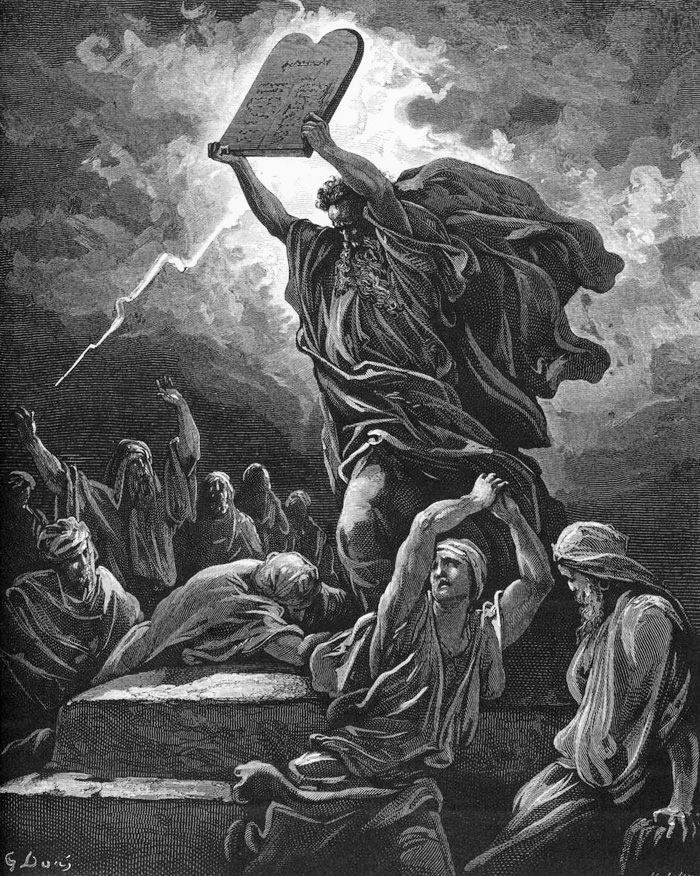


And then Moshe emerges, and in his own anger, he destroys the Luchot (tablets) and orders the killing of the worst offenders, which end up being around 3000 people. Leaving everything else aside, there is a certain irony in that the same man who petitioned that God spare and not destroy the nation is the one who presided over the deaths of half of a percent of the male population.

What led Moshe to think that he could stay and converse with God, after God told him to “Go down” in 32:7?

A very simple reading shows us that God spoke to Moshe in 32:7 using the verb “Vay’daber” (and He spoke) and continued speaking to him in 32:9 using the word “Va’yomer” (and He said). Since there was no interruption from Moshe in between these two introductory verbs, it stands to reason God had a change in attitude between 32:8, the conclusion of the “Vay’daber” portion, and 32:9, when we are told “va’yomer.”

This subtlety is similarly apparent in Shmot 6:2 when we see "Vay’daber" and "Va’yomer" both making an appearance, and the teaching that the former verb indicates God speaking harshly while the latter verb impresses us with God’s mercy is raised by several commentators. In other words, when God said, “Go down, for the people whom you brought out of Egypt have become corrupt. They have turned away from the way I have commanded them by making a golden mask,” God was really angry. But, when He saw that Moshe did not leave right away, and that Moshe was considering how to play his own hand, God saw a leader trying to figure out the best way to save his people. And so He switched gears, speaking to Moshe with “Vayomer,” indicating a compassionate attitude.

God says, “I have observed the people, and they are an unbending group. Now do not try to stop Me when I unleash my wrath against them to destroy them. I will then make you into a great nation.” (32:9-10)

I think what is going on here is quite clear. When God says, using language of compassion, “Do not try to stop Me,” what He is really saying is, “Now is your opportunity to stop Me. Give it your best shot.” And of course, Moshe comes up with a 3-part argument that removes the immediate danger to the nation: a. they are actually Your people whom You took out of Egypt, b. why should Egypt be given fuel to desecrate Your name with a claim that this was Your plan all along, to annihilate Israel in the wilderness?, and c. what ever happened to Your promise to the forefathers?

Let us be clear – the people were guilty of desecrating God’s name in the most egregious of ways. A punishment was in order. But in this particular case, the punishment through the hands of man was going to be far less encompassing and devastating than that which God might have otherwise wrought. (Compare the irony to David's decision in Samuel II 24:14)

Neither Moshe's breaking the tablets or ordering the deaths of thousands seem to weigh against him in the future. In fact the Rabbis taught that God was pleased with the choice Moshe made in smashing the Luchot. He gets overwhelmingly passing grades in this story, despite some of the eyebrow-raising details in his not listening to God, on the one hand, and in his wrath which unfolds against the people, on the other hand.

In terms of Aharon's role, he too is vindicated in his legacy. He certainly does not lose his high priest status, and to this day he continues to be revered as a lover of and pursuer of peace. However in Devarim 9:20 – Moshe tells the people that God got angry at Aharon, and Abravanel maintains the view that Aharon lost any rights to enter the land on account of his role in this story.

Perhaps the difference between the two brothers is that each one had a very different leadership role in relating to the people here. Vis-à-vis God, Aharon never lost his focus. As God sees to the heart, Aharon retained his status as high priest forever. But as a leader to the people, he seems to have given in to their whims a little too much.

Moshe, on the other hand, earned his best stripes here. He showed God how good of a shepherd he could be to his people, and he showed the people that sometimes a father has a right to get angry at his children. It is surely a difficult balance, to be a loving and caring shepherd while also being the disciplinarian father who must take a stand and defend everything that is holy.

But every indication in the story, especially at the end when Moshe's face is shining, demonstrates that Moshe did everything right here. His choices, his decisions, and his actions are all vindicated as he is elevated to the highest status a mortal could achieve.

May we be so lucky that our choices and decisions and actions always turn out to be the right ones.

Thursday, September 24, 2015

How Moshe's Punishment Has Very Little to Do With a Rock

There is very compelling evidence that Moshe was never supposed to go into the land. So why does the Torah keep harping on the incident of Mei Merivah (Bamidbar 20)?

Parshat Ha'azinu

by Rabbi Avi Billet

The song of Haazinu is troubling because it seems to describe actions and behaviors of the nation of Israel that we have never seen before in the Torah. The punishments God declares He has given and will give seem unequal to the violations committed.

 Equally disturbing is how the punishment to Moshe is described in our parsha – because it is not an accurate reflection of what happened in Bamidbar 20. In 32:50 Moshe is told he will die as his brother Aharon had died (see Bamaidbar 20:22-28). In 32:51, the reason is given: “because you broke faith with me (‘m’altem bi’) in the midst of the Israelites at the Waters of Dispute at Kadesh in the Tzin Desert, and because you did not sanctify Me (‘lo kidashtem oti’) among the Israelites.”

 While it is true that the event described took place, the way it is described in Bamidbar is quite different from how it is presented here.

 In Bamidbar 20:12-13 the Torah tells us “God said to Moses and Aaron, 'You did not cause there to be enough faith in Me (lo he’emantem’) to cause Me to be sanctified (‘l’hakdisheini’) in the presence of the Israelites! Therefore, you shall not bring this assembly to the land that I have given you.' These are the Waters of Dispute (Mey Meribhah) where the Israelites disputed with God, and where He was [nevertheless] sanctified (‘va’y’kadesh bam’).” Eleven verses later we are told that “'Aaron will [now die and] be gathered up to his people. He will not come to the land that I am giving the Israelites because you rebelled against My word (‘asher m’ritem et pi’) at the Waters of Dispute.”

 It is important to note that when referring to this incident in Bamidbar 27:14, Moshe is also told “m’ritem pi” and that you failed “l’hakdisheini.”

 Strangely, some of these formulations appear once more in the Torah, in Devarim 9:23, when Moshe recounts the events surrounding the Golden Calf, and he describes the guilt of the people as “but you rebelled against the word (“vatamru et pi”) of God your Lord, and did not have faith in Him (“lo he’emantem lo”) or obey Him.

 To summarize, using the Hebrew verbs describing Moshe’s and Aharon’s guilt:
At the incident with the rock - lo he’emantem and l’hakdisheini, though the latter seems to be countered by v’y’kadesh bam 
Aharon’s death – m’ritem et pi 
Moshe’s first direct accusation of non-compliance other than the actual event, when he was told he could not bring the nation into the land – m’ritem pi and l’hakdisheini 
Moshe reminding the people of their sin at Golden Calf – vatamru and lo he’emantem 
Our parsha – m’altem bi and lo kidashtem oti

 It is also noteworthy that until now Moshe has been told he will not bring the people to the land (Bamidbar 20:12), and that he will see the land and then die (Bamidbar 27:13). Both options leave open the possibility that he will enter the land as a private citizen (leader emeritus, perhaps) and that he can die shortly after he sees the land for himself, even from the inside. Only in our parsha, Devarim 32:52, is Moshe finally told point-blank, you will not be going into the land (in Devarim 1:37, Moshe says he was told he will not enter the land, but we never saw God actually tell him that). In Devarim 3:27, Moshe reported that God said “you will not be crossing the Jordan” – but Moshe still had hopes that he while he might not enter the Land alive, he would be buried in the Land. The idea of seeing the land from a distance and being buried outside the land is clarified for Moshe immediately before he dies, in Devarim 34:4.

 So what is going on? Why do the reasons for not entering the land differ from explanation to explanation, and from person to person?

 Abravanel’s approach to the punishment meted to Aharon and Moshe pins their non-entry status on the Golden Calf and the Spies incidents, respectively. He explains God’s constant reference to the Rock incident as a cover for the real reasons, to avoid embarrassment. But the Rock episode was very mild in comparison to those other nation-shattering events. [He compares this to the mystery surrounding the deaths of Nadav and Avihu. The Torah gives us very sketchy information, while the rabbis heap a slew of accusations upon the lads, indicating the real reason for their deaths was hidden by the Torah, as it was pinned on a minor violation.]

Considering that the verse tells us in Bamidbar 20:13 (Rock incident) that God was nonetheless sanctified, it is hard to imagine that they failed to cause the people to have faith in God there. Therefore the “lo heemantem” must be linked to the other time it appears, Devarim 9:23, referring to the Sin of the Golden Calf, when the people indeed lost their faith in God. Interestingly, Moshe reports about Aharon’s death there in 10:6, after recounting how he brought down the second Tablets, even though Aharon’s death occurred 40 years later.

 The act of “Me’i’lah,” of which Moshe is accused in our parsha, refers to using something holy for a mundane act. Reading Devarim 1:19-38, it is clear that the holiness of the Land was rejected for mundane reasons by the people. Additionally, they are accused of “vatamru et pi Hashem” (rebelling against God) in Devarim 1:26, smack in the middle of the description of the Spies story. And, most obviously, Moshe attaches his non-entry to the land to this incident (1:37)

 There are certainly eyebrow raising details in the Rock story of Bamidbar 20. But all told, God’s name IS sanctified there – as the verse plainly states – and the rebellion of Moshe and Aharon, the misuse of something holy, and the causing a lack of faith are simply not present. Those accusations refer to these other incidents of the Spies and Golden Calf.

 Referring specifically to our Parsha, Abravanel says the following, as he utilizes a creative reading to understand the text: “There are two reasons attached to the deaths of Moshe and Aharon. An impersonal one – Mei Meribah (the Rock incident), and a personal one, their earlier sins [of Golden Calf and Spies]. For both of those they are accused of “Me’i’lah,” (using holy for mundane purposes), not sanctifying, rebelling, etc… Aharon had the opportunity to sanctify God’s Name through giving up his life in place of succumbing to making the Golden Calf. This is his special mitzvah, (Vayikra 22:32) to sanctify God’s Name and not desecrate it…. Moshe rebelled and caused lack of faith first when he added to questions for what the spies should be looking for, all of which caused the people not to have faith that the Land to which they were going was a good land.”

 We now understand why the accusation hurled at Moshe in our parsha does not reflect what happened in Bamidbar 20. The Rock incident was minor and was a cover to shield Moshe and Aharon from more embarrassing episodes in their lives.

 Even at the final hour, when there’s nothing to lose from getting everything out on the table, God still chooses to go the route of not embarrassing His most beloved Moshe. What a lesson in piety and respect in seeing that a person’s worth and dignity is worth preserving through death!

Friday, March 8, 2013

A Gathering to Mend Relationships - by Rav Aharon Lichtenstein

In honor of Rav Aharon Lichtenstein's 80th birthday, many rabbis have dedicated this weekend to sharing his teachings. [See the ad for the Yeshivat Har Etzion "Shabbat" and Sunday dinner here]

The following is a modified version of this "sicha" given by Rav Lichtenstein in 1997]

SICHA OF HARAV AHARON LICHTENSTEIN SHLIT"A
Mending a Damaged Relationship

In the wake of the sin of the Golden Calf, a large gap had developed between the nation and God. Along with this, another gap opened up - one which we usually overlook: a gap between Am Yisrael and Moshe himself. This, I believe, was a two-sided affair caused by mutual disappointment - a disappointment exacerbated by the expectations which had preceded it.

Firstly, Moshe was sorely disappointed in his nation. They had betrayed not only God, but also him. He could understand that an enslaved nation would be unlikely to follow him, and he had forseen this eventuality (see Shemot 4:1, 6:9)

But after they had left Egypt, their relationship with Moshe deepened. Moshe, the leader, saw before him a responsibility - an entire nation to whom he dedicated every second of his life. He loved this nation so much that he was not able to initiate even the simplest of plans if it would separate him from them - an oft-overlooked by-product of the format of judgment that Yitro criticized (Shemot 18:18).

For their part, the nation approached Moshe with admiration, reverence and a sense of complete dependence.

In light of this mutually developing bond, God had promised Moshe, prior to the Golden Calf, "And they will also believe in you forever" (Shemot 19:9). Yet in a twinkling, this relationship, this promise, this destiny seemed to disintegrate. Am Yisrael destroyed a connection that had been forged in blood, anguish, concern, constant guidance and plain hard work.

Their Golden Calf activities, however, demonstrated the wildest, basest, most primitive type of Egyptian paganism - a reversion so complete it defied his comprehension; but more painfully, it defied his love for them.

This was Moshe's disappointment.

However, and this is not something we appreciate, Am Yisrael, too, was disappointed. We read Vayakhel while bearing in mind all the background information about what really happened on Har Sinai. We know of Moshe's bold intervention with God on behalf of the people, of his courage and self-sacrifice in pleading their case. The problem is that all this took place in the presence of God alone; at the time, Benei Yisrael knew nothing about this dialogue. 

We need to try to understand how these events unfolded from Bnei Yisrael's perspective.

Am Yisrael had undergone events beyond the power of human imagination; their world had been turned upside down - plagues, sea-partings, encounters with God - all in a ridiculously short time-span. They had been enslaved physically and mentally for centuries, and their dependence on a defined, authoritarian, discipline-structure cannot be underestimated. Make no mistake, they had to be LED out of Egypt. They trekked into a bleak and barren desert, with little water and food - a situation which would be trying for even a more emancipated people.

All the time, however, they are comforted by one solid presence - Moshe Rabbeinu. He weathers all crises with powers and knowledge beyond their ken. Then they arrive at Mount Sinai and undergo an experience which would shake the foundations of any human being - they hear God speak, they apprehend infinity. While reeling from this series of unbelievable phenomena, Moshe disappears. They have no leader. Who can they blame? What can they do?

How do they feel? "He has abandoned us! What are we to do? Where can we go? He has left us to fend for ourselves! How could he do this to us?" Not just that - but when he finally returns, unannounced, what does he do, what do they see? They see a man acting insanely - he smashes the tablets; he destroys their symbolic leader, the calf, who was there only because he had abandoned them; he makes them drink the ashes of their "failure," and then on top of that he begins some sort of vindictive massacre, as a result of which three thousand people are killed (Shemot 32:26-28). As opposed to Aharon, who had always been "a lover of human beings, bringing them closer to the Torah" (Avot 1:12), who was Moshe now in their eyes? A hot-tempered, wrathful murderer.

We, with our knowledge of what happened behind the scenes, understand what really happened here; we know how close the entire nation came to being destroyed. But Moshe never told them his side. He never recounted the daring measures he took on their behalf, going so far as to issue an ultimatum: "Now, if You will forgive their sin [well and good]; but if not, erase me from the record that You have written!" (32:32).

He restrained himself for forty years and only in that last year, just before his death, does he reveal what happened - and not even to them, but to their children. They did not know that God had told him, "Leave me alone and I shall destroy them and I shall erase their name from under the heavens, and I shall make you a great nation, bigger and mightier than them" (Devarim 10:5). Faced with this threat/promise, Moshe embarked on one of the most daring and incredible events recorded in the Torah - a mortal man struggling to "convince" Infinity, as it were, to bargain, to argue, to demand Am Yisrael be spared. "And Moshe entreated..." (Shemot 32:11) - of his prayer they knew nothing; of his two-pronged attack - "Think of the desecration of Your name! Think of Your promise to the forefathers!" - they were ignorant.
"'God said to Moshe: ...And now leave Me be and I will be wrathful with the people and destroy them, and I will make you into a great nation [in their stead]' (Shemot 32:10) - Rabbi Abbahu said: If the verse hadn't been written, one would have been unable to say such a thing; Moshe grabbed the Almighty like one who grabs another person by his clothing, and he said before Him, 'Master of the World, I am not going to let go of You until You forgive and pardon them!'...
Rabbi Elazar said: Moshe stood in prayer before the Almighty until he became ill. [The Bach's version: Abbaye said, Until he made God ill.]" (Berakhot 32a)

Firstly, as depicted in this gemara, Moshe attempted to quell God's anger, to prevent their imminent destruction. Yet Moshe was not content with securing mere forgiveness for Bnei Yisrael. He wanted a second chance for them - he wanted a return to their previous status, as if what they had done had never happened! 
"Rava said: [Moshe prayed] until God annulled His vow [to destroy the nation and not to dwell among them]...
Shemuel said: This teaches us that Moshe was prepared to accept death for them, as it is written, 'If not, erase me from the record that You have written' (Shemot 32:32)." (Ibid.)

The Ramban (Shemot 32:32) goes so far as to interpret:
 "In my opinion, when Moshe said, 'Now, if You will forgive their sin [well and good]; but if not, erase me from the record that You have written,' [he meant to say, 'Erase me] instead of erasing them, from the book of the living, and I shall suffer their punishment.'"

Unlike Shemuel's interpretation in the gemara above, according to which Moshe was prepared to die with the people, the Ramban writes that he was prepared to die IN THEIR PLACE and to suffer punishment on their behalf!

Am Yisrael knew none of this. All they saw was the punishment, the anger and the dread news which Moshe bore after returning again from the mountaintop, "I [God] will not go in your midst, since you are a stiffnecked people... Now, then, leave off your finery, and I will consider what to do with you" (33:3-5). Moreover, they saw that Moshe, already distant from them, became even more removed, pitching his tent outside the camp - and not just outside, but "far from the camp" (Shemot 33:7). The same Moshe before whom the people had stood from morning until evening is now isolated and detached from them.

This, then, was Am Yisrael's view of Moshe's actions; uninformed of all that he had done for them, they were disappointed in him as well.

How did they react?

"Whenever Moshe went out to the Tent, all the people would rise and stand... and gaze after Moshe until he had entered the Tent" (33:8). Rashi asks: Why did they watch Moshe? "It is to tell [their] praise - [they thought to themselves,] 'Happy is the mortal who is assured that God's presence will come after him into the tent.'" But there are other opinions, which tap the depth of Am Yisrael's disappointment. The Gemara (Kiddushin 33b) cites a dispute about whether the people's gazing in this case was favorable or critical. The Yerushalmi (Shekalim 5:2) explains the view that they looked upon him critically:
"Those who looked upon Moshe claimed: Look at his thick thighs, look at his knees, look at his neck; it is all from us - Moshe eats and drinks from the Jews, and everything he has comes from the Jews!"
 According to this opinion, the people looked upon Moshe with resentment. Some interpretations go even further:
"Rabbi Shemuel Bar Nachmani said: They suspected Moshe of committing adultery, as it says (Shemot 33:7), 'Moshe took the tent and pitched it outside the camp.'" (Sanhedrin 110a)

So disappointed were they in Moshe, so much had they lost faith in the wisdom of his counsel and actions, so much had they seemingly suffered because of HIS leadership, that they could not but help suspect his motives, no matter what he did.

We can now appreciate the atmosphere which prevailed in the camp after these events - the cold peace between Moshe and his nation. The nation felt betrayed and resentful; Moshe not only mirrored their feelings, but had to restrain himself from explaining to them how mistaken they were about him. He forced himself to live with his own hurts while he knew that his greatest act - saving the entire nation at the risk of his own life - would continue to be construed by them as a barbaric purge. Think of what must have been going through his mind - his hopes, his life's work all dashed in one day of stupidity; and he has to bottle it all up inside, always nurturing, always prodding, always hoping.

We now understand the need for a special assembly of the entire nation at this point. On the threshold of Am Yisrael's undertaking of its historic mission, Moshe sensed that because of the rift which had opened up between him and his nation, because of the veil which he now wore at all times, there was a desperate need to connect once again, to bridge the gaps. Therefore he gathered everyone together, not just to give them the command to construct the tabernacle, by which God would once again dwell among them, but to ensure that he and they, disappointed leader and disappointed nation, would begin to dwell together once again.
******************************************************

Rav Lichtenstein's message here speaks volumes of the need to have a heart to heart when trying to achieve a peaceful resolution to a damaged relationship. 
Too often when we get into fights with others, we decide not to have anything to do with the other person anymore. But that is not always a reasonable solution to the issue. It could be that we are taking things to extremes, often because we don't have the whole picture and don't know the whole story. 
Those who want to live life carrying grudges and never letting go of hatred are not paying close to attention to the mitzvot of Al Tisna Et Achikha Bilvavekha and V'Ahavta L'Reiakha Kamokha.
An open conversation (if need be with a mediator) can help mend relationships gone afoul, if that is indeed a goal one wants to pursue.
May it never come to this. But let us be open to fixing what is broken, if need be. Amen.


Monday, March 4, 2013

In Defense of Aharon

See also this attempt at understanding Aharon

Defending His Role in Golden Calf Story (A portion of a sermon on Ki Sisa)

When we look at the story of the Golden Calf, the hero of the story is Moshe.

He destroys the luchos (see the Gemara (Yevamos 62, BB 14, Menachos 99) יישר כחך ששברת), destroys the Eigel and makes the people drink its dust, tells God that destroying the Jewish people is unacceptable, beseeches God to consider the repercussions of such an action visavis God's reputation amongst the nations of the world, and threatens to have himself removed from the Torah if his "demands" are not met.

In contrast, we have Aharon, who should have been the hero of the story.

They came to him seeking advice, looking for help; he should have said more forcefully that MOSHE WILL RETURN; he should not have given into the demands of the people; he should have taken a stronger stand.

As a result, Aharon seems to be the goat of the story on account of the things he does:
  • He's the one who suggests they bring the gold earrings.
  • He is credited with fashioning the calf with an engraving tool.
  • He builds the Mizbeach, and then says, חג לה' מחר – Tomorrow will be a festival to God
  • He is yelled at by his brother Moshe "What did the people do to you that caused you to bring this great sin upon them?" You were weak, and this seems to be your fault. 
Malbim suggests that when Moshe destroyed the Eigel and was not harmed by the people, this was the real moment when Aharon was deemed weakest, because it proved that had Aharon done the same thing, they would have listened to him. [Of course, we can argue that Moshe did not yet know that Hur had been killed, and as the Eigel was meant to replace Moshe, his presence proved no need for the Eigel – which Aharon's presence clearly did not serve to remind the Israelites.]

Thursday, August 2, 2012

Moshe's Failure

An Important Lesson in Education

  Parshat Va'Etchanan

  by Rabbi Avi Billet

 One of the more fascinating narratives in the Torah is the one surrounding the fate of Moshe, the great leader, and his passionate effort to gain entry into the Promised Land. In last week's parsha he seemed to imply that the episode of the spies doomed him to the same fate as the entire generation (Devarim 1:37).

 In this week's parsha, Moshe has a more cryptic explanation when, in the context of a paragraph in which he explains why God took the people out of Egypt to make them His special nation, "He got angry at me [because of] your words, and He swore I would not cross the Jordan, and I would not come into the land that Hashem your God is giving to you as an inheritance." (4:21) No further explanation is given here beyond blaming "your words."

 Why, then, was Moshe barred from entering the land? Is Moshe referring to the spies incident? The rock incident? Something else? Which "words" uttered by the people may have brought upon him the devastating fate that he tries over and over to have reversed?

The Or HaChaim points out that Moshe's reference to "not crossing the Jordan" as well as "not coming to the land" covers his non-entry in life, or in death (to be buried there), respectively. The traditional approach has all of Yaakov's sons' remains being brought to the land for burial. Moshe is excluded even from this. Why could he not even be buried in the land? Because of their words.

 What were their words?

 The Shakh on the Torah suggests that the anger that God wrought on Moshe was at the Golden Calf incident. When God told Moshe to "Go down" (Shmot 32:7) He meant "Go down from your greatness." Perhaps the underlying message is, "What kind of leader leaves his people in such a state that when he is missing for a 40 day period, they not only don't have more patience, but they go to such an extreme that they create a golden image and seemingly serve it?" This is a failure of leadership.

 The Shakh goes on to say that Moshe's response to the people in the rock incident (Bamidbar 20) hardly fits with his words here – "their words" there, complaining for water, could certainly not be viewed as causing his non-entry to the Land.

 Taking Moshe's message home, Ramban provides the most poignant message in his illuminating comment on this verse. He explains Moshe's words as meaning "God commanded me to teach you the commandments, that you will do in the Land when you cross over [the river] to get there. So, take the lesson, because I will be dying in Moab and I will not be able to teach you in the Land. [When you are] there, don't forget what I have taught you. Nor what you saw in Sinai… God was angry with me on account of worry that you will forget the covenant with God." This is why when Moshe repeats the "Ten Statements," he mentions "as God commanded you" (5:12,16) as if to say, "What I am telling you here was not my own words – it was never my words. All of my teachings come from God."

 What then were "their words?" On a simple level, it is likely words of rebellion that were legitimately out of place – which, as the Shakh points out, is likely not the incident with the rock. Does it matter if it was the Golden Calf, the spies, or something else? I think the point is that it's very hard to square Moshe's failure on a single incident. The punishment, as it were, does not fit any single crime.

 On a much deeper level, I think Ramban is suggesting that Moshe is saying, "I was punished because of your words, because I failed you as a teacher. I didn't understand your complaints. I didn't appreciate where you were coming from. I couldn't relate to you on your level. I may have advocated when you complained, but I didn't anticipate your needs in the right way. This lack on my part brought about the moral failures that fill the Torah, and is the reason I will not enter the land in life, and why not even my body will enjoy the benefit of burial in the land."

This is an incredible admission.

 Moshe is teaching every parent and teacher that God gets angry at us – the parents and teachers – on account of the words of those we are meant to teach, guide and inspire. We need to listen, to try hard to understand, and to respond in a way that is direct, pointed, and that helps the student or child overcome the obstacle, move past the challenging question or episode, with more clarity, with proper guidance. We need to provide answers that the children and students can appreciate and understand.

 And, most importantly, we need to be intellectually honest, without evading issues. Students and children can spot hypocrisy in an instant, and they also know when they're not being listened to or when their genuine concerns are misunderstood by those they look to for guidance. There is a big difference between the response elicited by our teaching or rebuke when a child says "I hate you" versus "I don't like what you're saying, but I respect you nonetheless because you respect me."

 Moshe concludes saying, "While I may not have understood you, I hope you will see that my teachings are good. Heed them, don't disregard them, don't forget what I have taught you."

 May we merit to learn from Moshe. Let us succeed in hearing "their words" so God may always be pleased with us in our roles as parents and teachers - horim and morim. And even when they don't like our methods, let us pray that the students and children will be able to see that our teachings are good, even though we, human beings that we are, are not perfect.

Friday, July 6, 2012

The Deed in the Desert

Parshat Balak

 by Rabbi Avi Billet 

 At the beginning of Chapter 24, the Torah informs us of Bilaam's third attempt to curse the Israelites – which will once again turn into a blessing, in this case the most famous of the three. "When Bilaam realized that God desired to bless Israel, he did not seek out the occult forces ("nechashim") as he had done before. Instead, he set his gaze toward the desert. When Bilaam raised his eyes, and saw Israel dwelling at peace by tribes, God's spirit was on him."

 The word used to describe the occult, Bilaam's source of strength, is "nechashim" – which Ramban and others take to literally mean "snakes." Bilaam had intended to cause snakes to come attack the Israelites. Rashi and others say that "nechashim" refers to Bilaam's unique ability to divine when the occult forces were in his favor. On this last attempt however, he saw his own tricks would not work, so he looked to the desert.

 If he looked to see if the snakes curse would work (Ramban) – looking to the desert would send him to last week's parsha, when a plague of snakes was defeated through the creation of the copper serpent which was visible to all.

 If his divination skills were of no use (Rashi), why was he looking to the desert? Rashi said on the previous phrase (on "nechashim") that Bilaam's intent was to recall their sins, such that his curse could fall upon the remembered sin. And the sin? Rashi says, in one word, what it was – and why Bilaam needed to look to the desert.

 Rashi, in a typical example of the brilliance of his simplicity, says, "K'targumo," which means – look at the explanation of Targum. Targum Onkelos, Targum Yerushalmi and Targum Yonatan all say, "He looked to the desert to remember the (Golden) Calf, and the sin they had committed there."

 The Targum Yonatan goes on, in the second verse of the chapter, to describe what he saw now, as "Israel dwelled at peace by tribes." He quotes the same Midrash Rashi quotes about how the openings of their tents did not face one another, so there was privacy, but he adds that when they dwelled by tribes, they were "in their houses of study."

 With one word, Rashi told us "I might have my own feelings on this, but what you need to see is what Targum says about this." And unlike the many commentators who quote Rashi in full and then either choose to agree, disagree, or explain their own understanding of what Rashi meant, Rashi just passes the source along.

Rashi may have been referring specifically to Onkelos, but I like to think he was giving the credit to all the Targums. Because the lesson we see from the Targum Yonatan goes a step beyond just plain modest living, which is hopefully a universal concept all citizens of the world might appreciate.

 Targum Yonatan says they were engaged in Torah study, which is a level of greatness Bilaam could not comprehend in the slightest, or even attempt to understand or appreciate. And it was the antidote to what Bilaam saw as being the desert-downfall of the people.

 But the lesson is a profound one. Bilaam wanted to attack the Israelites for a sin done by the current generation's parents, 39 years earlier, for which the nation had been punished, had achieved atonement, and from which, as much as possible, they had moved on. Not only were they way past it, but they were currently engaged in Torah study, a sure sign that the sin of the Golden Calf episode was not part of who the people before him were.

 Whether it's a political campaign or just the way we relate to people we know, we cannot define people solely by their past deeds.

 Some people don't change, they're still doing the same thing (just in an older version of their past), their influences from their formative years still resonate strongly in defining who they are. And if they haven't changed, perhaps there is room to allow for treating them based on past impressions, if they are confirmed in the here and now.

 But some people do change, even dramatically, over time. They do allow positive influences to effect change in them, and they work hard to become better, more wholesome people. And to judge them based on their past alone would be completely out of line – we need to see what they are doing in the here and now. Bilaam saw the people in their Batei Midrash – which meant nothing to him – and he still saw the Golden Calf. He judged the children based on their parents, not realizing that the children were not only a different generation, but were their own individuals and communities.

 In today's media-driven age, it is a Herculean task to hide from one's past. Those who try often fail, no thanks to the internet and newspapers. But those who seek to move on from past foibles do best when they face and embrace their past and make it clear that the experiences of yesteryear "are part of what made me who I am. Here is where I learned from a mistake, and here is how I grew from that setback."

 And if, unlike Bilaam, we can learn to see that over 40 years, people might change and become more impressive, and certainly are not carbon copies of their parents (though in many case, being a carbon copy would not be a bad thing!), our overall experience with other people can be more fulfilling and more gratifying as we cross paths with others time and time again, each in our own journey through life.

Thursday, August 18, 2011

Remember, and Don't Forget

Parshat Eikev

by Rabbi Avi Billet

Our parsha features another installment of Moshe's Wilderness History 101 crash course for the second generation entitled, "Where your parents messed up at the Golden Calf." It includes Moshe's account of how he went up the mountain for three 40-day spans, and how God wanted to destroy the people but didn't on account of Moshe's prayer.

In the midst of all this, we are told one of the "Shesh Zekhirot," the six remembrances that appear at the end of Shacharit in many siddurim.

"Remember and never forget how you provoked God your Lord inthe desert. From the day you left Egypt until you came here, you have been rebelling against God." (Devarim 9:7)

The other remembrances are understandably important daily reminders.

Remembering the Exodus (1) reminds us of God's presence and His covenant to watch over the descendants of Avraham. Remembering Shabbos (2) is ostensibly one of the most distinguishing qualities of the Jewish people. God's presence at Mt. Sinai (3) is the source for our devotion and dedication to the Torah. What happened to Miriam (4) is an ever constant reminder that even the greatest amongst us are at the perils of lashon hara, and that it is a draw that we ought to fight from the deepest depths of our souls. The reminder to destroy Amalek (5) is a call to vigilance, for the Jewish people to never lose sight of the fact that there are enemies looking to harm them.

But a reminder about the Golden Calf (6) seems counterintuitive and counterproductive. Why should we be reminded of a major sin? Why be reminded of a time when our ancestors angered God? While it may be true that the generation that left Egypt rebelled against God over and over, does that mean their children were similarly rebelling? Furthermore, is this remembrance something that was meant to be applicable for all time, or was Moshe directing this memory-command at the people he addressed for only their time, and only their generation?

The obvious answer is that if we are reminded of how bad we were, the memory of the repercussions of such a sin might trigger an automatic forcefield against the inclination to sin.

The Torah Temimah (Baruch HaLevi Epstein) struggled over how to explain this "remembrance."
Firstly, the injunction to "Remember" is more than just feeling it in your heart. It is about repeating things over and over, saying things with your mouth. He mentions Ramban's struggle over whether to count this as a mitzvah – was it a one-time instruction or was it for all future generations?

"I don't know what are the qualities of this mitzvah…" Rabbi Epstein pondered. "What to remember, when to remember, because many of the parshas in the Torah talk about when Israel angered God. For example: desiring to return to Egypt, the collecting of the manna on Shabbos, the Golden Calf, the complainers, the spies, the Korach rebellion, and the Baal Pe'or debacle, etc."

He goes on to compare this instruction to the instructions for wiping out Amalek, which includes a similar double language of "Remember, and do not forget." Not to forget is an instruction to be reminded once a year. But to 'remember,' that is something that must take place on a regular basis. It requires an active regular effort.

It might not be a mitzvah – Maimonides, for example, did not codify it – but there is something about the instruction that should strike a resounding chord in our souls. Which would suggest that it was not only meant for the wandering Israelites, but for us as well.

Rabbi JJ Schacter shared a very interesting insight inhis Tisha B'Av webcast, on an unrelated subject, that I believe has relevance here. He quoted Rav Kasher who said that sometimes when you see a verse quoted, it is meant to remind us of the context in which the verse appears. In our case, the next few verses describe how at the moment we generally, and Moshe most specifically, were closest to God, we somehow managed to turn in the other direction – a complete 180 degree turn.

In essence, this reminder is doubled (Remember and don't forget) because the draw of sin is so powerful, so enticing, so exciting, we need to put up safeguards at every turn.

Ramban wrote a very instructive letter to his son, encouraging him to read it once a week in order to stay on the proper path and veer away from sin. (It can be found in some prayer books near the six remembrances.)

Maybe we can find a mussar talk that we can read or some inspiring recording that we can listen to as a podcast or on a cd in the car. If we can take the positive action step of giving ourselves such constant reminders, with God's help we will succeed in warding off the yetzer hara as we continue to grow spiritually in our continued quest to get closer to God.

Friday, February 18, 2011

His Finest Hour...? Not Really (and yet...)

See also this attempt at defending Aharon

Parshat Ki Tisa

by Rabbi Avi Billet

Looking objectively at the depiction of the creation of the Golden Calf, it is quite hard to understand the role Aharon plays. Is he guilty of something really really bad? Is he a manipulated victim? Was he coerced? Was he just in the wrong place at the wrong time?

What is clear is that on account of Moshe's delayed return, Aharon is approached and told to make "something" to replace Moshe as leader. Aharon instructs the people to get the earrings of their family members – children and wives – and with the earrings the men bring back (which seem to be their own earrings), he has a mold or model golden calf fashioned. Either he does it personally, or he has someone else do it. Upon seeing how some of the people related to the calf, Aharon builds a mizbe'ach and announces "There will be a festival to God tomorrow!" – God, of course, being the Tetragrammaton – God's four letter name of יקוק.

What is also clear is that Aharon never referred to this calf as a God, and he certainly never participated in any festivities or worshipping of the calf.

What, then, was his role? Why does Moshe become so upset with him?

Ralbag posits that Aharon was doing only one thing: stalling.

He asked for the jewels of family members, assuming they would not give their jewelry up easily. He began to mold a model of the calf to delay the actual building of what the people were asking for.

When Moshe still did not show, Aharon began building a mizbe'ach. This takes time. And when it was finished, instead of inaugurating it right away as is commonly done, Aharon had the brilliant idea to buy more time through delaying until "tomorrow." That the people took the initiative on their own the following morning, when they saw Aharon was not leading any festivities, is their problem. Aharon could no longer fight off the mob mentality that had overtaken the minds of those who were smitten by the perception of what the Golden Calf would do for them.

Abravanel observes that we really do not know when the people first approached Aharon. At the end of Mishpatim Moshe went up, with no provisions and no foreseeable means of nutrition, to be on the mountain for an undetermined amount of time. Up until then, every time he went up he came down the same day. (See his ups and downs in Shmot 19).

Did they approach Aharon after 3 days? A week? Two weeks? Just because the tale of the creation of the Golden Calf pans out in six verses does not mean it did not take two weeks of negotiating and staying the crowd! That the Torah told us Moshe went up for 40 days and nights (24:18) does not indicate the people, or even Moshe, were aware he'd be away that long, or for any specific amount of time. It is possible Moshe might have stayed longer, had he not been sent packing on account of the wayward actions of the people down below.

And if Hur had been killed (24:14 indicates he and Aharon were in charge and as Hur does not appear in our tale, the Rabbis said he had been killed by the mob), Aharon has real cause to respond to their requests, to indicate he is working with them, before he is taken down as well. Ibn Ezra raises one person's opinion (he does not quote from whom) that Aharon felt the need to avoid losing his life in order to save as many people as possible. Were he to die, things would go out of control quickly, and many more people would succumb to the peer-pressure and join the ranks of the Golden-Calf-ers – 3,000 of whom were killed in its aftermath.

Therefore the Abravanel spells out in great details how Aharon was delaying. He took the time to fashion a small model of a golden calf (the choice of calf versus lamb has to do with the lamb being Aries, the god of Egypt, and the calf being Taurus, the next Zodiac sign, as the god of Egypt had been defeated by the God of Israel). In turn, the model would be copied in a much larger version, which would take a day or two to fashion. And, frankly, Aharon indicated that such an "important" item could not be completed without the stamp of Moshe! This would further cause them to wait.

That he wanted everything to be done right would also play into why he insisted on building the mizbe'ach himself! He was hoping that in all the delayed efforts, the people would take a step back and realize they were pursuing a worthless goal of a meaningless symbol to replace Moshe as the leader.

He said the "Festival would be for Hashem tomorrow" hoping A. that God would hear and tell Moshe to scoot on down to nip the rebellion in the bud; and B. that the masses would understand that anything they were doing was for the sake of Hashem in Heaven. Unfortunately, neither plan worked and Moshe was only told to leave after the party had started, on account of the boors who did not understand Aharon's intent when utilizing God's name in anticipation of any celebration.

When Moshe emerges he becomes so upset with his brother because Aharon played a role in bringing about the sin the people committed. It could be Aharon's intentions were honorable: play the role, cater to them in a way they think you're on their side while you delay as much as you can, hope and pray that Moshe will come down and set everything right. But honorable intentions don't always bring about positive results. Just think about Lot's daughters.

Are we to understand that delay tactics don't work, and a person must take a stand to do what's right at the outset, even at the cost of one's life? Not at all. Sometimes delaying a little while allows a sensible solution to play itself out. (Sometimes it doesn't – see Samuel I 13:6-14) From Moshe's perspective, however, the stakes were too high and his brother faltered at what could have been his finest hour.

In an immediate and direct sense, it does not seem Aharon is punished for any idolatry component of the Golden Calf. He does not lose his life and he does not lose the right to be the High Priest who brings about forgiveness for the people on Yom Kippur. Therefore I do not think it is our place to be too critical of Aharon.

What might any one of us have done were we in his place? It is very hard to say.

Wednesday, August 19, 2009

The Month of E.L.U.L.

There is very nice young man now entering high school who has gathered a group of friends - we try to learn together once a week.

As tonight is Rosh Chodesh - well, it is Rosh Chodesh, even though it is still the 30th of Av - I decided to learn with them rules surrounding the beginning of the month of Elul.
So we picked the laws of this same title in the Kitzur Shulchan Arukh (the one composed by Rabbi Ganzfried).

[
As an aside, I've found really great resources on the internet, such as this website dedicated to the Kitzur Shulchan Arukh, when looking for links to put in this blog. The internet is incredible.]

Section 128 talks of how this time period, the forty day period from Rosh Chodesh through Yom Kippur is a time of longing and yearning - of the Jews to God, and of God for His people. It is a particularly open time for repentance, and those seeking to repent should utilize this time to do so. We compared it to the holiday season in the secular calendar, a time when people are apt to be more giving and more concerned for one another.

T
his time of year is a time in which God is exceedingly forgiving: He wants our repentance during this time.

The reason this time is so open for this yearning movement is because Moses spent this time
period on the mountain, achieving forgiveness for the Jewish people for the sin of the Golden calf, and orchestrating the delivery of the second set of tablets.

Finally, we discussed the different acronyms which spell out E.L.U.L., which together indicate the moods of "teshuvah, tefillah, tzedakah" - repentance, prayer and
righteousess (including charitable giving and behavior), which characterize where we need to focus our efforts of improvement during these times.

ואשר לא צדה והאלהים אנה לידו ושמתי לך, ראשי תבות אלול, לומר כי חדש זה, הוא עת רצון לקבל תשובה על החטאים שעשה בכל השנה. וגם רמז שגם על השגגות צריך לעשות תשובה בחדש הזה . עוד אמרו דורשי רשומות, ומל ה' אלהיך את לבבך ואת לבב זרעך, ראשי תבות אלול. וכן אני לדודי ודודי לי, ראשי תבות אלול. וכן איש לרעהו ומתנות לאביונים ראשי תבות אלול

May it be for a blessing.