Parshat Tzav
by Rabbi Avi Billet
Having given all the instructions for the Kohanim, in Chapter 8 we see Moshe being given precise instructions to set the stage for Inauguration Day.
In one of the most immediate cause and effect episodes in the Torah, Moshe is told to gather the people at the Ohel Moed (Gathering Tent, the Mishkan) in 8:3, and in 8:4, “the community was assembled at the entrance of the Ohel Moed.”
Was the entire community really there to watch Moshe vest his brother and nephews in their priestly vestments (8:6-13)?
Ibn Ezra says the “entire community” refers to the “leaders of the tribes and the elders.” That would be a little over 80 people. The Rosh is of the view that 600,000 people were able to gather in a relatively small space to witness this momentous occasion. And the point, explains Chizkuni (based on the Midrash), is that everyone should learn to conduct themselves in a holy manner with respect to and when relating to the priests.
In support of Ibn Ezra, the Torah Temimah reminds us of the passage in Sanhedrin 2a that a High Priest can only be appointed by the Sanhedrin of 71. And that the term used to describe the community, “Eidah” certainly refers to a Sanhedrin which passes judgments. Thus while leadership must be present, the entire nation need not bother with coming to watch the dressing ceremonies.
Rabbenu Bachaye describes the gathering in 8:4 as a “miraculous occurrence” and he gives a number of examples where the population that gathered defied all logical explanations, because their reality entered the realm of the supernatural. One example is the 22,000 chariots of angels that were present at Revelation at the bottom of Sinai. Where did they all fit? Other examples include: that when all of Israel crossed the Jordan to enter the land, they walked between the poles of the Ark; during the time of Resurrection when all the good people through the history of the world will return the living, there will be enough room for everyone.
On a purely rational basis, it is hard to understand some of these passages, and even more difficult to explain the physics. Surely, as a believer, I can accept that something did happen or can happen in the future, but it is hard to visualize, even if I believe its possibility is real.
I think looking at this passage from the vantage point of Purim, which was celebrated on Thursday, we can appreciate how truly miraculous events just defy explanation.
We are all familiar with the efficiency of the Nazi killing machine. Yet despite its organization, and the sheer numbers of how at their height, they could be murdering over 10,000 people a day, it still took them over 5 years to kill 6 millions Jews, and they were, thank God, unable to complete their diabolical plans of the destruction of world Jewry.
And Haman, their spiritual ancestor, was hoping to achieve the same goal in one day? How could he even think such a task was possible.
It would seem that owing to his beliefs in his powers, honor, and supernatural abilities, he felt that his lottery showed that his goal was divinely ordained. And he believed that his charm and his charisma would gather enough volunteers and haters to get to every Jew in Achashveirosh’s kingdom in one day.
But the real world doesn’t work like that. In Shushan alone, Esther needed to ask for another day for the Jews to confront their enemies. On the 13th of Adar, 500 Shushanites died, and on the 14th of Adar 300 more Shushanites died in the skirmishes. Relatively small numbers, it would seem.
And therein lies the difference between the plans of the man and the works of God. Man can only achieve what is humanly possible. God – using man, when He wants it to be such – can achieve things that go beyond reason and viable explanation.
Will there be peace in the Land of Israel? Will the Arabs stop hating the Jewish people? Will anti-Semitism ever end? Will the Messiah come – when so many Jews in the world do not live a life of Torah, do not observe the Sabbath, and in some cases, don’t even know what it means to be a Jew, or that they are even Jewish? In the realm of human achievement and possibility, all of these are far-fetched possibilities. But in the realm of God, they are attainable.
Of course from Ibn Ezra’s and the Torah Temimah’s perspective, there was a respectable but manageable-size crowd at the dressing-ceremony. But the other view is not to be discounted. And it is the person of faith who learns from what happened at the inauguration of the Mishkan, when 600,000 people fit in to a small space, that when God wills it, the seemingly impossible becomes as simple as filling the universe with billions of billions of stars and having none of them touch each other.
Monday, March 21, 2016


Monday, March 14, 2016
The Only Peace Offerings We Should See are "Sacrifices of Righteousness"
Parshat VAYIKRa
by Rabbi Avi Billet
When we think about how the beginning of the book of Vayikra relates to us today, we are challenged to find an answer. Our service is not the Service of the Temple, ours is not sacrificial lambs and goats and bulls.
The portions that speak of the animal sacrifices have much to teach in the homiletic sense, and in some of the passages drummed up in various Midrashim. But as far as practical use – if we don’t have the Temple Service, the Mishkan rules are not practical to our lives.
And yet, when one sees what is happening in the world with respect to how Jews are treated, one can’t help being drawn to the first verse in Vayikra Chapter 3. “If one's sacrifice is a peace offering and it is from the cattle, he may offer either an unblemished male or an unblemished female before God.”
A little over a month ago, President Obama spoke at the Islamic Society of Baltimore and said the following: “We have to be consistent in condemning hateful rhetoric and violence against everyone. And that includes against Muslims here in the United States of America.”
In an article responding to the president’s speech there, Dennis Prager addressed that quote saying, “Two facts are relevant here. One is that religious hate crimes are exceedingly rare in America. The other is that in 2014, the last year for which we have data, Jews were targets of hate crimes four times more frequently than Muslims.”
President Obama also said, “There are Christians [not Jews?] who are targeted now in the Middle East, despite having been there for centuries, and there are Jews who’ve lived in places like France for centuries who now feel obliged to leave because they feel themselves under assault — sometimes by Muslims.”
Beyond noting that "Jews in the Middle East” were ignored, perhaps because it is politically insensitive to note how Jews are the victims of terror in Israel on a regular basis, Prager noted that the president mentioned the many Jews in France who are attacked “sometimes by Muslims.” “Sometimes?” Prager queries. “French Jews have recently been murdered, tortured, and harassed more than at any time since the Holocaust. And virtually every one of those attacks has been perpetrated by Muslims.”
I have no qualms about noting who the terrorists are, especially in Israel – the Middle East – where Jews are always the targets, even though the terrorists sometimes get Americans (Taylor Force, RIP) and Arabs (Mohammed Wari, in Jaffa, who survived), having mistakenly (or not, since they don’t care) identified their victims.
David Fremd HY"D was murdered by a terrorist in Uruguay last week. The list can go on and on, from last week alone.
What are these sacrifices for? For peace? For a world order that will be Judenrein? Do these sacrifices need to continue because a peace-loving faction of Jews (in Israel!) believe that if you’re only nice to the people who hate you, they’ll stop hating you? Anti-Semitism is the world’s oldest hatred. It even pre-dates Islam, and might never be overcome, neither in America, in Israel, or elsewhere in the world.
After the terror attacks in Paris a little over a year ago, French Prime Minister Manuel Valls delivered a powerful speech against anti-Semitism. Let us note it is a stain on all of Europe, if not most of the civilized world. [Though terrorists are hardly what we might call “civilized.”] Whether his words had their desired impact is questionable, but it is hopefully a start in the right direction.
Rashi says “Shlamim – peace offerings” are called that because they bring peace to the world. Rashbam and Chizkuni says “Shlamim” comes from the word “Tashlumim” – a price that must be paid, or a promise that must be fulfilled. Ramban seems to say the same thing as he explains the term to have the same meaning as the phrase in Yeshayahu (44:28) which means “My desire he shall fulfill.” While he also notes the similarity to the phrase “complete stones.” Haktav V’ha’Kaballah explains this second view of Ramban to mean “there is no flaw in the offering, because it comes only from a pure devotion of the heart.” As Rav Hirsch puts it, the word “Shalem” means complete, and more accurately, “flawless” in the sense of the motivation of the person bringing the offering. Menachem Recanati opens his words saying “The Shlamim comes to bring peace in the world and to complete towards [the one bringing the offering] the trait of judgment. This is why it can be brought using a male or female [animal].”
R Pinchas Halevi Horowitz associates the Shlamim with the thought articulated by King David in Psalm 51:16-21, when he refers to what God truly wants, namely the sacrifices of righteousness.
We hope there need be no more sacrifices until the day when Jerusalem is completely rebuilt with the Jewish Temple at its epicenter, and the only Peace sacrifices which will be brought are those that are “sacrifices of righteousness” brought by those who are giving whole and complete devotions to God that don’t come at the price of an innocent person’s life.
by Rabbi Avi Billet
When we think about how the beginning of the book of Vayikra relates to us today, we are challenged to find an answer. Our service is not the Service of the Temple, ours is not sacrificial lambs and goats and bulls.
The portions that speak of the animal sacrifices have much to teach in the homiletic sense, and in some of the passages drummed up in various Midrashim. But as far as practical use – if we don’t have the Temple Service, the Mishkan rules are not practical to our lives.
And yet, when one sees what is happening in the world with respect to how Jews are treated, one can’t help being drawn to the first verse in Vayikra Chapter 3. “If one's sacrifice is a peace offering and it is from the cattle, he may offer either an unblemished male or an unblemished female before God.”
A little over a month ago, President Obama spoke at the Islamic Society of Baltimore and said the following: “We have to be consistent in condemning hateful rhetoric and violence against everyone. And that includes against Muslims here in the United States of America.”
In an article responding to the president’s speech there, Dennis Prager addressed that quote saying, “Two facts are relevant here. One is that religious hate crimes are exceedingly rare in America. The other is that in 2014, the last year for which we have data, Jews were targets of hate crimes four times more frequently than Muslims.”
President Obama also said, “There are Christians [not Jews?] who are targeted now in the Middle East, despite having been there for centuries, and there are Jews who’ve lived in places like France for centuries who now feel obliged to leave because they feel themselves under assault — sometimes by Muslims.”
Beyond noting that "Jews in the Middle East” were ignored, perhaps because it is politically insensitive to note how Jews are the victims of terror in Israel on a regular basis, Prager noted that the president mentioned the many Jews in France who are attacked “sometimes by Muslims.” “Sometimes?” Prager queries. “French Jews have recently been murdered, tortured, and harassed more than at any time since the Holocaust. And virtually every one of those attacks has been perpetrated by Muslims.”
I have no qualms about noting who the terrorists are, especially in Israel – the Middle East – where Jews are always the targets, even though the terrorists sometimes get Americans (Taylor Force, RIP) and Arabs (Mohammed Wari, in Jaffa, who survived), having mistakenly (or not, since they don’t care) identified their victims.
David Fremd HY"D was murdered by a terrorist in Uruguay last week. The list can go on and on, from last week alone.
What are these sacrifices for? For peace? For a world order that will be Judenrein? Do these sacrifices need to continue because a peace-loving faction of Jews (in Israel!) believe that if you’re only nice to the people who hate you, they’ll stop hating you? Anti-Semitism is the world’s oldest hatred. It even pre-dates Islam, and might never be overcome, neither in America, in Israel, or elsewhere in the world.
After the terror attacks in Paris a little over a year ago, French Prime Minister Manuel Valls delivered a powerful speech against anti-Semitism. Let us note it is a stain on all of Europe, if not most of the civilized world. [Though terrorists are hardly what we might call “civilized.”] Whether his words had their desired impact is questionable, but it is hopefully a start in the right direction.
Rashi says “Shlamim – peace offerings” are called that because they bring peace to the world. Rashbam and Chizkuni says “Shlamim” comes from the word “Tashlumim” – a price that must be paid, or a promise that must be fulfilled. Ramban seems to say the same thing as he explains the term to have the same meaning as the phrase in Yeshayahu (44:28) which means “My desire he shall fulfill.” While he also notes the similarity to the phrase “complete stones.” Haktav V’ha’Kaballah explains this second view of Ramban to mean “there is no flaw in the offering, because it comes only from a pure devotion of the heart.” As Rav Hirsch puts it, the word “Shalem” means complete, and more accurately, “flawless” in the sense of the motivation of the person bringing the offering. Menachem Recanati opens his words saying “The Shlamim comes to bring peace in the world and to complete towards [the one bringing the offering] the trait of judgment. This is why it can be brought using a male or female [animal].”
R Pinchas Halevi Horowitz associates the Shlamim with the thought articulated by King David in Psalm 51:16-21, when he refers to what God truly wants, namely the sacrifices of righteousness.
“Save me from blood, O God, the God of my salvation; let my tongue sing praises of Your charity. O Lord, You shall open my lips, and my mouth will recite Your praise. For You do not wish a sacrifice, or I should give it; You do not desire a burnt offering. The sacrifices of God are a broken spirit; O God, You will not despise a broken and crushed heart. With Your will, do good to Zion; build the walls of Jerusalem. Then You will desire sacrifices of righteousness, a burnt offering and a whole offering; then they will offer up bulls on Your altar.”While the resolve of the Jewish people will remain steadfast and strong, we are facing exactly this – a broken spirit, a broken and crushed heart – over all the sacrifices the Jewish people have had to give up, in both male and female victims, because Israel is faced with the politically incorrect battle of weeding out terrorists from its midst. Terrorists are now male, female, adults and children. While not impossible, it is a formidable task to weed out the evil people.
We hope there need be no more sacrifices until the day when Jerusalem is completely rebuilt with the Jewish Temple at its epicenter, and the only Peace sacrifices which will be brought are those that are “sacrifices of righteousness” brought by those who are giving whole and complete devotions to God that don’t come at the price of an innocent person’s life.
Thursday, March 10, 2016
First Day of First Month - a Day of Creation and Redemption
Parshat Fekudei
by Rabbi Avi Billet
The Torah tells us that Moshe was given an instruction that “On the day of the first month, on the first day, you shall erect the Communion Tent Tabernacle.” (40:2). Of course, this was fulfilled in 40:17, “In the first month of the second year [of the Exodus], on the first of the month, the Tabernacle was erected,” as a follow up to the verse that informs us that “Moshe proceeded to do exactly as God had commanded him.” (40:16)
The Midrash is fond of the sentiment that the Mishkan was assembled and disassembled on a daily basis over the course of its first week of operation, leading up to the anticipated “Eighth day" of Vayikra 9:1. The Midrash Tanchuma goes so far to say, based on the three appearances of the verb “KM” (erect, assemble) (40:2,17,18), that this process took place 3 times a day during the 7 days of Miluim - the dedication days leading up to the final consecration of the Mishkan!
The language the Torah uses to introduce us to the day the Mishkan was to be erected is strange in two regards. The Ibn Ezra, in his Peirush Ha’Arokh, recounts a debate as to whether the 1st of Nissan (per the name we now give to the first month) was the first day when the Mishkan was erected, or whether the 1st of Nissan was in fact the 8th day of the Miluim. He notes, of course, that if indeed the 1st of Nissan was the 8th day of the Miluim – the main dedication day as noted in Vayikra 9 – then the Mishkan was actually first assembled on the 23rd of Adar! Why doesn’t the Torah mention this date? And why doesn’t the Torah mention the daily ups-and-downs of the Mishkan?
Secondly, as Meshekh Chokhmah argues, the phrase “b’yom hachodesh harishon” – on the day of the first month – seems superfluous, since the Torah then says “on the first of the month!" He learns from the extra word, therefore, that the word “b’yom” indicates that all Mishkan work was done literally during the day, and not at night.
While this simple answer seems to resolve the second issue regarding the seemingly extra word “b’yom,” we are left to understand the focus on the 1st day of Nissan, and whether it is the first day Moshe assembled the Mishkan, or, in fact, the eighth day. Ramban answers this question by saying that the day the Mishkan was erected, as well as the day of the dedication after the Miluim days, were both special. Whether the first of the month equals the first day the Mishkan was erected, or the final day, it and its partner date are special. This is called having your cake and eating it too, and is reminiscent of the famous response of Daschel Parr to the words “Everyone is special,” when he said, “Which is another way of saying no one is.” (:44 seconds mark)
Rabbi Samson Raphael Hirsch notes that the phrase “on the day of the first month, on the first of the month” may be referring to the origins of the concept of the New Moon, which took place one year earlier, when the nation was established in the final days before the Exodus. While it is obvious that the Mishkan was not erected on a day when they were still in Egypt, the call to attention to the date could be a reminder to the people to remember where they were a year ago, and to note all their experiences and to see how far they’d come.
Perhaps most fascinating is the comment of Ibn Ezra in his Peirush HaKatzar. On “on the day of the first month, on the first of the month…” he says “This is a beginning of the world, and it is a Sod (סוד - secret).” Could he be referring to the opinion of rabbi Yehoshua that the world was created in Nissan (Rosh Hashana 11a)?
Usually when Ibn Ezra mentions a “sod,” there is an explanation for what he means, often a kabbalistic one. Yosef Ibn Caspi wrote a book, “Peirush HaSodot” to analyze and explain each time Ibn Ezra notes a “sod.” Unfortunately, Ibn Caspi missed this one.
Perhaps, in his attempts to equate the Mishkan’s ascent with a beginning of a world, Ibn Ezra is hinting to what Kli Yakar says outright.
Quoting a midrash that indicates the world was created in Moshe’s merit, the thought extends to indicate that the Mishkan, also put together by Moshe, is modeled on the structure of world. The three verbs describing the erecting of the mishkan (as noted above) can be applied and compared to the manner in which the 3 temples were or are to be built. The first two points of putting together the Mishkan require input from people. The last one, “that the Mishkan stood” indicates that somehow it put itself up on its own the final time, after all the efforts Moshe made of assembling and disassembling the Mishkan. This, explains Kli Yakar, reflects how the third and final Beit haMikdash will be brought to the people, regardless of their worthiness.
While the final message is certainly one that can give us hope, we must continue to look to the first day of the first month as a source of inspiration. Whether it might be the day of the birth of the world, it certainly is the day when the mitzvah of Rosh Chodesh was given to us, and when a slave people received a calendar which helped define them as a free people. It is the day the Rabbis have declared when the final redemption will come, in the month of Nissan, and in it being the day the Mishkan was consecrated, it changed the world, for it finally gave God a resting place on earth.
Thursday, March 3, 2016
Donating In Many Ways Other Than Financially
Parshat Vayakhel
by Rabbi Avi Billet
As the Torah progresses with the building of the Mishkan (Tabernacle), we find the instructions of chapters 25-31 coming to life with the actions of the people at the beginning of our Parsha, culminating with Moshe turning to Bezalel to essentially tell him, “Do your magic.” (end of chapter 35 –beginning of chapter 36)
“Every man and woman who felt an urge in their heart to give something for all the work that God had ordered through Moses, they – the Israelites – brought a donation for God.” (35:29)
Does “Every man” and “Every woman” refer just to those who had an urge to donate, or to every single person?
The Malbim shares a very powerful interpretation that should remind us of how each and every person can make a contribution.
“What it means to say is that all these donations [of money] are not what God seeks. He wants the hearts. If there was a man or woman amongst the Israelites who did not donate, because the poor people have nothing to donate, they at least dedicated their hearts. They donated their hearts and their thoughts (and skills?). They determined in their hearts that if they only had the means they’d donate all the money for the Mishkan and its vessels.
“This is what it means when it says they felt the urge to donate a donation of the heart – they wanted to build the entire Mishkan! The Israelites brought this man and this woman as a gift/donation to God. This man and this woman who desired with all their hearts to be involved – this is the ultimate donation that God wanted, and was receptive to accepting. It is as if Israel is bringing this kind of donation in that they merited to find among them straight, righteous people such as these.”
It seems profound, but in truth it’s not such a novel idea.
The way life looks these days, some people manage to ride around the financial struggle that others live day in and day out. And many live check to check, are in debt, and truly cannot afford to participate in certain aspects of Jewish life, and certainly not in philanthropy, in the manner that others seem so able to do.
How can everyone none the less feel “This is my mishkan?” By giving time instead of money. By showing up. By volunteering. By working the phones, working behind the desk. And through being one of the people that brings life to an institution.
Maybe some parents provide free handiwork to their childrens' school in lieu of tuition. Maybe some members teach classes, or attend every class possible, to support shul programming. Other “shul-people” seem to always be involved in constructive and active ways in the goings-on of the synagogue, they become staples at every event, every program, and almost seem to define the shul itself.
“Owning” a shul or a school doesn’t mean that every person who wants to needs to become a great writer (punch line “who wrote a check.” (2nd to last joke there))
Sometimes the make-up of these institutions is largely defined by those who roll up their sleeves, on the ground, who become the movers and shakers who determine the trajectory of where the community is headed, simply because they are the ones with the most experience, and the most inside knowledge of what the people want, and what is best for the growth of the community.
Raise your hand if you know someone like this. Be even prouder, if this has been describing you.
by Rabbi Avi Billet
As the Torah progresses with the building of the Mishkan (Tabernacle), we find the instructions of chapters 25-31 coming to life with the actions of the people at the beginning of our Parsha, culminating with Moshe turning to Bezalel to essentially tell him, “Do your magic.” (end of chapter 35 –beginning of chapter 36)
“Every man and woman who felt an urge in their heart to give something for all the work that God had ordered through Moses, they – the Israelites – brought a donation for God.” (35:29)
Does “Every man” and “Every woman” refer just to those who had an urge to donate, or to every single person?
The Malbim shares a very powerful interpretation that should remind us of how each and every person can make a contribution.
“What it means to say is that all these donations [of money] are not what God seeks. He wants the hearts. If there was a man or woman amongst the Israelites who did not donate, because the poor people have nothing to donate, they at least dedicated their hearts. They donated their hearts and their thoughts (and skills?). They determined in their hearts that if they only had the means they’d donate all the money for the Mishkan and its vessels.
“This is what it means when it says they felt the urge to donate a donation of the heart – they wanted to build the entire Mishkan! The Israelites brought this man and this woman as a gift/donation to God. This man and this woman who desired with all their hearts to be involved – this is the ultimate donation that God wanted, and was receptive to accepting. It is as if Israel is bringing this kind of donation in that they merited to find among them straight, righteous people such as these.”
It seems profound, but in truth it’s not such a novel idea.
The way life looks these days, some people manage to ride around the financial struggle that others live day in and day out. And many live check to check, are in debt, and truly cannot afford to participate in certain aspects of Jewish life, and certainly not in philanthropy, in the manner that others seem so able to do.
How can everyone none the less feel “This is my mishkan?” By giving time instead of money. By showing up. By volunteering. By working the phones, working behind the desk. And through being one of the people that brings life to an institution.
Maybe some parents provide free handiwork to their childrens' school in lieu of tuition. Maybe some members teach classes, or attend every class possible, to support shul programming. Other “shul-people” seem to always be involved in constructive and active ways in the goings-on of the synagogue, they become staples at every event, every program, and almost seem to define the shul itself.
“Owning” a shul or a school doesn’t mean that every person who wants to needs to become a great writer (punch line “who wrote a check.” (2nd to last joke there))
Sometimes the make-up of these institutions is largely defined by those who roll up their sleeves, on the ground, who become the movers and shakers who determine the trajectory of where the community is headed, simply because they are the ones with the most experience, and the most inside knowledge of what the people want, and what is best for the growth of the community.
Raise your hand if you know someone like this. Be even prouder, if this has been describing you.
Thursday, February 25, 2016
Moshe Earns His Stripes
Parshat Ki Tisa
by Rabbi Avi Billet
Through much of the story of the Golden Calf, the focus is often Aharon. What was he thinking? What was his plan? How could he do what he did? Was he ever blamed for his role? Was he justified or vindicated in the end?
While that is certainly an important discussion, those questions have been addressed in this column in the past. (Linked above and below) However, the same questions can also be applied to Moshe.
Think about it. He was on the mountain, oblivious of any tumult down below. He is informed by God, at a peak in his “chavrusa” (personal study session) with God, “Go down, for the people whom you brought out of Egypt have become corrupt.”
Moshe chooses to listen to everything God has to say before deciding if he’s actually going to go down to watch his people face the music. However, he also makes the choice to stay and talk to God about His plan to destroy the nation, creating a new nation of the Children of Moses. He talks to God, seems to convince God to change His mind, but also even His Middot (character traits, how He operates), to the point that God no longer intends to destroy the people.
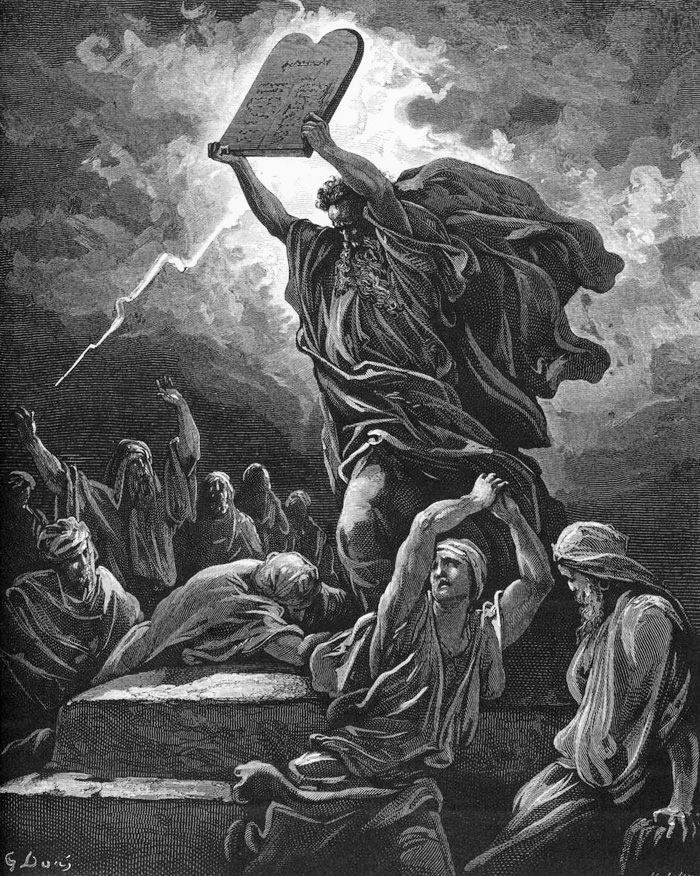
And then Moshe emerges, and in his own anger, he destroys the Luchot (tablets) and orders the killing of the worst offenders, which end up being around 3000 people. Leaving everything else aside, there is a certain irony in that the same man who petitioned that God spare and not destroy the nation is the one who presided over the deaths of half of a percent of the male population.
What led Moshe to think that he could stay and converse with God, after God told him to “Go down” in 32:7?
A very simple reading shows us that God spoke to Moshe in 32:7 using the verb “Vay’daber” (and He spoke) and continued speaking to him in 32:9 using the word “Va’yomer” (and He said). Since there was no interruption from Moshe in between these two introductory verbs, it stands to reason God had a change in attitude between 32:8, the conclusion of the “Vay’daber” portion, and 32:9, when we are told “va’yomer.”
This subtlety is similarly apparent in Shmot 6:2 when we see "Vay’daber" and "Va’yomer" both making an appearance, and the teaching that the former verb indicates God speaking harshly while the latter verb impresses us with God’s mercy is raised by several commentators. In other words, when God said, “Go down, for the people whom you brought out of Egypt have become corrupt. They have turned away from the way I have commanded them by making a golden mask,” God was really angry. But, when He saw that Moshe did not leave right away, and that Moshe was considering how to play his own hand, God saw a leader trying to figure out the best way to save his people. And so He switched gears, speaking to Moshe with “Vayomer,” indicating a compassionate attitude.
God says, “I have observed the people, and they are an unbending group. Now do not try to stop Me when I unleash my wrath against them to destroy them. I will then make you into a great nation.” (32:9-10)
I think what is going on here is quite clear. When God says, using language of compassion, “Do not try to stop Me,” what He is really saying is, “Now is your opportunity to stop Me. Give it your best shot.” And of course, Moshe comes up with a 3-part argument that removes the immediate danger to the nation: a. they are actually Your people whom You took out of Egypt, b. why should Egypt be given fuel to desecrate Your name with a claim that this was Your plan all along, to annihilate Israel in the wilderness?, and c. what ever happened to Your promise to the forefathers?
Let us be clear – the people were guilty of desecrating God’s name in the most egregious of ways. A punishment was in order. But in this particular case, the punishment through the hands of man was going to be far less encompassing and devastating than that which God might have otherwise wrought. (Compare the irony to David's decision in Samuel II 24:14)
Neither Moshe's breaking the tablets or ordering the deaths of thousands seem to weigh against him in the future. In fact the Rabbis taught that God was pleased with the choice Moshe made in smashing the Luchot. He gets overwhelmingly passing grades in this story, despite some of the eyebrow-raising details in his not listening to God, on the one hand, and in his wrath which unfolds against the people, on the other hand.
In terms of Aharon's role, he too is vindicated in his legacy. He certainly does not lose his high priest status, and to this day he continues to be revered as a lover of and pursuer of peace. However in Devarim 9:20 – Moshe tells the people that God got angry at Aharon, and Abravanel maintains the view that Aharon lost any rights to enter the land on account of his role in this story.
Perhaps the difference between the two brothers is that each one had a very different leadership role in relating to the people here. Vis-à-vis God, Aharon never lost his focus. As God sees to the heart, Aharon retained his status as high priest forever. But as a leader to the people, he seems to have given in to their whims a little too much.
Moshe, on the other hand, earned his best stripes here. He showed God how good of a shepherd he could be to his people, and he showed the people that sometimes a father has a right to get angry at his children. It is surely a difficult balance, to be a loving and caring shepherd while also being the disciplinarian father who must take a stand and defend everything that is holy.
But every indication in the story, especially at the end when Moshe's face is shining, demonstrates that Moshe did everything right here. His choices, his decisions, and his actions are all vindicated as he is elevated to the highest status a mortal could achieve.
May we be so lucky that our choices and decisions and actions always turn out to be the right ones.
Monday, February 15, 2016
Where are the Pants (and the Tzitz)?
Parshat Tetzaveh
by Rabbi Avi Billet
Prior to describing each of the garments of the priests, the Torah tells us “These are the vestments that they shall make: a breastplate, an ephod, a robe, a knitted tunic, a turban, and a sash. Make them sacred vestments for Aaron and his sons so that they will be able to be priests to Me.” (28:4)
Every Jew who went to day school or yeshiva, or who simply studies the parsha, knows that a regular Kohen wears 4 garments, and the Kohen Gadol (High Priest) wears 4 additional garments for a total of eight garments. And yet, this preview summary only mentions 6 garments, leaving out the pants and the “tzitz” (forehead plate).
And so, the obvious question: why are the pants and tzitz left out? [Almost seems like a bad gag from the Lego Movie]

One could suggest that the pants are obvious. How they are made is not described in this chapter, as the verse simply says “Also make linen pants to cover their nakedness, reaching from their waists to their thighs.” (28:42) Even in their placement in the instructions, they seem an afterthought after “Place these [vestments] on Aaron and his sons. Then anoint them, and install them, sanctifying them to be priests to Me.” (28:41)
However, one can wonder about the simplicity of the tunic, turban and sash, which are included in the list of the magnificent-six even though their instructions are all in one verse! “Knit the tunic out of linen. [Also] make the turban out of linen and an embroidered sash.” (28:39) The instruction to make them precedes that seemingly final command for placing the vestments on the kohanim, which indicates they are not an afterthought. Clearly, leaving out the pants is not because of their simplicity in design and instruction.
The tzitz, on the other hand, has three verses dedicated to its instruction (28:36-38). It is certainly not an afterthought. And yet, why not mention in the magnificent-six verse?
Ibn Ezra notes simply that the pants are not mentioned because they are obvious, as everyone wears undergarments. The tzitz is left out of the garment list because even though it is part of the count of the Kohen Gadol’s vestments, it is not really a "garment."
More practically, Chizkuni suggests that the pants and the tzitz are included in the words “Make them sacred vestments” from 28:4, while he also notes that the pants don’t go in a “makom kavod,” in a place of honor/respect on the body. Baal haTurim combines these teachings of Ibn Ezra and Chizkuni, while Or haChaim says the six vestments listed are all of equal holiness, while the tzitz is higher than all, on account of it being made out of gold and having God’s name on it, while the pants, owing to their placement, is on a lower level than the other garments. (no pun intended)
In fact, Rabbenu Bachaye notes that the pants are the only garments for which the Kohen did not get assistance in putting on (28:41, 29:5) because the pants are a private matter, while the other garments are what the people are instructed to place on the kohanim.
The Talmud notes in Arachin 16a that each vestment of the priests helps bring atonement for sins related to either where it is placed on the body, or some other sin thematically related to it in the Bible.
Utilizing the direction set in motion by the Talmud, we’ll conclude with a teaching from Kli Yakar, to hopefully understand a little more clearly.
According to the Talmud, the Tzitz brings atonement for brazenness, while the pants provide atonement for sins of a sexual nature.
Kli Yakar argues that the Tzitz provides atonement for the sins of a sexual nature as well. The pants, which are private and not seen, atone for the private sins of individuals. The Tzitz, on the other hand, must bring atonement for the brazen nature of sexual sins done in public. He notes that the Talmud may be referring to a basic sin of brazenness, but he thinks the connection made between the pants and Tzitz is too much to be overlooked, and not appreciated for this deeper message.
Perhaps the lesson for the kohanim is also for the people. Of course, a Kohen who represents the people in their service of God is advised to remember the significance attached to his undergarments, as per the Talmudic message to him, as well is the Kohen Gadol to recall on an even higher level what his responsibility is - not only to his Kohen brethren but to all of the nation of Israel which he serves - to be exceedingly humble and cognizant of the role he plays as the messenger of the people.
But the pants and Tzitz being grouped together might also be a reminder of the message associated with the other “tzitz” of the Torah – the “tzitzit.” The Torah tells us in the paragraph of tzitzit, that seeing them will remind “You to not stray after your heart and eyes, which [in the past] have led you to immorality” (Bamidbar 15:39) Maybe, at least for men who wear tzitzit, the tzitzit, which are seen when put on, and are otherwise often tucked into the pants, can play that role of the tzitz and the pants of the kohanim, to help us overcome sins of brazenness and immorality, whether committed in public – through the things we see on the street, or committed in private – in whatever that means to people, as our hearts and eyes are trained to use the tzitzit as guides to proper service of God.
by Rabbi Avi Billet
Prior to describing each of the garments of the priests, the Torah tells us “These are the vestments that they shall make: a breastplate, an ephod, a robe, a knitted tunic, a turban, and a sash. Make them sacred vestments for Aaron and his sons so that they will be able to be priests to Me.” (28:4)
Every Jew who went to day school or yeshiva, or who simply studies the parsha, knows that a regular Kohen wears 4 garments, and the Kohen Gadol (High Priest) wears 4 additional garments for a total of eight garments. And yet, this preview summary only mentions 6 garments, leaving out the pants and the “tzitz” (forehead plate).
And so, the obvious question: why are the pants and tzitz left out? [Almost seems like a bad gag from the Lego Movie]

One could suggest that the pants are obvious. How they are made is not described in this chapter, as the verse simply says “Also make linen pants to cover their nakedness, reaching from their waists to their thighs.” (28:42) Even in their placement in the instructions, they seem an afterthought after “Place these [vestments] on Aaron and his sons. Then anoint them, and install them, sanctifying them to be priests to Me.” (28:41)
However, one can wonder about the simplicity of the tunic, turban and sash, which are included in the list of the magnificent-six even though their instructions are all in one verse! “Knit the tunic out of linen. [Also] make the turban out of linen and an embroidered sash.” (28:39) The instruction to make them precedes that seemingly final command for placing the vestments on the kohanim, which indicates they are not an afterthought. Clearly, leaving out the pants is not because of their simplicity in design and instruction.
The tzitz, on the other hand, has three verses dedicated to its instruction (28:36-38). It is certainly not an afterthought. And yet, why not mention in the magnificent-six verse?
Ibn Ezra notes simply that the pants are not mentioned because they are obvious, as everyone wears undergarments. The tzitz is left out of the garment list because even though it is part of the count of the Kohen Gadol’s vestments, it is not really a "garment."
More practically, Chizkuni suggests that the pants and the tzitz are included in the words “Make them sacred vestments” from 28:4, while he also notes that the pants don’t go in a “makom kavod,” in a place of honor/respect on the body. Baal haTurim combines these teachings of Ibn Ezra and Chizkuni, while Or haChaim says the six vestments listed are all of equal holiness, while the tzitz is higher than all, on account of it being made out of gold and having God’s name on it, while the pants, owing to their placement, is on a lower level than the other garments. (no pun intended)
In fact, Rabbenu Bachaye notes that the pants are the only garments for which the Kohen did not get assistance in putting on (28:41, 29:5) because the pants are a private matter, while the other garments are what the people are instructed to place on the kohanim.
The Talmud notes in Arachin 16a that each vestment of the priests helps bring atonement for sins related to either where it is placed on the body, or some other sin thematically related to it in the Bible.
Utilizing the direction set in motion by the Talmud, we’ll conclude with a teaching from Kli Yakar, to hopefully understand a little more clearly.
According to the Talmud, the Tzitz brings atonement for brazenness, while the pants provide atonement for sins of a sexual nature.
Kli Yakar argues that the Tzitz provides atonement for the sins of a sexual nature as well. The pants, which are private and not seen, atone for the private sins of individuals. The Tzitz, on the other hand, must bring atonement for the brazen nature of sexual sins done in public. He notes that the Talmud may be referring to a basic sin of brazenness, but he thinks the connection made between the pants and Tzitz is too much to be overlooked, and not appreciated for this deeper message.
Perhaps the lesson for the kohanim is also for the people. Of course, a Kohen who represents the people in their service of God is advised to remember the significance attached to his undergarments, as per the Talmudic message to him, as well is the Kohen Gadol to recall on an even higher level what his responsibility is - not only to his Kohen brethren but to all of the nation of Israel which he serves - to be exceedingly humble and cognizant of the role he plays as the messenger of the people.
But the pants and Tzitz being grouped together might also be a reminder of the message associated with the other “tzitz” of the Torah – the “tzitzit.” The Torah tells us in the paragraph of tzitzit, that seeing them will remind “You to not stray after your heart and eyes, which [in the past] have led you to immorality” (Bamidbar 15:39) Maybe, at least for men who wear tzitzit, the tzitzit, which are seen when put on, and are otherwise often tucked into the pants, can play that role of the tzitz and the pants of the kohanim, to help us overcome sins of brazenness and immorality, whether committed in public – through the things we see on the street, or committed in private – in whatever that means to people, as our hearts and eyes are trained to use the tzitzit as guides to proper service of God.
Thursday, February 11, 2016
Symbolism in the Menorah's Branches
For more on the Menorah (and not just its branches) click here
Parshat Terumah
by Rabbi Avi Billet
As the Torah depicts the instructions for the vessels of the Mishkan, each item has very detailed instruction pertaining to its particular structure. The Ark, for example, is relatively easy to understand. The Menorah, being more artistic, is more complicated in its design, and therefore in the details of its instruction.
And yet, some elements of instruction seem nonetheless out of place. The Menorah, being a symmetrical edifice, has a middle branch and two sides of three branches each, which mirror one another exactly. Armed with this knowledge, we might expect that the manner in which 25:33 depicts the design on each branch would be the standard for all of the Menorah. “There shall be three embossed cups, as well as a sphere and a flower on each and every one of the branches. All six branches extending from the menorah's [stem] must be the same in this respect.”
Note how the verse does not give the exact same description for each branch – it just says that all six should be identical in the manner of the cups, sphere and flower. But then it says in 25:35, “A sphere shall serve as a base below two branches, a sphere shall serve as a base below two branches, and a sphere shall serve as a base below two branches for the six branches of the Menorah.” Even Rabbi Aryeh Kaplan noted the oddity and chose to translate the verse in summary fashion, “A sphere shall serve as a base for each pair of branches extending from [the shaft]…” covering the repetition through the phrase “for each pair of branches!”
Rashbam focuses on the word “Kein” – meaning “so it was” for all branches, which appears in 25:33, but does not appear in 25:35. He notes that the word “kein” doesn’t appear in the verse which repeats where the sphere was at each connection of branches because the verse covers all the spheres in this part of the menorah! In the earlier verse, when it says “kein” it was for all the branches, the Torah only gives us two examples of the six branches, before essentially saying “etcetera.”
Fair enough. But is there a deeper lesson to be learned from the repetition of the word “Kaftor” (sphere) and its placement between the two branches at every connection of the branches to the center stem, which is the Menorah?
Most commentaries on the Mishkan parshas take to the world of symbolism in explaining the Mishkan to Torah-readers. The Alshikh does exactly this in explaining the repetition of the need for each Kaftor.
He says there are parts of the body, similar in design to a Kaftor, which, in each case has a covering. That body part has the opportunity to complete that which the branches begin, if it is utilized properly, and the message of the branches is understood.
The first branches are the ears. Everything a person hears from teachers is than transmitted to others through the “Kaftor” that is the tongue. The tongue is covered by the mouth. The ears hear, and the tongue impacts others’ ears.
The second set of branches are the eyes, and the “Kaftor” beneath them is the heart, which is drawn by the things the eyes see. The heart is covered by the body. What the heart wants it desires
The third set of branches are the hands, and the “Kaftor” beneath them, is only on men, and is covered by garments. Both the branches and the “kaftor,” explain the Alshikh are governed by the sense of touch. He notes the practice of Rebbe (Shabbos 118b) to not lower his hands below his navel.
The branches each have the opportunity to serve God: the ears hear, leading the tongue to share words of Torah. If the eyes don’t see bad, they won’t be enticed to draw the heart to bad. If hands are trained to do good things, they can be associated with mitzvah fulfillment and deeds which benefit others – carrying things, driving, fixing, etc. And certainly this is the case for a man’s “kaftor.”
Perhaps it’s not too farfetched to suggest that the ears have lobes, the eyes have lids, and the hands have the ability to clench, so these “branches” can prevent themselves from being utilized improperly.
Using the kaftorim for mitzvos, and training the branches – the ears, eyes and arms – in the service of God, is good for everyone, whereas misappropriating any of these parts of the body for sin makes for a wasteful existence.
Just as the Menorah was “Kulah Mikshah Achas Zahav Tahor,” entirely made out of a solid piece of gold, concludes the Alshikh, so should each person merit that his (or her) entire body, not just parts of it, be models of good and proper behavior, ideally in the service of God and as a person who does chesed (acts of kindness) towards other people.
Once we understand the Torah's imagery on a symbolic level, referring to the body, the reason why each set of branches is singled out becomes clear. We are faced with different kinds of behavior choices, distinguished by the differences in our branches and kaftorim. May we merit to fulfill the blessing of the Alshikh, that our externals and internals should be an honest reflection of one another in our constant effort to be complete people, made of one solid stock that is flawless in its construction and implementation of doing God's will.
Parshat Terumah
by Rabbi Avi Billet
As the Torah depicts the instructions for the vessels of the Mishkan, each item has very detailed instruction pertaining to its particular structure. The Ark, for example, is relatively easy to understand. The Menorah, being more artistic, is more complicated in its design, and therefore in the details of its instruction.
And yet, some elements of instruction seem nonetheless out of place. The Menorah, being a symmetrical edifice, has a middle branch and two sides of three branches each, which mirror one another exactly. Armed with this knowledge, we might expect that the manner in which 25:33 depicts the design on each branch would be the standard for all of the Menorah. “There shall be three embossed cups, as well as a sphere and a flower on each and every one of the branches. All six branches extending from the menorah's [stem] must be the same in this respect.”
Note how the verse does not give the exact same description for each branch – it just says that all six should be identical in the manner of the cups, sphere and flower. But then it says in 25:35, “A sphere shall serve as a base below two branches, a sphere shall serve as a base below two branches, and a sphere shall serve as a base below two branches for the six branches of the Menorah.” Even Rabbi Aryeh Kaplan noted the oddity and chose to translate the verse in summary fashion, “A sphere shall serve as a base for each pair of branches extending from [the shaft]…” covering the repetition through the phrase “for each pair of branches!”
Rashbam focuses on the word “Kein” – meaning “so it was” for all branches, which appears in 25:33, but does not appear in 25:35. He notes that the word “kein” doesn’t appear in the verse which repeats where the sphere was at each connection of branches because the verse covers all the spheres in this part of the menorah! In the earlier verse, when it says “kein” it was for all the branches, the Torah only gives us two examples of the six branches, before essentially saying “etcetera.”
Fair enough. But is there a deeper lesson to be learned from the repetition of the word “Kaftor” (sphere) and its placement between the two branches at every connection of the branches to the center stem, which is the Menorah?
Most commentaries on the Mishkan parshas take to the world of symbolism in explaining the Mishkan to Torah-readers. The Alshikh does exactly this in explaining the repetition of the need for each Kaftor.
He says there are parts of the body, similar in design to a Kaftor, which, in each case has a covering. That body part has the opportunity to complete that which the branches begin, if it is utilized properly, and the message of the branches is understood.
The first branches are the ears. Everything a person hears from teachers is than transmitted to others through the “Kaftor” that is the tongue. The tongue is covered by the mouth. The ears hear, and the tongue impacts others’ ears.
The second set of branches are the eyes, and the “Kaftor” beneath them is the heart, which is drawn by the things the eyes see. The heart is covered by the body. What the heart wants it desires
The third set of branches are the hands, and the “Kaftor” beneath them, is only on men, and is covered by garments. Both the branches and the “kaftor,” explain the Alshikh are governed by the sense of touch. He notes the practice of Rebbe (Shabbos 118b) to not lower his hands below his navel.
The branches each have the opportunity to serve God: the ears hear, leading the tongue to share words of Torah. If the eyes don’t see bad, they won’t be enticed to draw the heart to bad. If hands are trained to do good things, they can be associated with mitzvah fulfillment and deeds which benefit others – carrying things, driving, fixing, etc. And certainly this is the case for a man’s “kaftor.”
Perhaps it’s not too farfetched to suggest that the ears have lobes, the eyes have lids, and the hands have the ability to clench, so these “branches” can prevent themselves from being utilized improperly.
Using the kaftorim for mitzvos, and training the branches – the ears, eyes and arms – in the service of God, is good for everyone, whereas misappropriating any of these parts of the body for sin makes for a wasteful existence.
Just as the Menorah was “Kulah Mikshah Achas Zahav Tahor,” entirely made out of a solid piece of gold, concludes the Alshikh, so should each person merit that his (or her) entire body, not just parts of it, be models of good and proper behavior, ideally in the service of God and as a person who does chesed (acts of kindness) towards other people.
Once we understand the Torah's imagery on a symbolic level, referring to the body, the reason why each set of branches is singled out becomes clear. We are faced with different kinds of behavior choices, distinguished by the differences in our branches and kaftorim. May we merit to fulfill the blessing of the Alshikh, that our externals and internals should be an honest reflection of one another in our constant effort to be complete people, made of one solid stock that is flawless in its construction and implementation of doing God's will.
Subscribe to:
Posts (Atom)